

How Long Should My Severance Last Before Finding My Next Job?
Last reviewed: July 2026
Your severance package timeline should match your realistic job search window, which for most professionals runs four to eight months. The simple math: divide your after-tax severance plus savings by your monthly expenses, then plan for the longer end of that range. Severance is a bridge, not a vacation fund, and building your timeline around the average job search length protects you from running out of money before the right offer arrives.
Key Takeaways
- Calculate your runway by dividing after-tax severance plus emergency savings by your monthly essential expenses.
- The median U.S. unemployment duration was 10.2 weeks as of early 2026, per the Bureau of Labor Statistics.
- Plan for a job search 50% longer than the average; hope for faster, prepare for longer.
- Federal unemployment benefits typically last up to 26 weeks and can supplement your severance runway.
- Cut discretionary spending the week severance arrives, not the week it runs out.
About the Author: Jeff Judge, CFP®, AEP®, ChFC®, CLU® is Managing Partner of Chesapeake Financial Planners in Forest Hill, Maryland. He has been helping families and business owners in Harford County and the Baltimore metro area navigate career transitions and sudden money events since earning his CFP® certification in 2013, by using Chesapeake Financial Planners’ signature process, the R.U.D.D.E.R. method™. The clients who weather a layoff best are the ones who treat severance as runway to defend, not a windfall to spend.
Losing a job stings. But a severance package gives you something most people in transition don't have: time. The question is how to use that time well. Below is a practical framework for figuring out how long your severance should realistically last and how to make every dollar of it count while you find your next role.
How Do I Calculate My Severance Runway?
Your severance package timeline starts with one calculation: after-tax severance plus liquid savings, divided by monthly essential expenses, equals the number of months you can cover. That number is your runway, and everything else builds from it.
Here's the math in practice. Say you receive $30,000 in severance. Severance is taxed as supplemental wages, and the IRS applies a flat 22% federal withholding rate on supplemental income up to $1 million, before state taxes and FICA. After all withholding, you might net roughly $20,000 to $22,000. If your essential monthly expenses run $5,000, that severance alone buys you about four months.
Now add your emergency fund. If you have $15,000 set aside, your combined runway jumps to roughly seven months. That distinction matters. Most people calculate severance in isolation and panic. The honest number includes every liquid resource you can tap without penalty.
Jeff Judge tells clients to run this number the same day the severance offer lands, before emotion takes over. Knowing you have seven months instead of four changes how you negotiate, how you job-search, and whether you accept the first mediocre offer out of fear.
How Long Does the Average Job Search Actually Take?
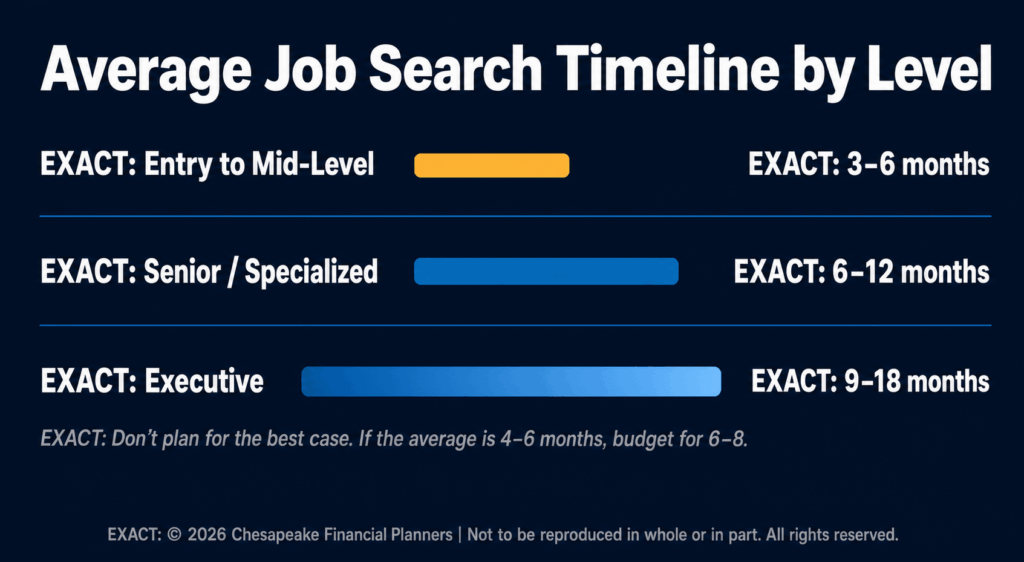
The average job search runs three to nine months depending on your seniority, and your severance package timeline should be built around the longer end. According to the Bureau of Labor Statistics, the median duration of unemployment was 10.2 weeks as of early 2026, but medians hide the tail. Senior and specialized roles take materially longer.
Rough planning ranges by level:
- Entry to mid-level roles: 3 to 6 months
- Senior or specialized roles: 6 to 12 months
- Executive roles: 9 to 18 months
Your actual job search timeline depends on a handful of factors you partly control. Industry matters: some sectors hire in weeks, others in quarters. Location matters, with denser metro markets generally offering more openings than rural ones. Market conditions matter, and so does your flexibility. People willing to relocate or pivot industries tend to land faster. A strong professional network can cut months off the search, often the single biggest lever. Jeff Judge notes: "Senior-level searches routinely run six months or longer even in a healthy market, so when I help someone map out their severance runway, we plan to the 75th percentile outcome, not the median, because running out of cushion at month five is not a recoverable mistake."
The planning rule is simple. If the average for your level is four to six months, budget for six to nine. Don't build your runway around the best case. Build it around the case that lets you sleep.
What Counts Toward My Severance Beyond the Cash?
Your severance package is often worth more than the headline cash figure, and counting the full value extends your effective timeline. Before you calculate runway, inventory everything the package includes.
Continued health insurance is the big one. If your employer subsidizes coverage for several months, that's hundreds of dollars a month you don't have to budget. Without it, you face COBRA continuation, which lets you keep your group plan but requires you to pay the full premium plus an administrative fee. Knowing which applies changes your monthly expense number significantly.
Other components worth tallying:
- Unused PTO payout. Many employers pay out accrued vacation. That's additional cash, often several thousand dollars.
- Outplacement services. Career coaching and resume help don't extend your runway directly, but they can shorten the search, which has the same effect.
- Bonus or equity timing. If you were close to a bonus or a vesting date, your departure date may be negotiable. Sometimes a two-week shift preserves thousands of dollars.
If a large lump sum is involved, the decisions multiply quickly, and a structured process helps. The R.U.D.D.E.R. Method™ is Chesapeake Financial Planners' six-step planning process: Review and Recognize, Uncover and Understand, Design and Develop, Discuss and Decide, Execute and Empower, and Reassess and Refine. It keeps people from making fear-driven choices with money that has to stretch.
How Do I Make My Severance Last Longer?
You make severance last longer by cutting discretionary spending immediately, claiming every benefit you qualify for, and treating the first offer as optional rather than urgent. The biggest mistakes happen when people wait until the money is nearly gone before adjusting.
Start with spending. The week severance arrives, trim the budget as if the search will run long. Cancel subscriptions you forgot you had. Pause discretionary purchases like clothing, tech upgrades, and home projects until you're employed again. None of this is permanent. It's a temporary defensive posture that buys you weeks of runway.
Next, claim unemployment benefits. Federal-state unemployment insurance typically provides up to 26 weeks of payments in most states, according to the Department of Labor. In some states a severance payment can delay or reduce your benefit eligibility, so check your state's rules and file promptly rather than assuming you don't qualify. Jeff Judge regularly sees clients leave thousands of unclaimed benefit dollars on the table simply because they assumed severance disqualified them.
Finally, protect your liquidity. Don't rush to pay off low-interest debt or make a large purchase while your income is paused. Cash flexibility is the whole point of severance. Keep it.
Can I use my severance package to fund a career change?
What should I do with a large severance package?
Frequently Asked Questions
How do I calculate how long my severance will last?
Divide your after-tax severance plus any liquid savings by your essential monthly expenses to get the number of months your runway covers. Severance is taxed as supplemental wages, so use the net figure after withholding, not the gross amount. Include your emergency fund for the honest total, since most people underestimate by calculating severance in isolation.
Should I budget for the average job search or longer?
Always budget for longer than the average job search timeline. If the typical search for your level runs four to six months, plan your runway around six to nine months. Building on the best-case scenario leaves no margin for a slow market or a specialized role, and running out of money forces you to accept a worse offer out of pure financial pressure.
Can I collect unemployment benefits while receiving severance?
In many states you can collect unemployment benefits while or after receiving severance, but the rules vary. Some states delay or reduce your benefit while severance is being paid, while others treat them separately. File promptly rather than assuming you're disqualified. Federal-state unemployment insurance typically provides up to 26 weeks of payments, which can meaningfully extend your overall financial runway.
How much should my emergency fund add to my severance runway?
Your emergency fund should be counted as part of your total runway, not held separately. If you have three to six months of expenses saved, that can roughly double the timeline your severance alone provides. A common planning mistake is treating severance and savings as two separate buckets, which leads people to feel more financially pressured than the math actually warrants.
What happens to my health insurance after severance ends?
After employer-subsidized coverage ends, you can typically continue your group health plan through COBRA, but you pay the full premium plus an administrative fee. Alternatively, a job loss qualifies you for a special enrollment period on the health insurance marketplace, which may cost less. Compare both options before your current coverage lapses to avoid an unexpected monthly expense.
Is it smart to use severance to start a business or change careers?
Using severance to fund a career pivot can work, but only if your runway is honest about the longer timeline a transition usually requires. Career changes and new ventures often take longer to produce income than a same-industry job search. Keep a defensive emergency reserve untouched, and model your runway around the slower path rather than the optimistic one.
If you're working through a career transition and want a clear picture of how far your severance and savings will actually stretch, our free planning resources walk through the runway calculation step by step. Download our financial transition guide at chesapeakefp.com to map your timeline before the next decision lands.
Disclosures
The information provided is for educational purposes only and should not be construed as investment advice. Investment strategies should be tailored to individual circumstances, risk tolerance, and goals. Past performance doesn't guarantee future results. Consult with qualified financial professionals regarding your specific situation.
Advisors associated with Chesapeake Financial Planners may be either (1) LPL Financial Registered Representatives offering securities through LPL Financial, Member FINRA and SIPC, and investment advisor representatives offering investment advice through Great Valley Advisor Group; or (2) solely investment advisor representatives offering investment advice through Great Valley Advisor Group and not affiliated with LPL Financial. Great Valley Advisor Group, and Chesapeake Financial Planners are separate entities from LPL Financial.


