

How Are Financial Advisory Practices Valued for Sale?
Last reviewed: July 2026
A financial advisory practice valuation is the process of determining the fair market value of an advisor's client relationships, managed assets, and recurring revenue, usually for a sale, succession, partnership buyout, or estate plan. Most practices are valued as a multiple of recurring revenue or earnings, and that multiple typically lands between 1.5x and 3x annual recurring revenue depending on the quality of the book. The number isn't arbitrary. It reflects how reliably that revenue will transfer to a new owner.
On This Page
- Key Takeaways
- What Is the Core Metric Behind a Practice Valuation?
- What Drives Advisory Practice Valuation Up?
- What Drives Advisory Practice Valuation Down?
- What Non-Revenue Factors Do Buyers Consider?
- Frequently Asked Questions
- Disclosures
Key Takeaways
- Financial advisory practice valuation usually runs 1.5x to 3x annual recurring revenue, with premium fee-based practices commanding the high end.
- Larger RIA deals are often valued on earnings, reaching roughly 6x to 9x EBITDA according to published M&A research.
- Fee-based revenue, high client retention, and younger clients push valuation up; commission income and concentration push it down.
- Documentation matters: undocumented relationships that live in one advisor's head get discounted because they may not transfer.
About the Author: Jeff Judge, CFP®, AEP®, ChFC®, CLU® is Managing Partner of Chesapeake Financial Planners in Forest Hill, Maryland. He has been helping families and business owners in Harford County and the Baltimore metro area navigate practice transitions and business valuations since earning his CFP® certification in 2013, by using Chesapeake Financial Planners’ signature process, the R.U.D.D.E.R. method™. Jeff has reviewed enough advisory books to know that two practices with identical revenue can be worth wildly different amounts once you look at how those clients actually behave.
What Is the Core Metric Behind a Practice Valuation?
The most common valuation method in financial advisory M&A is the revenue multiple. A practice's value gets expressed as a multiple of its annual recurring revenue, the ongoing fee income the practice generates from clients year after year. That recurring stream is what a buyer is really purchasing.
In most transactions, that multiple ranges from roughly 1.5x to 3x annual recurring revenue. Larger, institutional-grade firms get valued differently. According to ECHELON Partners RIA deal research, valuations for sizable registered investment advisory firms are frequently expressed on an earnings basis, often in the range of 6x to 9x EBITDA, reflecting strong buyer demand and premium pricing for high-quality practices. The gap between a 1.5x book and a 3x book comes down to specific, measurable factors that buyers underwrite carefully.
A small commission-heavy book and a clean fee-based practice of the same revenue size will not fetch the same multiple. One is predictable. The other depends on activity that may stop the day the selling advisor walks out the door. For a broader look at the underlying business value, see How much is my business actually worth if I want to sell?.
What Drives Advisory Practice Valuation Up?
High-quality practices command premium multiples because they reduce risk for the buyer. The factors that push valuation higher:
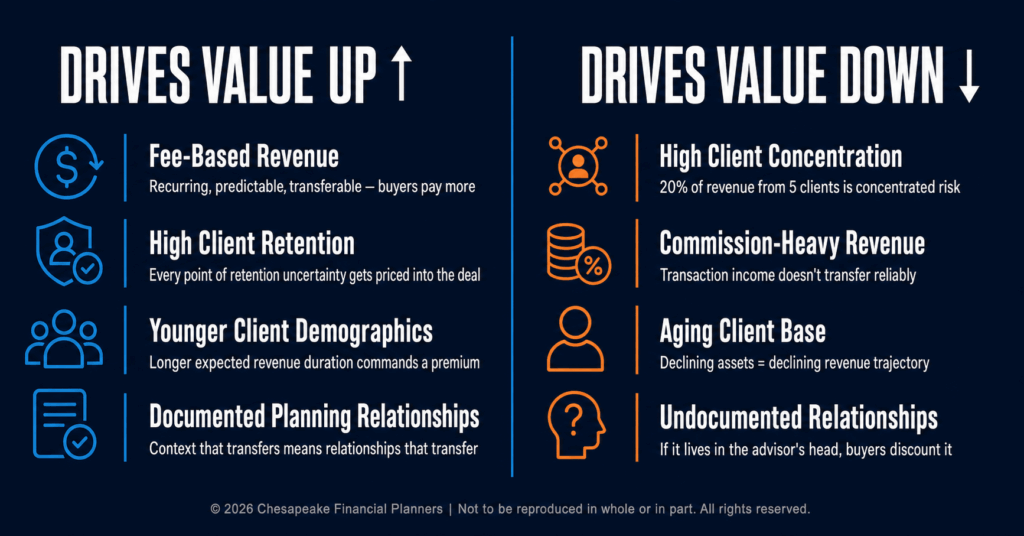
- Fee-based revenue. Practices generating most of their income from ongoing advisory fees, rather than one-time commissions, are worth more. Recurring fees are predictable, transferable, and far less likely to evaporate during a transition.
- Client retention rates. A practice retaining 95% of clients annually is worth more than one at 80%. Every point of retention uncertainty becomes risk that buyers price into the deal.
- Client demographics. Younger clients with long time horizons and growing assets are worth more than clients drawing down accounts. This reflects expected revenue duration, which directly affects the RIA valuation a buyer is willing to support.
- Average account size. A book with 100 clients averaging $500,000 is generally more attractive than 200 clients averaging $100,000. Larger accounts require similar service effort at higher revenue per relationship.
- Team depth. A practice built entirely on one advisor's personal relationships tends to lose clients during a transition. A practice with multiple advisors and shared client coverage transfers more cleanly.
The federal definition of a fiduciary advisory relationship under the SEC sets the standard for the kind of documented, client-first process buyers want to see. A practice that already operates that way is easier to value and easier to transfer.
What Drives Advisory Practice Valuation Down?
The mirror image is just as important. Factors that reduce the advisory practice valuation multiple and create risk for buyers:
- High client concentration. If 20% to 30% of revenue comes from five or fewer clients, the practice is fragile. Those clients may be loyal to the individual advisor, not the firm, and they can walk after a sale.
- Commission-heavy revenue. Transaction-based income doesn't transfer reliably. It depends on client activity and personal relationships, neither of which is guaranteed to continue under new ownership.
- Aging client base with declining assets. A book full of clients drawing down accounts generates declining revenue over time. Buyers price that downward trajectory directly into their offers.
- Undocumented planning relationships. If the advisor's process lives in their head instead of in documented plans and CRM records, the relationships are harder to transfer. Buyers discount heavily for that opacity.
Jeff Judge at Chesapeake Financial Planners is blunt about this: "Valuation isn't just about the AUM number. A million-dollar book with ten clients isn't the same as a million-dollar book with a hundred. The depth of those relationships, and how well they're documented, determines whether that revenue actually transfers or quietly disappears."
This is where the R.U.D.D.E.R. Method™ earns its keep. The R.U.D.D.E.R. Method™ is Chesapeake Financial Planners' six-step planning process: Review and Recognize, Uncover and Understand, Design and Develop, Discuss and Decide, Execute and Empower, and Reassess and Refine. Applied to a practice review, it forces the harder question: not just "what does this book produce?" but "what does it actually require to keep producing?" A practice that looks clean on a spreadsheet can still carry hidden costs if the relationships are high-maintenance, poorly documented, or dependent on a single personality. For the firm's full review approach, see How Does Chesapeake Financial Planners Evaluate a Book of Business?.
What Non-Revenue Factors Do Buyers Consider?
Revenue multiples are the starting point, not the whole picture. Buyers also weigh several non-financial factors before settling on a final number:
- Compliance history. Any FINRA complaints, regulatory actions, or pending litigation are immediate red flags. You can check an advisor's record through FINRA BrokerCheck, and a clean CRD record adds real value while disclosures subtract from it.
- Technology and operations. A practice running on modern CRM, portfolio management, and planning software integrates easily. One running on spreadsheets and paper files does not, and buyers discount for the cleanup cost.
- Geographic overlap. For acquisitions meant to expand reach, geographic fit matters. For in-market deals, client retention risk is lower because clients can keep in-person relationships intact.
Timing also affects the number. The earlier an advisor begins preparing, the more they can fix before a buyer ever looks. For practical timing guidance, see When should I start valuing my business for a future sale?.
Frequently Asked Questions
What is the average multiple for a financial advisory practice?
Most financial advisory practices sell for 1.5x to 3x annual recurring revenue. Higher-quality practices with strong fee-based income, younger client demographics, and high retention rates can command multiples at or above the top of that range. Larger RIA firms are often valued on an earnings basis instead, frequently in the range of 6x to 9x EBITDA.
How is a financial advisory practice different from a book of business?
A "book of business" refers specifically to the client relationships and the revenue they produce. A "practice" implies a more structured operation that includes that book plus staff, documented processes, technology, leases, and employee agreements. The terms get used interchangeably, but the distinction matters because a full practice typically transfers more reliably and supports a higher advisory practice valuation multiple than a bare book.
Do clients affect the valuation of an advisory practice?
Clients affect it directly and heavily. Client demographics, retention rates, average account size, and relationship depth all factor into how buyers price a practice. A young, growing, well-documented client base increases value. A concentrated or declining one reduces it, because the buyer is pricing the risk that the revenue won't survive the transition.
Should clients know if their advisor's practice is being valued?
Not necessarily during the valuation process itself, but clients should be notified before or at the close of any actual transaction. Surprise is the enemy of retention. Clients who learn about an acquisition after the fact are far more likely to leave, which is exactly the attrition risk a buyer worries about and prices into the deal.
How long does a financial advisory practice valuation take?
A preliminary valuation can usually be completed in a few weeks. A full due-diligence valuation in the context of an actual sale typically takes 30 to 90 days, because the buyer needs time to verify revenue, review the compliance record, confirm retention history, and assess how transferable the client relationships really are.
Can the same valuation method be used to sell any small business?
No, advisory practices are valued differently than most small businesses because recurring fee revenue is the central asset. A typical business is often valued on earnings or hard assets, while an advisory practice trades primarily on the transferability and durability of client relationships. The principles overlap, but the multiples and risk factors are specific to the financial services model.
If you're a business owner trying to understand what your own company is worth before a sale, our Tax Strategy Readiness Quiz can help you see how ready your tax strategy is before you go to market. Take it at chesapeakefp.com.
Disclosures
The information provided is for educational purposes only and should not be construed as investment advice. Investment strategies should be tailored to individual circumstances, risk tolerance, and goals. Past performance doesn't guarantee future results. Consult with qualified financial professionals regarding your specific situation.
Advisors associated with Chesapeake Financial Planners may be either (1) LPL Financial Registered Representatives offering securities through LPL Financial, Member FINRA and SIPC, and investment advisor representatives offering investment advice through Great Valley Advisor Group; or (2) solely investment advisor representatives offering investment advice through Great Valley Advisor Group and not affiliated with LPL Financial. Great Valley Advisor Group, and Chesapeake Financial Planners are separate entities from LPL Financial.


