
How Much Should I Have in My Emergency Fund?
Last reviewed: July 2026
You should keep three to six months of essential expenses in your emergency fund, held in a separate, liquid account you can reach within a day or two. That range covers most people, but the right number depends on your income stability, fixed costs, and how many people depend on you. A single freelancer with a mortgage needs a very different cushion than a dual-income household renting an apartment.
Key Takeaways
- Most households should hold three to six months of essential expenses in an accessible emergency fund.
- The Federal Reserve found 37% of adults could not cover a $400 emergency with cash as of its 2024 survey.
- Self-employed and single-income households should target nine to twelve months of expenses.
- Keep your emergency fund in a high-yield savings account, not in checking, cash, or investments.
- Build to $1,000 first, then layer toward your full target while paying down high-interest debt.
About the Author: Jeff Judge, CFP®, AEP®, ChFC®, CLU® is Managing Partner of Chesapeake Financial Planners in Forest Hill, Maryland. He has been helping families and business owners in Harford County and the Baltimore metro area build durable financial foundations since earning his CFP® certification in 2013, by using Chesapeake Financial Planners’ signature process, the R.U.D.D.E.R. method™. Jeff has watched more retirement plans get derailed by a missing emergency fund than by bad investment picks, and he treats this as the first conversation, not an afterthought.
What Is an Emergency Fund?
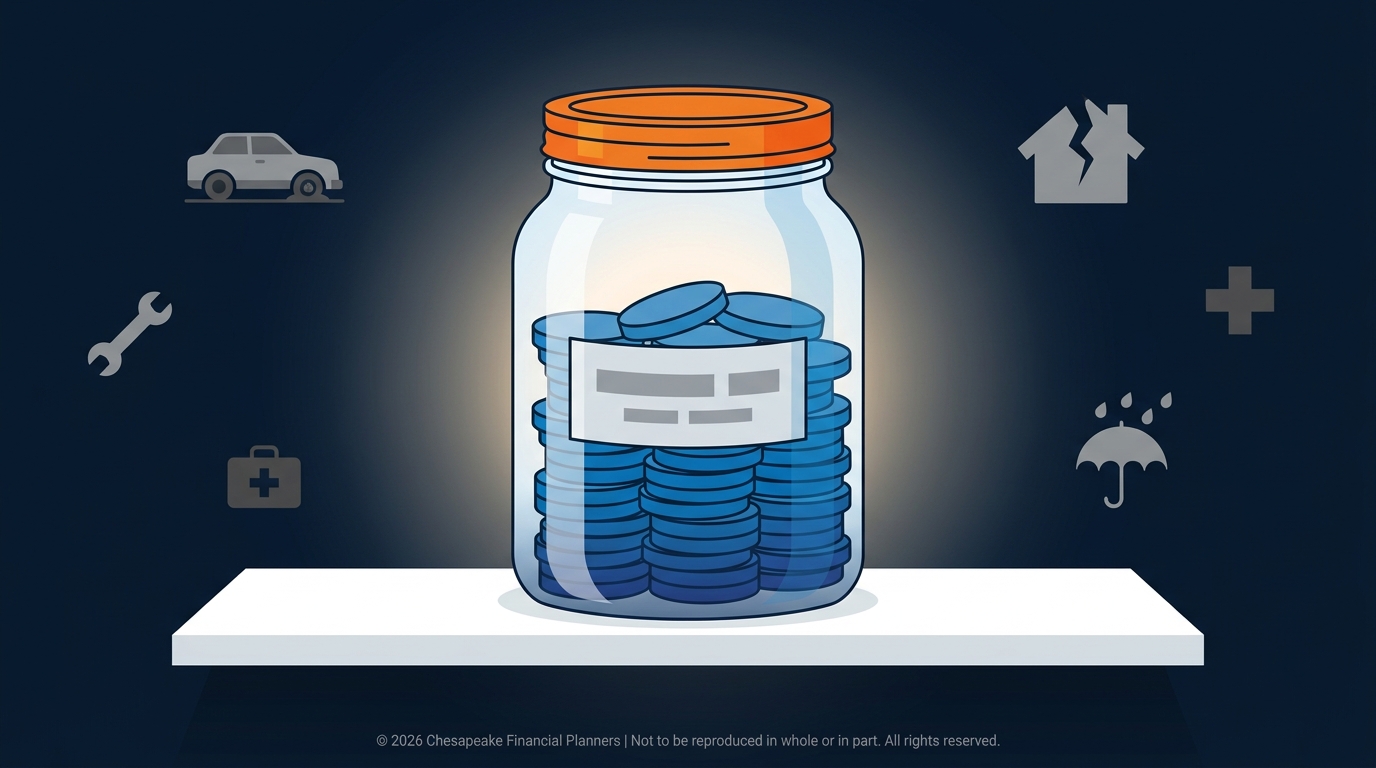
An emergency fund is money set aside specifically for unexpected, urgent expenses you cannot plan for. It is not a vacation account, a holiday shopping fund, or a savings bucket for a new couch. It exists for one job: to keep a surprise expense from turning into credit card debt or a raid on your retirement accounts.
A true emergency is something urgent, necessary, and unplanned. Job loss qualifies. So does a medical bill insurance did not cover, a transmission that died on the highway, or a flight home for a family crisis. Things you can see coming, like annual insurance premiums or routine car maintenance, are not emergencies. They are planned expenses that belong in a separate sinking fund.
The reason this distinction matters is behavioral. When the line between "emergency" and "I really want this" blurs, the fund drains and stops protecting you. Jeff often tells clients that the emergency fund is the one account you should feel a little guilty touching. If you are reaching for it without a knot in your stomach, it is not an emergency.


How Much Should I Have in My Emergency Fund?
For most people, three to six months of essential monthly expenses is the right target. Notice the word essential. You are not replacing your full lifestyle during a crisis. You are covering rent or mortgage, utilities, groceries, insurance, minimum debt payments, and transportation. Strip out dining out, subscriptions, and discretionary spending when you calculate the number.
Three months covers the common short-term disruptions: a single car repair, a brief gap between paychecks, a medical deductible. Six months gives you breathing room for a longer job search or two expensive problems landing in the same month, which happens more often than people expect.
The need is real and widespread. The Federal Reserve's Survey of Household Economics and Decisionmaking found that 37% of U.S. adults could not cover an unexpected $400 expense using cash or its equivalent as of the 2024 survey. Bankrate reported in early 2026 that a majority of Americans still feel uncomfortable with their level of emergency savings. The gap between what people should have and what they actually have is enormous, and it is the single most common weakness Jeff sees when a new household walks through the door.
To find your number, add up your essential monthly expenses and multiply by the months that fit your situation. If your essentials run $4,000 a month, a three-month fund is $12,000 and a six-month fund is $24,000.
Who Needs More Than Six Months?
Some households should aim higher, in the nine-to-twelve-month range. The common thread is fragility: either the income is unpredictable or there is no backup if it stops.
| Situation | Suggested target | Why |
|---|---|---|
| Self-employed or freelance | 9-12 months | No unemployment benefits, no severance, income swings |
| Single-income household | 8-12 months | One job loss eliminates all household income |
| Specialized or executive roles | 9-12 months | Searches in narrow fields take far longer to fill |
| High fixed expenses | 8-12 months | Large mortgage, childcare, or medical costs do not pause |
| Volatile or cyclical industry | 8-12 months | Layoffs cluster and recoveries are slow |
If your income is variable, you carry the risk that an employee does not. There is no employer safety net when client work dries up, so the fund has to do more work. The same logic applies to single-income families. Losing that one paycheck is not a setback, it is a cliff, and a thicker cushion buys the time to find the right next job instead of grabbing the first one out of panic.
Who Can Get Away with Less Than Six Months?
A few households are genuinely safe with three to four months. The protection comes from redundancy or low fixed costs.
Dual-income households where both partners work in stable fields can usually run leaner. The odds of both incomes disappearing at once are low, and a single remaining paycheck can often cover the essentials while the other person searches. People in steady, in-demand professions with strong job security sit in a similar spot. So do renters with low monthly obligations, no dependents, and minimal debt, since their essential expenses are small and flexible.
If you also carry disability insurance or have other reliable backstops, you can lean toward the lower end of the range. The point is not to hoard cash for its own sake. Money sitting in savings is money not working toward retirement, so once you have enough to absorb a realistic shock, the next dollar usually belongs somewhere with more growth potential.
Where Should You Keep Your Emergency Fund?
Your emergency fund needs two things: it has to be safe, and it has to be reachable fast. That points to a high-yield savings account at an FDIC-insured bank, where deposits are protected up to $250,000 per depositor per institution, according to the FDIC. Online high-yield savings accounts have recently paid well above the national average, and the FDIC publishes the current national average rate so you can see how far ahead a competitive account puts you.
Do not keep it in your checking account, where it blends into spending money and quietly disappears. Do not park it in the stock market either. The whole point is that it holds its value the day you need it, and markets do not cooperate on demand. A separate, named savings account is the sweet spot: liquid enough to use this week, separate enough that you are not tempted to.
How Do You Build an Emergency Fund From Scratch?
Start small and concrete. The first milestone is $1,000, which covers the most common emergencies and stops the bleeding on new credit card debt. Hitting that number quickly also builds momentum, and momentum is what keeps a savings habit alive.
From there, the order of operations matters. If you carry high-interest debt, balance building the fund against attacking that debt, since credit card interest usually costs more than savings earns. Once your starter fund is in place, automate a recurring transfer into your high-yield account every payday so the decision happens once, not monthly. This is exactly the kind of sequencing the R.U.D.D.E.R. Method™, Chesapeake Financial Planners' six-step planning process of Review and Recognize, Uncover and Understand, Design and Develop, Discuss and Decide, Execute and Empower, and Reassess and Refine, is built to bring order to. The emergency fund is foundational, and the framework keeps it from competing chaotically with every other goal.
For more on getting the foundation right, see What are the fundamentals of personal financial planning? and What is the best way to pay off debt quickly?. If you want to understand why behavior matters more than account balances, Why Do Your Money Values Matter More Than Your Investment Choices? is a good next read, as is What behavioral biases most commonly hurt investment decisions and how do you fix them?.
Frequently Asked Questions
How much should I have in my emergency fund?
Most people should hold three to six months of essential monthly expenses in an emergency fund. Calculate the number by adding rent or mortgage, utilities, groceries, insurance, transportation, and minimum debt payments, then multiplying by your chosen number of months. Self-employed and single-income households should target nine to twelve months.
Where should I keep my emergency fund?
Keep your emergency fund in a high-yield savings account at an FDIC-insured bank, separate from your everyday checking. It should be liquid enough to access within a day or two but kept apart so you are not tempted to spend it. Avoid checking accounts, cash at home, and the stock market for these funds.
Should I pay off debt or build an emergency fund first?
Build a small starter emergency fund of about $1,000 first, then balance the rest against high-interest debt. A starter fund keeps a surprise expense from creating new debt while you pay down existing balances. Because credit card interest usually exceeds savings yields, prioritize that debt once your starter cushion is set.
How do I calculate my emergency fund target?
Add up only your essential monthly expenses, which include housing, utilities, food, insurance, transportation, and minimum debt payments, while excluding discretionary spending like dining out and subscriptions. Multiply that essential total by three to six months. If your essentials are $4,000 monthly, a six-month fund equals $24,000.
Is a high-yield savings account safe for emergency funds?
Yes, a high-yield savings account at an FDIC-insured bank is one of the safest places for an emergency fund. The FDIC insures deposits up to $250,000 per depositor, per insured bank, per ownership category. Your money stays liquid and protected while earning more interest than a standard checking or savings account.
Can my emergency fund ever be too large?
Yes. Once you have enough to cover a realistic worst-case shock for your situation, additional cash usually earns more working toward retirement or other goals. Holding far beyond twelve months of expenses in low-yield savings often means money is sitting idle when it could be growing. Match the fund size to your actual risk.
Building an emergency fund is the foundation everything else sits on, and it is where smart planning starts long before investments enter the picture. If this was helpful, our free guide to personal finance basics walks through emergency savings, debt, and the building blocks of a durable plan in depth. Download it at chesapeakefp.com.
Disclosures
The information provided is for educational purposes only and should not be construed as investment advice. Investment strategies should be tailored to individual circumstances, risk tolerance, and goals. Past performance doesn't guarantee future results. Consult with qualified financial professionals regarding your specific situation.
Advisors associated with Chesapeake Financial Planners may be either (1) LPL Financial Registered Representatives offering securities through LPL Financial, Member FINRA and SIPC, and investment advisor representatives offering investment advice through Great Valley Advisor Group; or (2) solely investment advisor representatives offering investment advice through Great Valley Advisor Group and not affiliated with LPL Financial. Great Valley Advisor Group, and Chesapeake Financial Planners are separate entities from LPL Financial.


