

Last reviewed: September 2026
Most tech employees never write down an equity compensation plan because nothing forces the decision until a vesting event, a job change, or a tax bill makes the absence expensive. The fix is not more tax knowledge. It is a one-page written plan, decided once, that answers the same four questions every quarter so you are not negotiating with yourself at each vest.
Key Takeaways
- A written equity compensation plan answers four questions in advance: how much to sell at each vest, how much goes to a tax reserve, what rebalancing trigger applies, and where the proceeds go.
- Knowledge of ISOs, AMT, and RSU withholding rules does not replace a decision rule. Without one, every vesting event becomes its own negotiation.
- Federal withholding on RSU vests is a flat 22% up to $1 million in supplemental wages for the year, rising to 37% above that threshold, per the IRS. That flat rate frequently under-collects what a higher earner actually owes.
- Maryland residents carry an added layer: a top state marginal rate of 6.5% plus a Harford County local rate of 3.06% for 2026, both stacked on top of the federal gap.
- Leaving a job without a written plan turns the post-termination ISO exercise window, often 90 days, into a scramble instead of a decision you already made.
About the author: Jeff Judge, CFP®, AEP®, ChFC®, CLU®, is the founder of Chesapeake Financial Planners in Bel Air, Maryland, where he works with tech employees and business owners across Harford County and the Baltimore metro area on equity compensation, tax, and retirement planning.
What Does a Written Equity Compensation Plan Actually Say?
A written plan does not need to run fifteen pages or include a financial model with forty tabs. It needs four numbers, written down before the next vest hits your account, not the day the stock moves and you are deciding in real time.
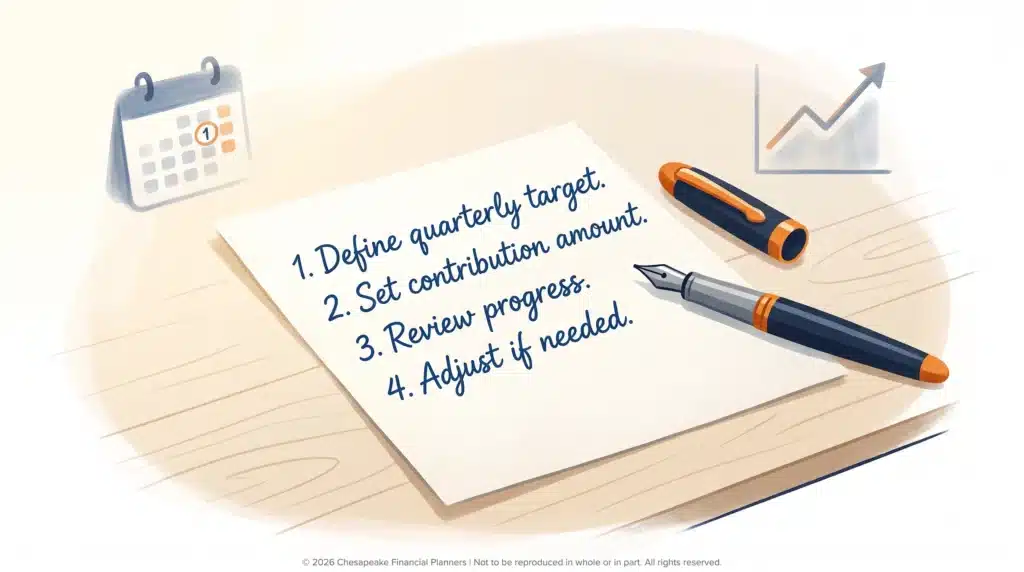
Four numbers, decided in advance: 1. What percentage do you sell at each vesting event? Not "some." A specific number, chosen when you were thinking clearly, that fits your concentration comfort rather than the mood of the week the stock jumped. 2. How much goes into a tax reserve before you touch the rest? Employers typically withhold a flat 22% federal rate on RSU vests. If your marginal bracket runs higher, that gap is real money you need set aside the day you vest, not the day you file. 3. What triggers a rebalance? A specific share of net worth in single-stock exposure, checked on a set schedule, that does not depend on how you feel about the stock that quarter. 4. Where do the proceeds go? Tax reserve first, then a diversified allocation, then whatever else you have prioritized, decided before the money lands rather than in the moment.
Why Does a Mental Model Fail Where a Written Plan Works?
A mental model fails because it asks you to make the same decision, under the same pressure, every quarter, indefinitely. Every vesting event becomes its own negotiation: the stock is up, so maybe you wait for more; the stock is down, so selling now feels like locking in a loss, so you wait again. Neither version of waiting is free.

What happens when someone has equity knowledge but no written plan?
Knowledge without a decision rule turns into a longer, more informed delay rather than a better outcome. An engineer who can explain the difference between a qualifying and disqualifying ISO disposition can still let vested shares sit in a brokerage account for months because nothing tells them what to do next, and the technical fluency just makes the hesitation feel more justified.
"The people who manage concentrated stock well are not the ones with the most sophisticated tax knowledge. They made the hard decision once, wrote it down, and let the rule do the work every quarter after that." (Jeff Judge, CFP®, AEP®, ChFC®, CLU®)
How Does Maryland's Tax Picture Raise the Stakes for Harford County Employees?
This is where the Maryland layer matters, and it is not cosmetic. Federal withholding on RSU vests sits at a flat 22% for supplemental wages up to $1 million in a calendar year, rising to 37% above that threshold, per IRS Publication 15 for 2026. That flat rate is calibrated for a middle bracket, so anyone whose marginal federal rate runs higher is already under-withheld before state and local tax enter the picture.
Maryland then adds two more layers most national equity-comp articles never mention. The state's top marginal income tax rate for 2026 reaches 6.5% on taxable income over $1,000,000 (single) or $1,200,000 (joint), per the Comptroller of Maryland. On top of that, Harford County residents, including Bel Air, Forest Hill, and Fallston, owe a local income tax of 3.06% for 2026, also confirmed by the Comptroller's withholding tables. Neither of those rates is touched by the flat 22% federal withholding on your pay stub, which means a Harford County tech employee's true withholding gap at each vest is wider than the national conversation about RSU under-withholding usually accounts for.
| Withholding stage | Rate for 2026 | Source |
|---|---|---|
| Federal supplemental wage withholding, up to $1M in the year | 22% | IRS Publication 15 |
| Federal supplemental wage withholding, above $1M in the year | 37% | IRS Publication 15 |
| Maryland top state marginal rate | 6.5% | Comptroller of Maryland |
| Harford County local income tax | 3.06% | Comptroller of Maryland |
A written plan's tax reserve rule is where this gap gets closed. Set your reserve percentage against your actual combined marginal rate, federal, Maryland state, and Harford County local, rather than against the flat 22% your employer withholds, and April stops being a surprise.
What Happens If You Leave Your Job Before You've Written This Down?
This is where the absence of a plan stops being a slow leak and turns into a real number fast. If you leave a job, whether by choice, a layoff, or a new offer, you typically face a limited post-termination window, often 90 days, to exercise vested ISOs before they convert to non-qualified stock options or expire. The exact window varies by plan, so check your grant agreement rather than assuming.
Without a written plan, that window becomes a scramble: modeling AMT exposure, finding exercise cash, and deciding how much of a severance payment to put into a former employer's private stock, all while job hunting. With a plan, most of that is already answered. Your plan should name the scenario directly: exercise up to a set number of shares if the AMT cost stays under a threshold you defined in advance, funded from the tax reserve you already built.
What should a written equity plan say about leaving a job?
The plan should name a specific exercise ceiling tied to an AMT cost threshold, both decided while you are still employed and not under deadline pressure. It should also name which account funds the exercise, ideally the tax reserve described earlier, so the decision is already made before the 90-day clock starts.
How Does the R.U.D.D.E.R. Method™ Turn a Written Plan Into a Habit?
A written plan only works if it gets revisited on a schedule instead of every time a vest lands. Chesapeake Financial Planners builds this kind of decision framework into the R.U.D.D.E.R. Method™, a structured planning process that walks a client through gathering the full equity picture, setting the rebalance and reserve numbers, and building in an annual review rather than a reactive one. Jeff Judge, CFP®, AEP®, ChFC®, CLU®, has used that structure with engineering and product leaders across the Baltimore metro area who arrived with plenty of technical knowledge and no written rule connecting it to action.
Does a written plan mean you can never change it?
No. A written plan is a default, not a permanent rule, and it should be revisited once a year or after a material change such as a new role, a liquidity event, or a shift in risk tolerance. What it replaces is re-litigating your entire equity strategy every single vesting event, which is decision fatigue dressed up as diligence rather than genuine flexibility.
Frequently Asked Questions
How much of my company stock is too much to hold?
There is no single number that fits every household, but a common ceiling many planners use is somewhere between 10% and 20% of investable net worth in a single company's stock. Your own number should reflect your risk tolerance, your other assets, and how much of your future income already depends on that same employer.
What percentage should I set aside for taxes when RSUs vest?
Start with your actual combined marginal rate, federal, Maryland state, and (if you live in Harford County) the local rate of 3.06%, rather than the flat 22% federal rate your employer withholds. For many dual-income tech households, the true combined marginal rate runs well above that flat withholding percentage, which is exactly the gap a tax reserve rule is meant to close.
Do I need a financial advisor to write this plan?
You can draft the first version yourself in about thirty minutes using the four questions above. Having someone stress-test the plan against your actual tax situation, net worth, and Maryland residency helps catch gaps, particularly around the AMT and post-termination exercise rules, that are easy to miss on your own.
How often should I revisit my written equity plan?
Once a year is a reasonable default, along with a fresh look after any material change such as a new job, a liquidity event, or a significant shift in your net worth. Outside of those triggers, the plan is meant to make the decision for you so each vesting event does not become its own negotiation.
The mistake was never a lack of understanding. It was believing that understanding your equity was the same as having a plan for it. Write the four numbers down, put a date on the page, and let the plan make the decision the next time a vest notification shows up.
A version of this article was originally published on Jeff Judge's LinkedIn.
Disclosures
The information provided is for educational purposes only and should not be construed as investment advice. Investment strategies should be tailored to individual circumstances, risk tolerance, and goals. Past performance doesn't guarantee future results. Consult with qualified financial professionals regarding your specific situation.
Certified Financial Planner Board of Standards Center for Financial Planning, Inc. owns and licenses the certification marks CFP®, CERTIFIED FINANCIAL PLANNER®, and CFP® (with plaque design) in the United States to Certified Financial Planner Board of Standards, Inc., which authorizes individuals who successfully complete the organization's initial and ongoing certification requirements to use the certification marks.
The ChFC® is the property of The American College of Financial Services, which reserves sole rights to its use, and is used by permission.
The CLU® is the property of The American College of Financial Services, which reserves sole rights to its use, and is used by permission.
Advisors associated with Chesapeake Financial Planners may be either (1) LPL Financial Registered Representatives offering securities through LPL Financial, Member FINRA and SIPC, and investment advisor representatives offering investment advice through Great Valley Advisor Group; or (2) solely investment advisor representatives offering investment advice through Great Valley Advisor Group and not affiliated with LPL Financial. Great Valley Advisor Group, and Chesapeake Financial Planners are separate entities from LPL Financial.
Chesapeake Financial Planners | 2402 Scotlon Ct, Forest Hill, MD 21050 | (410) 652-7868 | www.chesapeakefp.com
© 2026 Chesapeake Financial Planners | Not to be reproduced in whole or in part. All rights reserved.


