

Last reviewed: September 2026
The Roth conversion mistake that triggers a Medicare surcharge is converting an amount that, combined with income you did not factor in, such as a K-1, RSU vesting, or a required distribution, pushes your household across an IRMAA bracket line on the tax return Medicare reviews two years later. IRMAA is not triggered by the size of the conversion alone. It is triggered by total modified adjusted gross income (MAGI), and a conversion sized without checking the full picture is where the surprise comes from.
I have watched this exact pattern play out with a client whose CPA, estate attorney, and prior advisor were each doing competent work in their own lane, and together still handed him an extra tax bill and a Medicare premium surcharge he never saw coming.
Key Takeaways
- A Roth conversion by itself rarely trips an IRMAA bracket. It is the conversion stacked with other income in the same tax year that does it.
- Medicare sets your premium using the tax return from two years earlier, so a 2026 conversion affects your 2028 premium, not your 2026 or 2027 premium.
- Once a Roth conversion is complete, it cannot be undone. There is no recharacterization to reverse it.
- Maryland taxes traditional IRA and 401(k) withdrawals but does not tax qualified Roth distributions, which changes the math on when to convert for Maryland retirees.
- A written list of every income source and irreversible deadline, reviewed by more than one professional, is the most effective way to avoid the stacking problem.
About the Author
Jeff Judge, CFP®, AEP®, ChFC®, CLU®, is the founder of Chesapeake Financial Planners in Forest Hill, Maryland, serving clients throughout Harford County and Baltimore County and virtually nationwide. He built the firm's R.U.D.D.E.R. Method™ around exactly this kind of coordination gap, checking a proposed decision against a client's full tax, investment, and estate picture before it becomes irreversible.
How Does a Roth Conversion Trigger an IRMAA Surcharge Two Years Later?
IRMAA, the Income-Related Monthly Adjustment Amount, is added to your Medicare Part B and Part D premiums once your household's modified adjusted gross income crosses a threshold set by CMS. The Social Security Administration determines your premium using the tax return from two years before the coverage year, so your 2026 Medicare premium was set using your 2024 MAGI. Income you realize in 2026, including a Roth conversion, will not show up in your premium until 2028.
That lag is exactly why the mistake is so easy to make. The decision feels contained in the year you make it, but the bill arrives two years later, often long after anyone has connected it back to the conversion.
Here is what the 2026 Part B premium brackets look like for a single filer:
| 2024 MAGI (Single) | Monthly Part B Premium | Monthly IRMAA Surcharge |
|---|---|---|
| $109,000 or less | $202.90 | $0.00 |
| $109,001 to $137,000 | $284.10 | $81.20 |
| $137,001 to $171,000 | $405.80 | $202.90 |
| $171,001 to $205,000 | $527.50 | $324.60 |
| $205,001 to $499,999 | $649.20 | $446.30 |
| $500,000 or more | $689.90 | $487.00 |
A household that crosses even the first threshold pays an extra $81.20 a month, per person, for a full year. Cross two or three thresholds because a conversion stacked on top of unplanned income, and the number climbs fast for both spouses.
Does converting to a Roth always raise your Medicare premium?
No. A Roth conversion only affects your Medicare premium if it pushes your household's modified adjusted gross income across one of the IRMAA thresholds on the tax return Medicare reviews two years later. Plenty of retirees convert modest amounts every year specifically to stay under the next bracket line, and their premiums never move.
Why Did Three Good Professionals Still Cost My Client $9,000 in Extra Tax and Medicare Costs?
A client of mine, I will call him Mark, was 61 with close to $2 million in a traditional IRA. His advisor at the time recommended converting $120,000 that year, a reasonable amount with a reasonable rationale: fill up the lower brackets before required withdrawals started forcing the pace.
What that advisor did not know is that Mark also held a stake in a family real estate partnership, and that year the partnership sold a property. The K-1 showed up in March with roughly $95,000 of income Mark had not budgeted for and had not mentioned to his advisor, because he did not think of it as something his advisor needed to know. His CPA filed the return correctly and flagged that the tax bill was higher than expected, but by then the conversion had already happened the previous December. Stack $120,000 of conversion income on top of $95,000 of partnership income, and Mark did not just pay more federal tax. He crossed into a higher Medicare premium bracket two years later, adding a real surcharge to both Part B and Part D for himself and his spouse, for a full year.
"Nobody made a mistake in their own lane. The advisor's conversion made sense in isolation, the CPA's return was accurate, and the estate documents were sound. The problem was that none of them knew what the other two were doing in the same twelve-month window." Jeff Judge, CFP®, AEP®, ChFC®, CLU®
Three ways I have seen a single Roth conversion collide with income nobody flagged in advance:
- An IRA withdrawal taken the same year a family real estate partnership sold a property, generating an unplanned K-1.
- A Roth conversion recommended without knowing a spouse had just exercised a large batch of stock options.
- A required minimum distribution combined with a one-time capital gain from an inherited asset an estate attorney had just helped settle.
In each case, any one piece on its own would have been fine. The stacking is what did the damage, and stacking is invisible to a professional who only sees their own slice of the picture.
Can you undo a Roth conversion once you have made it?
No, not anymore. Congress eliminated Roth recharacterization in the 2017 tax law changes that took effect in 2018, so once the conversion executes and the tax year closes, the income is locked in regardless of what else shows up on your return. That is exactly why checking the full picture before you convert, rather than after, matters so much.
How Should You Size a Roth Conversion Against the IRMAA Bracket Edge?
The fix is not avoiding Roth conversions. It is sizing them against your full projected income for the year, not just the conversion amount in isolation.

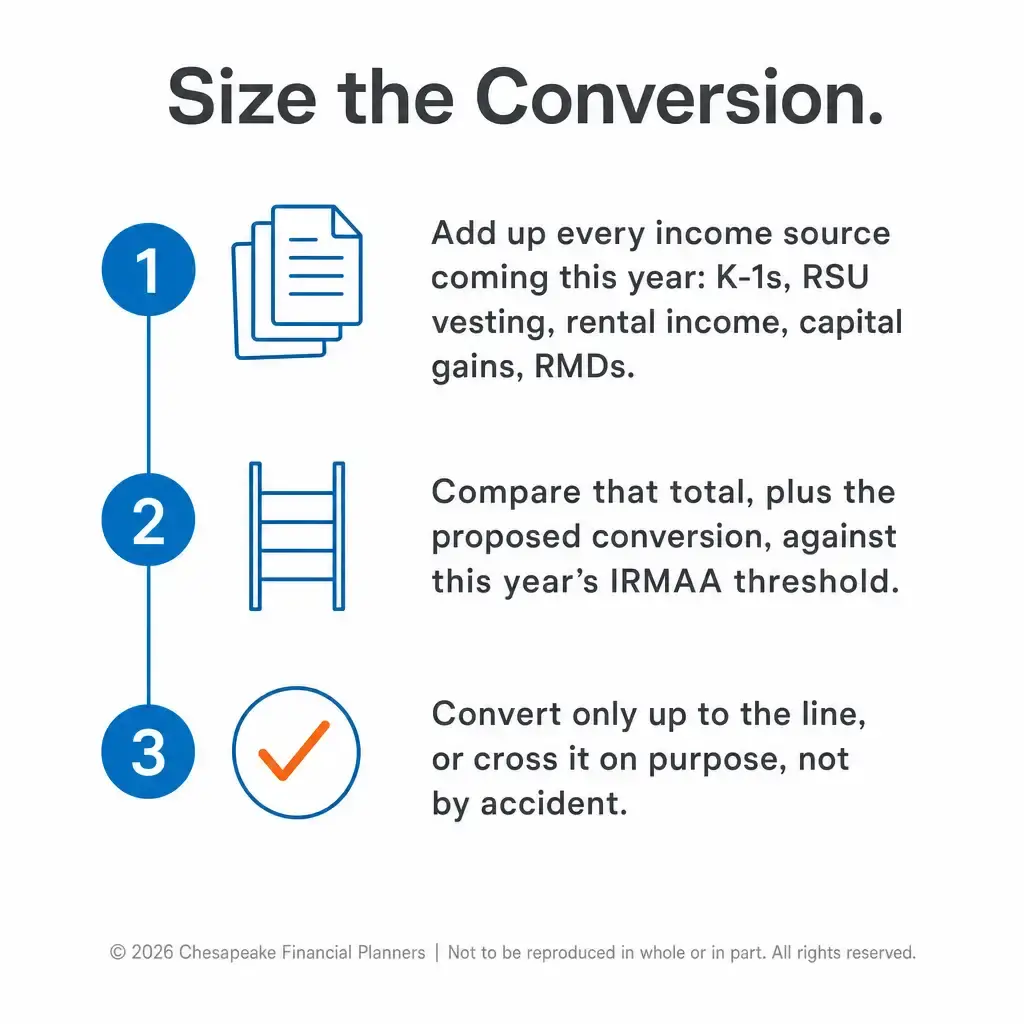
A practical sizing checklist:
- Add up every income source you already know is coming this year: K-1s, RSU vesting, rental income, capital gains, and any required minimum distributions.
- Compare that total, plus the proposed conversion amount, against the current-year MAGI threshold for your filing status.
- Convert only enough to stay under the threshold, or cross it deliberately, with your eyes open, rather than by accident.
Is it ever worth crossing into the next IRMAA bracket on purpose?
Sometimes, yes. If converting a larger amount now clears a traditional IRA balance that would otherwise force much larger required distributions, and a much bigger premium hit, in your 70s, a deliberate one-time bracket crossing can be the cheaper long-term choice. The mistake is not crossing the line. It is crossing it without knowing you did.
Does Maryland Add Another Layer to Roth Conversion Timing?
For households in Forest Hill, Bel Air, and across Harford County, Maryland adds a real wrinkle on top of the federal IRMAA math. Maryland taxes traditional IRA and 401(k) withdrawals as ordinary income but does not tax qualified Roth distributions, which is one more reason the gap years before required distributions begin are a valuable conversion window for Maryland retirees.
Maryland's pension exclusion also matters here. For 2026, the maximum exclusion is $40,600 for eligible residents 65 and older, and it phases down dollar-for-dollar against Social Security income. A Roth conversion sized without accounting for that phase-down can quietly shrink the exclusion at the same time it pushes MAGI toward an IRMAA threshold, a double cost that a federal-only calculation misses entirely.
What Should You Ask Before Your Next Irreversible Roth Decision?
Coordination is not a personality trait some advisors have and others do not. It is a specific, checkable process, and it is the backbone of the R.U.D.D.E.R. Method™ we use with clients at Chesapeake Financial Planners to catch exactly this kind of stacking problem before a decision becomes irreversible.
Ask these questions about your own situation:
- Does anyone see your full projected tax return, not just last year's, before a conversion gets recommended?
- Do your CPA, estate attorney, and financial advisor talk to each other directly, or are you the one relaying updates between them?
- Has anyone modeled what this year's decisions do to your Medicare premium two years out, given the lookback?
- Is there a single written list of every account, every K-1-generating interest, and every irreversible deadline in the next twelve months that more than one of your professionals has actually seen?
None of this requires firing anyone. It requires someone whose actual job, not just their intention, is to hold the full picture and run the "what happens if these decisions stack" question before it gets made, not after the return gets filed.
Frequently Asked Questions
How far back does Medicare look when calculating IRMAA?
Medicare uses the tax return from two years before the current coverage year. Your 2026 premium is based on your 2024 modified adjusted gross income, which is why a Roth conversion or other income event in 2026 will not affect your premium until 2028.
Can I appeal an IRMAA surcharge caused by a one-time event like a Roth conversion?
A standard IRMAA appeal is built for specific life-changing events defined by the Social Security Administration, such as marriage, divorce, or the loss of income-producing property, and a planned Roth conversion generally does not qualify on its own. The better approach is sizing the conversion in advance so it does not trigger a surcharge you would then have to appeal.
Does a Roth conversion count as income for Social Security taxation too?
Yes. A Roth conversion adds to your modified adjusted gross income for the year, and that same MAGI figure is part of the calculation that determines how much of your Social Security benefit is taxable, in addition to feeding into the IRMAA lookback two years later. Sizing a conversion means checking both effects, not just one.
A version of this article was originally published on Jeff Judge's LinkedIn.
Disclosures
The information provided is for educational purposes only and should not be construed as investment advice. Investment strategies should be tailored to individual circumstances, risk tolerance, and goals. Past performance doesn't guarantee future results. Consult with qualified financial professionals regarding your specific situation.
Certified Financial Planner Board of Standards Center for Financial Planning, Inc. owns and licenses the certification marks CFP®, CERTIFIED FINANCIAL PLANNER®, and CFP® (with plaque design) in the United States to Certified Financial Planner Board of Standards, Inc., which authorizes individuals who successfully complete the organization's initial and ongoing certification requirements to use the certification marks.
The ChFC® is the property of The American College of Financial Services, which reserves sole rights to its use, and is used by permission.
The CLU® is the property of The American College of Financial Services, which reserves sole rights to its use, and is used by permission.
Advisors associated with Chesapeake Financial Planners may be either (1) LPL Financial Registered Representatives offering securities through LPL Financial, Member FINRA and SIPC, and investment advisor representatives offering investment advice through Great Valley Advisor Group; or (2) solely investment advisor representatives offering investment advice through Great Valley Advisor Group and not affiliated with LPL Financial. Great Valley Advisor Group, and Chesapeake Financial Planners are separate entities from LPL Financial.
Chesapeake Financial Planners | 2402 Scotlon Ct, Forest Hill, MD 21050 | (410) 652-7868 | www.chesapeakefp.com
© 2026 Chesapeake Financial Planners | Not to be reproduced in whole or in part. All rights reserved.


