

What Your Advisor's 1% Fee Costs on a $3 Million Portfolio
Last reviewed: July 2026
A client sat down across from me last spring with eleven years of account statements. She had done the math herself before the meeting, which I respect. Her advisor had charged a 1% fee on assets the whole time. On a portfolio that grew from roughly $1.8 million to $3.4 million over that stretch, she had paid somewhere between $180,000 and $230,000 in advisory fees. "I didn't know it was that number," she said. Most people don't.
Key Takeaways
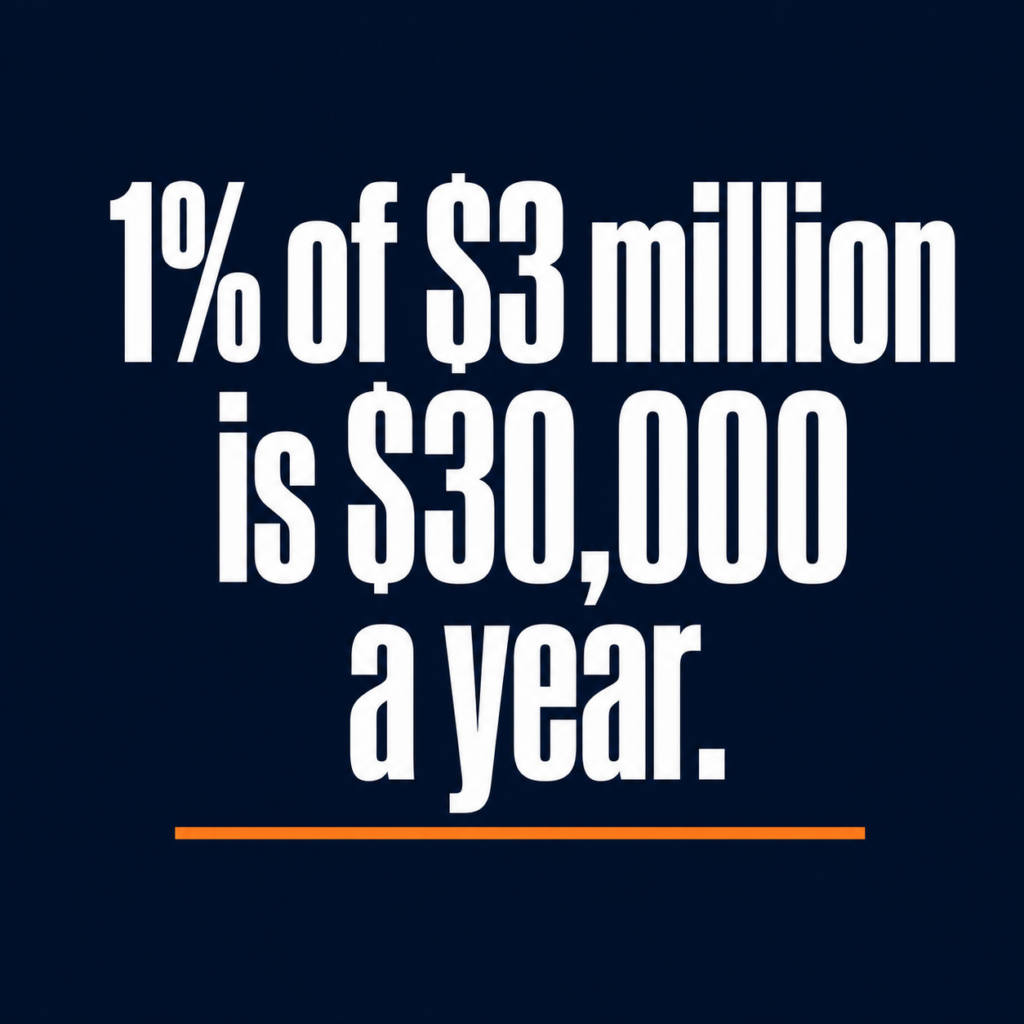
- A 1% assets-under-management fee on a $3 million portfolio costs $30,000 a year, a number most clients have never translated from the percentage.
- The fee grows automatically as your portfolio grows, with no renegotiation, so the dollar cost climbs every year the balance does.
- At $30,000 a year, the fee should buy integrated tax planning, estate coordination, and behavioral coaching, not investment management alone.
- The Morningstar Mind the Gap study found investors trailed their own funds by about 1.2% a year over the decade ending 2024.
About the Author: Jeff Judge, CFP®, AEP®, ChFC®, CLU® is Managing Partner of Chesapeake Financial Planners in Forest Hill, Maryland. He has been helping families and business owners in Harford County and the Baltimore metro area evaluate what they pay for financial advice since earning his CFP® certification in 2013, by using Chesapeake Financial Planners’ signature process, the R.U.D.D.E.R. method™. In Jeff's experience, the clients who have never mapped their fee in dollar terms are also the ones who have never had a direct conversation about whether they are getting their money's worth. As Jeff puts it: "When I ask a client to tell me what they paid their advisor last year in actual dollars, not a percentage, the number they come up with is almost always lower than the real one, and closing that gap is almost always what starts a productive conversation."
What Does a 1% Fee Actually Cost in Dollars?
A 1% AUM fee costs you 1% of your portfolio every year, expressed in dollars rather than a percentage that feels abstract. At $1 million, that is $10,000 a year. At $3 million, it is $30,000. At $5 million, it is $50,000. The percentage sounds small precisely because it is presented as a percentage. Thirty thousand dollars a year does not feel like thirty thousand dollars when it is described as "one percent."
The number also does not hold still. When your portfolio grows from $2 million to $3 million, the fee grows with it. You do not renegotiate. The same percentage simply applies to a larger balance, so the dollar cost climbs every year your account does, without anyone sending you a notice.
The longer view is where it gets real. Assume a $3 million portfolio growing at 6% a year. A 1% fee paid from the portfolio each year is a compounding drag, because the fees you pay are capital that is no longer invested and growing. Over 20 years, the cumulative cost, including the lost growth on the fees themselves, can approach or exceed $800,000. That is not a minor line item, and it deserves the same scrutiny you would give any other six-figure expense.
What Should a 1% Fee Cover at This Level?
At $3 million, a 1% fee is $30,000 a year, and that is not investment-management money. At that price, the fee should buy a complete, coordinated financial relationship. If it does not, you are paying full price for something narrower than what is available at that cost. Here is what the fee should be buying.
Tax planning integrated into portfolio decisions, not just automated tax-loss harvesting at year end. That means actual coordination with your CPA before changes happen, Roth conversion analysis, distribution timing, and managing capital gains against your other income that year. Estate planning coordination, where your advisor knows your estate structure, understands the beneficiary designation on every account, and talks to your estate attorney when something changes downstream. Behavioral support during market stress, which gets undervalued in most fee conversations. The Russell Investments Value of an Advisor study attributes a meaningful share of an advisor's value to behavioral coaching, most of it from keeping clients from selling at the wrong moment. And a full financial picture beyond the accounts under management: Social Security timing, insurance review, cash-flow planning, and coordination around major liquidity events.
If most of those things are not happening, you are paying for investment management. And investment management on its own is not worth 1% at scale. Index-fund portfolios have outperformed most active management over long stretches, and tax-managed separately managed accounts do sophisticated tax work for 0.25% to 0.40%. The Morningstar Mind the Gap study found the average investor trailed the very funds they owned by about 1.2% a year over the decade ending 2024, almost entirely from buying after rallies and selling after drops. A good advisor who prevents those mistakes can offset the fee. The question is whether yours is actively doing that work, or whether you are paying for a relationship that runs on autopilot. Choosing the right advisor in the first place is its own decision, and our guide on how to choose a financial advisor walks through the criteria that matter most.
Why Do So Few Clients Have This Conversation?
Most clients never have a direct conversation about their fee because the percentage feels settled once they agreed to it, and nobody reopens it. Over the years I have asked a lot of clients what they actually get for their advisory fee, and the answers fall into three groups.
Some clients know exactly. They meet on a real schedule with real agendas, their advisor reaches out when something in their situation changes, and the relationship coordinates with their CPA and estate attorney when a decision calls for it. These clients can tell you in plain terms why they pay what they pay, and the conversation is confident because it is grounded in specifics. A second group sits in the middle. The portfolio is managed, statements arrive, the advisor seems competent, but they could not tell you the last time the advisor initiated contact about anything other than performance or a scheduled review. The relationship is professional and entirely passive. A third group is paying for annual statements and a phone number they rarely call.
None of those clients made an unreasonable decision when they hired their advisor. But a $30,000 annual expense deserves the same active evaluation as anything else you spend $30,000 on. If there has never been a direct conversation about what the fee covers and whether it is being delivered, the relationship is running on an assumption rather than a verified agreement. The remedy depends on the answer, which is exactly why the answer is worth getting.
Is a Flat-Fee Structure Worth Understanding?
A flat annual retainer is worth understanding because it removes the link between your portfolio size and what you pay, which is the structural conflict baked into the AUM model. Instead of charging a percentage of assets, some advisors charge a fixed annual fee for a defined scope of work. For a full-scope planning relationship, that fee commonly runs between $8,000 and $20,000 a year depending on complexity, though the figure varies widely by firm and region and is worth confirming directly rather than assuming.
The structural advantage is clear. The advisor's pay is not tied to your balance, so they do not earn more as your account grows, and they do not earn less if you pull money out to buy a business, a home, or to help family. The fee is for advice, not for custody of a number. That does not make a flat fee automatically better. A flat-fee advisor can run a passive, limited relationship just as easily as an AUM advisor can. But if you are at $3 million or above and your fee is a percentage, it is worth understanding what a flat-fee engagement would cost and what it would include, so you are comparing on the merits rather than on habit.
What Three Questions Should You Ask Before Your Next Meeting?
The three questions worth asking force a specific, dollar-grounded answer rather than a percentage and a smile. I am not arguing you should leave your advisor. I am arguing you should have this conversation before your next scheduled review.
First: in the past 12 months, what contact did my advisor initiate that was not about investment performance or scheduling? You are measuring whether the relationship is proactive or reactive. Second: how much did I pay in advisory fees last year in dollar terms, and what services were specifically included? If the answer comes back in percentages after you asked for dollars, that is information in itself. Third: what does your total compensation from my account look like, including platform fees, fund-level expense ratios you are compensated from, or arrangements with third-party managers? That is a reasonable question about a significant annual relationship, and an advisor who answers it directly is giving you confidence. One who deflects is giving you something else.
Want to go deeper? Our Cost vs. Value walks through this step by step.
There is one more step most clients have never taken: pull your advisor's Form ADV Part 2, which is publicly available through the SEC's Investment Adviser Public Disclosure database and FINRA BrokerCheck. It discloses how your advisor is compensated, what conflicts of interest exist, and any disciplinary history, in plain language. I have sat with clients who worked with the same advisor for 15 years without knowing the document existed. It is about 20 minutes of reading and the basic floor of due diligence for any relationship that costs you a significant fee every year.

What Does Fee-Based Advice Look Like in Harford County?
Fee-based advice in Harford County looks like an advisor who is paid primarily by the client and is transparent about every layer of that compensation, which is the standard worth holding any local advisor to. Chesapeake Financial Planners is a fee-based fiduciary firm based in Forest Hill, a short drive from Bel Air, and being clear about what that means is part of the point of this article. Fee-based and fee-only are not the same thing, and the distinction matters when you are evaluating advisors in the Maryland market.
A fee-only advisor accepts no commissions at all. A fee-based advisor is paid primarily through client fees but may also be licensed to offer certain products that pay a commission. Neither model is automatically better, and a fee-based fiduciary can serve your interests well, provided every source of compensation is disclosed and the advisor acts in your best interest. What matters is not the label but the transparency behind it. When you ask a Harford County advisor how they are paid, you should get a straight answer in a sentence or two, in writing, not a five-minute explanation that leaves you more confused than when you started. If you want to go deeper on the local version of this question, our guide to finding a fee-based financial advisor near Bel Air covers how to vet one.
The reason I tie our own structure back to this article's argument is consistency. If the case is that a $30,000 fee should buy coordinated planning and full transparency, then we should be held to exactly that standard. That is how we work with families across Harford County, Bel Air, and Forest Hill, and it is the same approach the R.U.D.D.E.R. Method™ is built around. The R.U.D.D.E.R. Method™ is Chesapeake Financial Planners' six-step planning process: Review and Recognize, Uncover and Understand, Design and Develop, Discuss and Decide, Execute and Empower, and Reassess and Refine. Fee transparency lives in the first step, where we put the cost and the scope of the relationship on the table before anything else happens.
Frequently Asked Questions
How much does a 1% advisor fee cost on a $3 million portfolio?
A 1% advisor fee on a $3 million portfolio costs $30,000 per year. Because the fee is a percentage of assets, the dollar amount rises automatically as your portfolio grows, with no renegotiation. Over 20 years on a portfolio growing around 6% annually, the cumulative cost including lost growth on the fees can approach or exceed $800,000.
Is a 1% AUM fee worth it?
A 1% fee can be worth it when it buys integrated tax planning, estate coordination, behavioral coaching, and a full financial picture, not investment management alone. At $3 million, that fee is $30,000 a year, and investment management by itself is available for far less. The fee is worth it only if the broader planning work is actually being delivered and you can name it.
What is the difference between a fee-only and a fee-based advisor?
A fee-only advisor is paid solely by clients and accepts no commissions, while a fee-based advisor is paid mainly by clients but may also earn commissions on certain products. Neither is automatically better. The key is full disclosure of every compensation source and a fiduciary commitment to act in your interest, confirmed in writing before you hire.
How do I find out how my financial advisor is really paid?
Pull your advisor's Form ADV Part 2 through the SEC's Investment Adviser Public Disclosure database or FINRA BrokerCheck, both free. The document discloses compensation, conflicts of interest, and any disciplinary history in plain language. Then ask your advisor directly, in dollar terms, what you paid last year and what every layer of fees, including fund-level costs, adds up to.
Does portfolio growth prove my advisor is worth the fee?
No. Portfolios grow during long bull markets with no advisor involvement at all, so growth alone is not evidence of advisory value. The real evidence is a direct line from advisor activity to outcomes you could not have produced yourself: specific tax savings, an estate issue caught early, or a behavioral guardrail that kept you from a costly decision during a downturn.
Where This Leaves You
Some advisors deliver real value at 1%, and some clients are getting a strong return on what they pay. Those relationships are not rare, and I have seen plenty of them. But the clients getting that value know they are getting it. They have verified it, had the direct conversation about what they pay and what they receive, and chosen to stay because they understand the terms. That is different from assuming the relationship is worth it because the portfolio went up.
The question is not whether you are paying. You know you are paying. The question is whether you have ever verified, in specific dollar terms, that what you receive justifies what you spend. If you have not, that is a conversation worth having before your next meeting, not because the answer is necessarily no, but because you should be the one who knows. Jeff Judge and the Chesapeake team serve families and business owners across Harford County and the Baltimore metro. Schedule a free fit call at chesapeakefp.com.
A version of this article was originally published on Jeff Judge's LinkedIn.
Disclosures
The information provided is for educational purposes only and should not be construed as investment advice. Investment strategies should be tailored to individual circumstances, risk tolerance, and goals. Past performance doesn't guarantee future results. Consult with qualified financial professionals regarding your specific situation.
Advisors associated with Chesapeake Financial Planners may be either (1) LPL Financial Registered Representatives offering securities through LPL Financial, Member FINRA and SIPC, and investment advisor representatives offering investment advice through Great Valley Advisor Group; or (2) solely investment advisor representatives offering investment advice through Great Valley Advisor Group and not affiliated with LPL Financial. Great Valley Advisor Group, and Chesapeake Financial Planners are separate entities from LPL Financial.


