

What Is the Difference Between a Tax Credit and a Tax Deduction?
Last reviewed: July 2026
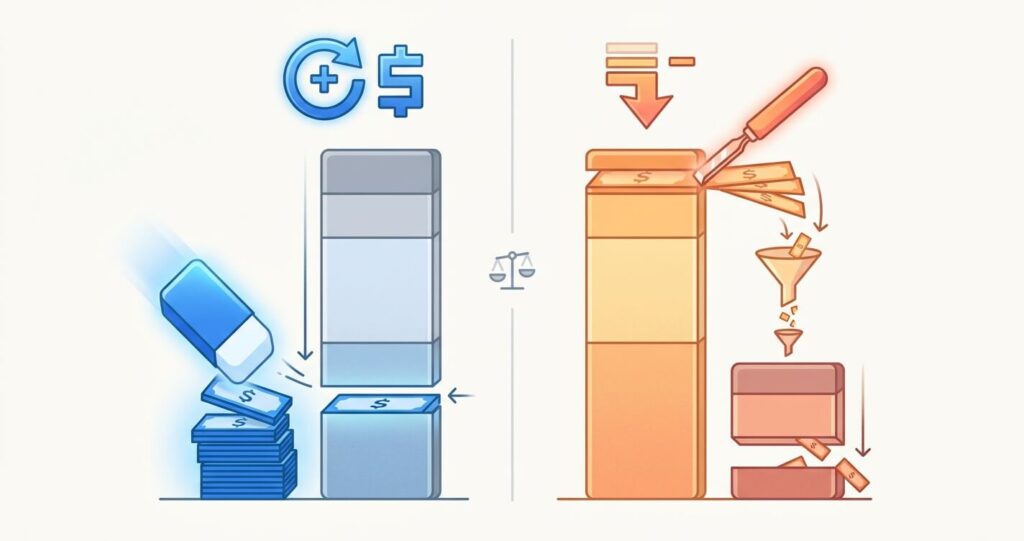
A tax credit reduces your tax bill dollar for dollar, while a tax deduction only reduces the income that gets taxed. That single difference is why a $1,000 credit is worth far more than a $1,000 deduction. The credit cuts $1,000 off what you owe. The deduction cuts your taxable income by $1,000, which saves you only your marginal tax rate times that amount. Understanding the tax credit vs deduction distinction is the first step to keeping more of your own money at filing time.
Key Takeaways
- A tax credit reduces taxes owed dollar for dollar; a deduction only reduces your taxable income before tax is calculated.
- A $1,000 credit saves you $1,000; a $1,000 deduction saves you your marginal rate times that amount.
- The 2026 standard deduction is $16,100 for single filers and $32,200 for married couples filing jointly.
- Refundable credits can pay you even when you owe zero tax; nonrefundable credits only zero out your bill.
About the Author: Jeff Judge, CFP®, AEP®, ChFC®, CLU® is Managing Partner of Chesapeake Financial Planners in Forest Hill, Maryland. He has been helping families and business owners in Harford County and the Baltimore metro area navigate tax planning since earning his CFP® certification in 2013, by using Chesapeake Financial Planners’ signature process, the R.U.D.D.E.R. method™. Jeff sees the same thing every spring: people chase deductions and overlook credits worth three or four times more.
How Does a Tax Deduction Actually Work?
A tax deduction reduces the amount of income the IRS can tax. It does not reduce your tax bill directly. The value of any deduction depends entirely on your marginal tax bracket.
Say you earn $90,000 and sit in the 22% federal bracket. A $1,000 deduction lowers your taxable income to $89,000. Your actual savings is 22% of $1,000, or $220. The same deduction is worth more to a high earner in the 32% bracket ($320) and less to someone in the 12% bracket ($120).
Most filers take the standard deduction instead of itemizing. For tax year 2026, the IRS set the standard deduction at $16,100 for single filers and $32,200 for married couples filing jointly. You itemize only when your deductible expenses (mortgage interest, state and local taxes, charitable gifts) exceed that threshold.
This is where the term above the line deduction matters. An above-the-line deduction (technically an adjustment to income) lowers your adjusted gross income and you can claim it whether or not you itemize. Contributions to a traditional IRA or HSA are common examples. Because AGI drives eligibility for many credits and other tax benefits, above-the-line deductions often do double duty. Jeff Judge notes: "Above-the-line deductions are some of the most valuable moves on the tax return because a traditional IRA or HSA contribution reduces your AGI first, which can then unlock credits and benefits that phase out at higher income levels."
What Is the Difference Between Marginal and Effective Tax Rate?
What Is a Tax Credit and Why Is It Worth More?
A tax credit is a dollar-for-dollar reduction of the tax you owe. If you owe $4,000 and claim a $2,000 credit, your bill drops to $2,000. The credit's value does not depend on your bracket, which is exactly why it beats a deduction of the same size.
Compare the two side by side using a filer in the 22% bracket.
| Feature | $1,000 Tax Deduction | $1,000 Tax Credit |
|---|---|---|
| What it reduces | Taxable income | Tax owed |
| Value at 22% bracket | $220 | $1,000 |
| Value at 32% bracket | $320 | $1,000 |
| Depends on your bracket? | Yes | No |
The takeaway is simple. A credit of any given dollar amount is worth more than a deduction of the same dollar amount, every time. According to the IRS, credits cover things like child care, education, energy improvements, and the Child Tax Credit. When you qualify for both a credit and a deduction on the same expense, the credit almost always wins.
How can I potentially optimize my taxes as my income grows?
What Is the Difference Between a Refundable and Nonrefundable Credit?
Not all credits behave the same way once your tax bill hits zero. The split between refundable and nonrefundable credits is where real dollars get left on the table.
A refundable credit can reduce your tax below zero, meaning the IRS pays you the difference. If you owe $500 and claim a $2,000 refundable credit, you get $1,500 back as a refund. The Earned Income Tax Credit is the best-known refundable credit, and for 2026 the IRS set its maximum at $8,231 for taxpayers with three or more qualifying children.
A nonrefundable credit can only bring your tax to zero. If you owe $500 and claim a $2,000 nonrefundable credit, you wipe out the $500 but forfeit the remaining $1,500. The credit caps out at what you owe.
Jeff Judge often tells clients to check refundability before they assume a credit is fully usable. He has watched lower-income filers leave hundreds of dollars unclaimed because they did not realize a credit was refundable and skipped filing. The money was theirs and they walked past it.
When Should You Care About Credits vs Deductions in Your Planning?
The distinction matters most when you are deciding how to time income, contributions, and major expenses. A deduction-heavy strategy helps high earners shave taxable income; a credit-focused strategy often delivers more for middle-income households.
At Chesapeake Financial Planners, this question runs through the R.U.D.D.E.R. Method™, Chesapeake Financial Planners' six-step planning process: Review and Recognize, Uncover and Understand, Design and Develop, Discuss and Decide, Execute and Empower, and Reassess and Refine. During the Uncover and Understand step, we map which credits a household actually qualifies for before chasing deductions that may save far less.
The practical move is to stop treating every tax break as equal. A $2,000 credit and a $2,000 deduction are not the same animal. One cuts your bill by $2,000; the other might cut it by $440. When you plan around that gap, you make better decisions about IRA contributions, education funding, and energy upgrades.
What is a year-round tax planning calendar for retirees and pre-retirees?
Frequently Asked Questions
Is a tax credit better than a tax deduction?
A tax credit is almost always better than a tax deduction of the same dollar amount. A credit reduces your tax bill dollar for dollar, while a deduction only reduces taxable income and saves you your marginal rate times the deduction. A $1,000 credit beats a $1,000 deduction every time.
What is a refundable tax credit?
A refundable tax credit can reduce your tax bill below zero, meaning the IRS pays you the difference as a refund. If you owe $300 and claim a $2,000 refundable credit, you receive $1,700 back. The Earned Income Tax Credit and the Additional Child Tax Credit are common refundable credits.
What is an above the line deduction?
An above the line deduction, technically an adjustment to income, lowers your adjusted gross income whether or not you itemize. Traditional IRA contributions, HSA contributions, and student loan interest are common examples. Because AGI determines eligibility for many credits, above the line deductions often unlock additional tax benefits beyond their direct savings.
Can I claim both a tax credit and a tax deduction?
Yes, you can claim both credits and deductions on the same return as long as you meet each one's rules. They work in different places: deductions reduce your taxable income first, then credits reduce the tax calculated on that income. You cannot, however, claim a deduction and a credit for the exact same dollar of expense.
How much is the standard deduction for 2026?
The 2026 standard deduction is $16,100 for single filers and $32,200 for married couples filing jointly, according to the IRS. You take the standard deduction unless your itemized deductions, such as mortgage interest, state and local taxes, and charitable gifts, add up to more than that threshold for your filing status.
If you found this helpful, our Tax Planning Starter Guide breaks down the credits and deductions most families overlook, with the 2026 thresholds laid out in plain language. Download it free at chesapeakefp.com and start keeping more of what you earn at tax time.
Want to go deeper? Our Tax-Smart Financial Plan walks through this step by step.
Disclosures
The information provided is for educational purposes only and should not be construed as investment advice. Investment strategies should be tailored to individual circumstances, risk tolerance, and goals. Past performance doesn't guarantee future results. Consult with qualified financial professionals regarding your specific situation.
This information is not intended to be a substitute for specific individualized tax, investment or legal advice. We suggest that you discuss your specific situation with a qualified tax, legal or financial advisor.
Advisors associated with Chesapeake Financial Planners may be either (1) LPL Financial Registered Representatives offering securities through LPL Financial, Member FINRA and SIPC, and investment advisor representatives offering investment advice through Great Valley Advisor Group; or (2) solely investment advisor representatives offering investment advice through Great Valley Advisor Group and not affiliated with LPL Financial. Great Valley Advisor Group, and Chesapeake Financial Planners are separate entities from LPL Financial.


