

What Is the Best Business Entity Structure for My Company?
Last reviewed: July 2026
The best business entity structure depends on three things: how much profit your business throws off, whether you plan to raise outside capital, and how you intend to exit. For most profitable small businesses, an LLC taxed as an S corporation hits the sweet spot, cutting self-employment tax while keeping liability protection. High-growth companies chasing venture money usually need a C corporation. Business entity selection is rarely permanent, but getting it right early saves you real money and real headaches.
Key Takeaways
- Business entity selection drives your taxes, liability exposure, and ability to raise capital, so match the structure to your actual business model.
- An S corporation election lets owners split income between salary and distributions, reducing the 15.3% self-employment tax on a portion of earnings.
- C corporations pay a flat 21% federal corporate tax but face double taxation when profits are distributed as dividends.
- The 2026 Social Security wage base is $184,500, which caps the most expensive portion of self-employment tax.
About the Author: Jeff Judge, CFP®, AEP®, ChFC®, CLU® is Managing Partner of Chesapeake Financial Planners in Forest Hill, Maryland. He has been helping families and business owners in Harford County and the Baltimore metro area navigate entity selection and exit planning since earning his CFP® certification in 2013, by using Chesapeake Financial Planners’ signature process, the R.U.D.D.E.R. method™. Jeff sees the same pattern over and over: owners pick a structure at formation based on convenience, then leave money on the table for years because nobody revisited the decision once the business got profitable.
What Are the Four Main Business Entity Types?
There are four structures most owners choose between: sole proprietorship, LLC, S corporation, and C corporation. Each carries different tax treatment, liability protection, and compliance demands. Understanding the trade-offs is the foundation of smart business entity selection.
A sole proprietorship is the default when you start operating without forming a separate legal entity. It's the simplest and cheapest option, with all income flowing onto your personal return via Schedule C. The catch is significant: no liability protection. Your personal assets sit fully exposed to business debts and lawsuits. Every dollar of net profit also gets hit with self-employment tax, which runs 15.3% (12.4% Social Security up to the 2026 wage base plus 2.9% Medicare on all earnings).
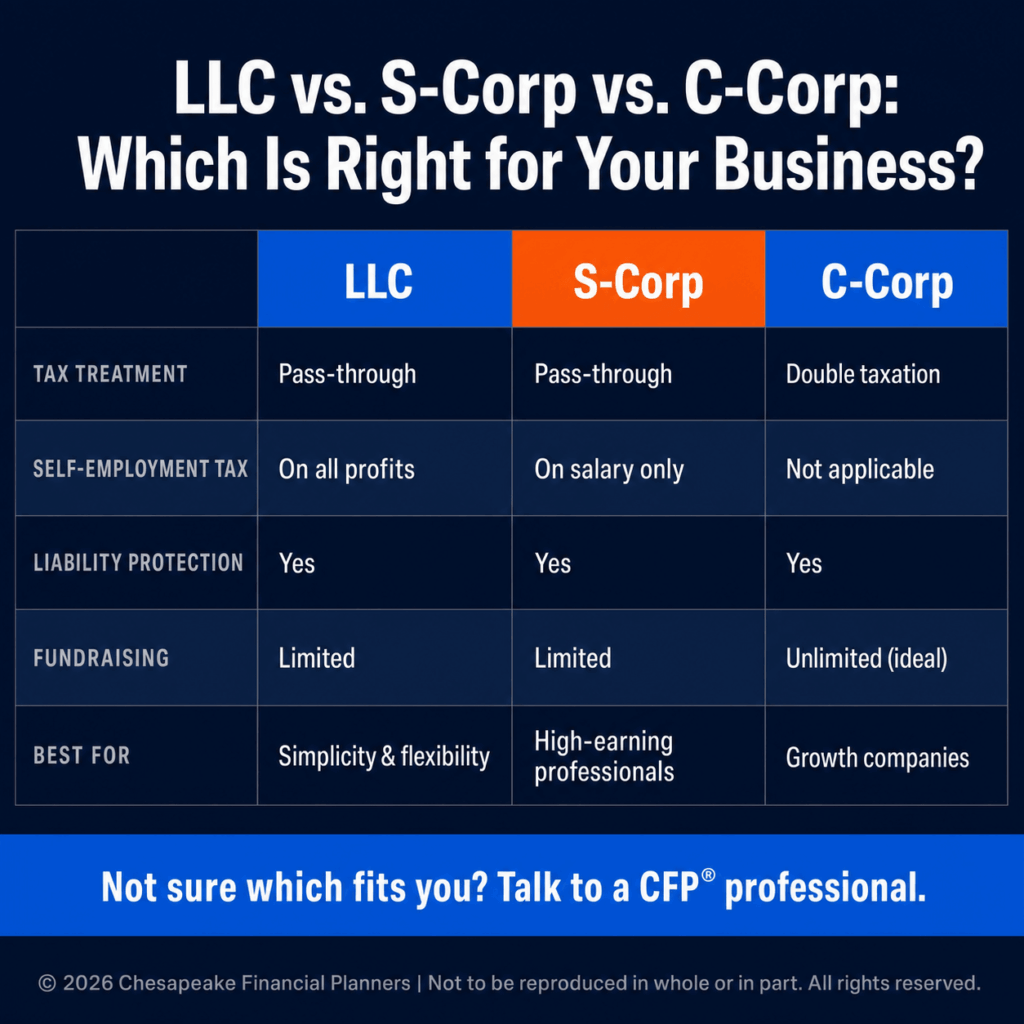
A C corporation is a fully separate taxable entity. It pays a flat 21% federal corporate income tax on profits. The downside is double taxation: profits are taxed once at the corporate level, then again when distributed to shareholders as dividends. C corps shine when you plan to reinvest profits, raise venture capital, or attract institutional buyers, which is why nearly every venture-backed startup is a Delaware C corp.
This is where small business entity types start to diverge based on goals rather than size alone. The LLC and S corporation, covered below, are where most established small businesses land.
How Does an LLC Compare to an S-Corp for Taxes?
An LLC and an S corporation are not mutually exclusive, which trips up most owners. An LLC is a legal entity; an S corporation is a tax election. You can form an LLC and then elect to have it taxed as an S corp, getting the legal flexibility of one with the tax treatment of the other. This is the core of the LLC vs S-Corp question.
By default, a single-member LLC is taxed like a sole proprietorship, meaning all net profit is subject to self-employment tax. That's fine when profits are modest. Once the business clears roughly $80,000 to $100,000 in net profit, the S corporation election usually starts paying for itself.
Here's the mechanics. With an S corp, you pay yourself a "reasonable compensation" salary via W-2, which is subject to payroll taxes. The remaining profit comes out as distributions, which are not subject to the 15.3% self-employment tax. Split $150,000 of profit into a $90,000 salary and $60,000 in distributions, and you've shielded that $60,000 from the Social Security and Medicare portions of self-employment tax. That can mean several thousand dollars in annual savings.
| Feature | LLC (default) | LLC with S-Corp election |
|---|---|---|
| Self-employment tax | All net profit | Salary portion only |
| Payroll required | No | Yes (reasonable W-2 salary) |
| Liability protection | Yes | Yes |
| Compliance burden | Lower | Higher (payroll, formalities) |
| Best for net profit | Under ~$80K | Over ~$80K-$100K |
Jeff Judge often tells clients the S corp election is not a free lunch. You take on payroll administration, more bookkeeping, and the IRS scrutiny that comes with setting your own salary. Pay yourself too little to dodge taxes, and you're inviting an audit. The savings have to outweigh that added complexity, which is exactly the kind of trade-off our R.U.D.D.E.R. Method™ is built to surface. The R.U.D.D.E.R. Method™ is Chesapeake Financial Planners' six-step planning process: Review and Recognize, Uncover and Understand, Design and Develop, Discuss and Decide, Execute and Empower, and Reassess and Refine.
How Should Business Owners Pay Themselves Salary vs Distributions?
When Does a C Corporation Make Sense?
A C corporation makes sense when you plan to raise venture capital, retain significant profits inside the business, or build toward a strategic acquisition. The flat 21% corporate tax rate can actually beat individual rates for owners who reinvest rather than distribute earnings.
Venture capital firms and most institutional investors strongly prefer C corporations, typically Delaware ones, because the share structure is familiar and supports multiple stock classes, preferred shares, and options pools. An S corp can't do that; it's limited to one class of stock and no more than 100 shareholders, all of whom must be US citizens or residents. Those restrictions kill an S corp's appeal the moment you want outside or foreign investors.
The trade-off remains double taxation. If you're pulling profits out each year, the C corp structure costs you. But for a company plowing earnings back into growth, or one heading toward a sale where buyers want a C corp, that 21% rate and clean cap table earn their keep. C corporation taxation rewards retention and punishes distribution, which is the opposite of how most small businesses operate.
What are the best exit strategies for business owners?
How Do You Choose the Right Structure?
Choosing the right structure starts with your numbers and your timeline, not with whatever your neighbor formed. Walk through your projected profit, your need for outside capital, your liability exposure, and your exit plan in that order. Those four answers narrow the field fast.
If you're a low-profit side business with little liability risk, a sole proprietorship or single-member LLC keeps things simple. If you've got meaningful profit and no plans to raise institutional money, an LLC with an S corp election usually wins. If you're building something venture-scale, file as a C corp from the start so you don't have to convert later under pressure.
The mistake Jeff watches owners make repeatedly is treating this as a one-time decision. Your business changes. A structure that fit at $50,000 in profit is leaving money on the table at $300,000. Revisit business structure taxes whenever your profit jumps, your ownership changes, or your exit timeline comes into view.
What Do Business Owners Most Often Forget to Plan Before Exiting?
Frequently Asked Questions
Is an LLC or S-Corp better for a small business?
For most profitable small businesses, an LLC taxed as an S corporation is better because it combines liability protection with self-employment tax savings. A plain LLC works fine below roughly $80,000 in net profit. Once profits climb higher, the S corporation election typically saves several thousand dollars annually by shielding distributions from the 15.3% self-employment tax.
What is the main disadvantage of a C corporation?
The main disadvantage of a C corporation is double taxation. Profits are taxed first at the flat 21% federal corporate rate, then taxed again at the individual level when distributed to shareholders as dividends. This makes C corps expensive for owners who pull profits out yearly, though it matters less for companies reinvesting earnings or raising venture capital.
Can I change my business entity later?
Yes, you can change your business entity later, though some conversions are easier than others. Electing S corporation status for an existing LLC is straightforward through an IRS filing. Converting an LLC to a C corporation, or unwinding a C corp, can trigger taxes and legal complexity. It's far cheaper to choose the right structure early than to restructure under pressure.
How much can an S-Corp election save in taxes?
An S corporation election can save several thousand dollars per year, depending on your profit and salary split. By paying a reasonable W-2 salary and taking remaining profit as distributions, you avoid the 15.3% self-employment tax on the distribution portion. A business splitting $150,000 into $90,000 salary and $60,000 distributions could save roughly $9,000 annually before added payroll costs.
Do I need an attorney or accountant to choose an entity?
You don't strictly need one, but for any business with meaningful profit or growth plans, professional guidance pays for itself. An accountant runs the tax math on each structure, and an attorney handles formation documents and liability questions. The cost of a few hours of advice is small next to the cost of an entity mismatch that overcharges you on taxes for years.
If you're weighing entity selection, our perspective on how LLC and S-Corp taxes compare breaks down the numbers side by side. Read it at chesapeakefp.com to see how the right structure fits your growth and exit goals.
Disclosures
The information provided is for educational purposes only and should not be construed as investment advice. Investment strategies should be tailored to individual circumstances, risk tolerance, and goals. Past performance doesn't guarantee future results. Consult with qualified financial professionals regarding your specific situation.
Advisors associated with Chesapeake Financial Planners may be either (1) LPL Financial Registered Representatives offering securities through LPL Financial, Member FINRA and SIPC, and investment advisor representatives offering investment advice through Great Valley Advisor Group; or (2) solely investment advisor representatives offering investment advice through Great Valley Advisor Group and not affiliated with LPL Financial. Great Valley Advisor Group, and Chesapeake Financial Planners are separate entities from LPL Financial.


