

What Happens to My Stock Options When My Company Goes Public?
Last reviewed: July 2026
When your company goes public, your stock options do not automatically convert to cash. Your vesting schedule keeps running, your unvested shares stay unvested, and a lockup period blocks you from selling for the first 90 to 180 days after the IPO. The IPO turns illiquid paper into a tradable asset, but it also triggers tax events and timing rules that can cost you real money if you ignore them.
Key Takeaways
- When your company goes public, an IPO lockup period typically prevents employees from selling shares for 90 to 180 days.
- RSUs with double-trigger vesting often vest in bulk after the IPO, dumping years of income onto one W-2.
- ISOs can trigger the alternative minimum tax, with the 2026 AMT exemption set at $90,100 for single filers.
- A 10b5-1 plan lets insiders sell on a pre-set schedule without violating insider trading rules.
- Selling everything the day your lockup expires is rarely the smartest tax move.
About the Author: Jeff Judge, CFP®, AEP®, ChFC®, CLU® is Managing Partner of Chesapeake Financial Planners in Forest Hill, Maryland. He has been helping families and business owners in Harford County and the Baltimore metro area navigate equity compensation and IPO windfalls since earning his CFP® certification in 2013, by using Chesapeake Financial Planners’ signature process, the R.U.D.D.E.R. method™. Jeff has watched more than one client treat an IPO as a finish line, only to learn the hard part starts the day the stock begins trading.
What Happens to Stock Options and RSUs When a Company Goes Public?
When your company goes public, the IPO does not unlock your equity overnight. What actually happens depends on whether you hold options or restricted stock units, and the difference matters a lot for your tax bill.
For incentive stock options (ISOs) and non-qualified stock options (NSOs), your grant stays valid until it expires, usually ten years from the grant date. The IPO does not accelerate vesting unless your specific grant says so, which is rare. What changes is liquidity. Before the IPO, exercising meant tying up cash in shares you could not sell. After the IPO, you can run a cashless exercise and sell into a public market, so the math on when to exercise shifts entirely.
RSUs work differently. Most pre-IPO RSUs carry double-trigger vesting: a time-based trigger (your normal schedule) and a liquidity trigger (the IPO itself). You can clear your one-year cliff well before the IPO and still have nothing vest for tax purposes until the company goes public. Once both triggers hit, years of "time-vested" RSUs can all settle within a few months of the IPO. That can drop hundreds of thousands of dollars of ordinary income onto a single year's W-2. Jeff has seen clients blindsided by exactly this, paying top-bracket federal rates plus state tax on income they never saw as cash because the shares were still locked up.
This is the moment where Chesapeake's R.U.D.D.E.R. Method™ matters. The R.U.D.D.E.R. Method™ is Chesapeake Financial Planners' six-step planning process: Review and Recognize, Uncover and Understand, Design and Develop, Discuss and Decide, Execute and Empower, and Reassess and Refine. For IPO equity, the "Uncover and Understand" step means reading your grant documents before you celebrate.
Can I Sell My Shares Right After the IPO?
No, you almost certainly cannot sell right after the IPO. An IPO lockup period blocks insiders and employees from selling shares for a set window, typically 90 to 180 days from the IPO date. According to the U.S. Securities and Exchange Commission, lockup agreements are private contracts between the underwriters and company insiders, and the specific terms appear in the company's S-1 registration statement.
The reason is supply control. If every employee sold on day one, the flood of shares could crash the price. Underwriters require lockups to stabilize the stock while the public float settles. A few details to know:
- The clock starts on the IPO date, not the day you joined the company.
- Your exact expiration date lives in the S-1 filing, so read it.
- Executives and large holders often face longer lockups than rank-and-file employees.
Even after the lockup ends, you still cannot trade whenever you want. Public companies impose blackout periods around earnings releases and only allow insiders to trade during open windows, usually a stretch of weeks after quarterly results. So your first real chance to sell might land four or five months after the IPO, not the day the lockup lifts.
How Does Going Public Affect My Taxes?
Going public changes your taxes mostly by making your numbers public and by clustering income into a tight window. The tax treatment splits along the type of equity you hold.
For ISOs, exercising and holding can trigger the alternative minimum tax, because the spread between your strike price and the fair market value counts as an AMT preference item. Before the IPO, that fair market value was an estimate from a 409A valuation. After the IPO, it is whatever the stock traded at, which can be far higher and far more volatile. The 2026 AMT exemption is $90,100 for single filers and $140,200 for married couples filing jointly, with phaseouts at higher income. A large ISO exercise post-IPO can blow past those exemptions quickly. Jeff Judge notes: "After an IPO the 409A valuation that set your ISO spread is replaced by a live stock price that can be significantly higher and far more volatile, so an exercise that looked manageable on paper pre-IPO can blow past the AMT exemption before you've sold a single share."
For NSOs, the rule is simpler. You owe ordinary income tax on the spread at exercise, then capital gains on any appreciation afterward. The post-IPO advantage is certainty: the price is public, so you know your tax bill before you pull the trigger.
For long-term capital gains, holding qualifying shares more than a year shifts you from ordinary rates to the preferential 0%, 15%, or 20% brackets the IRS sets each year. With ISOs, holding more than two years from grant and one year from exercise also unlocks the better long-term treatment, which is exactly why dumping everything the moment your lockup expires can be the expensive choice.
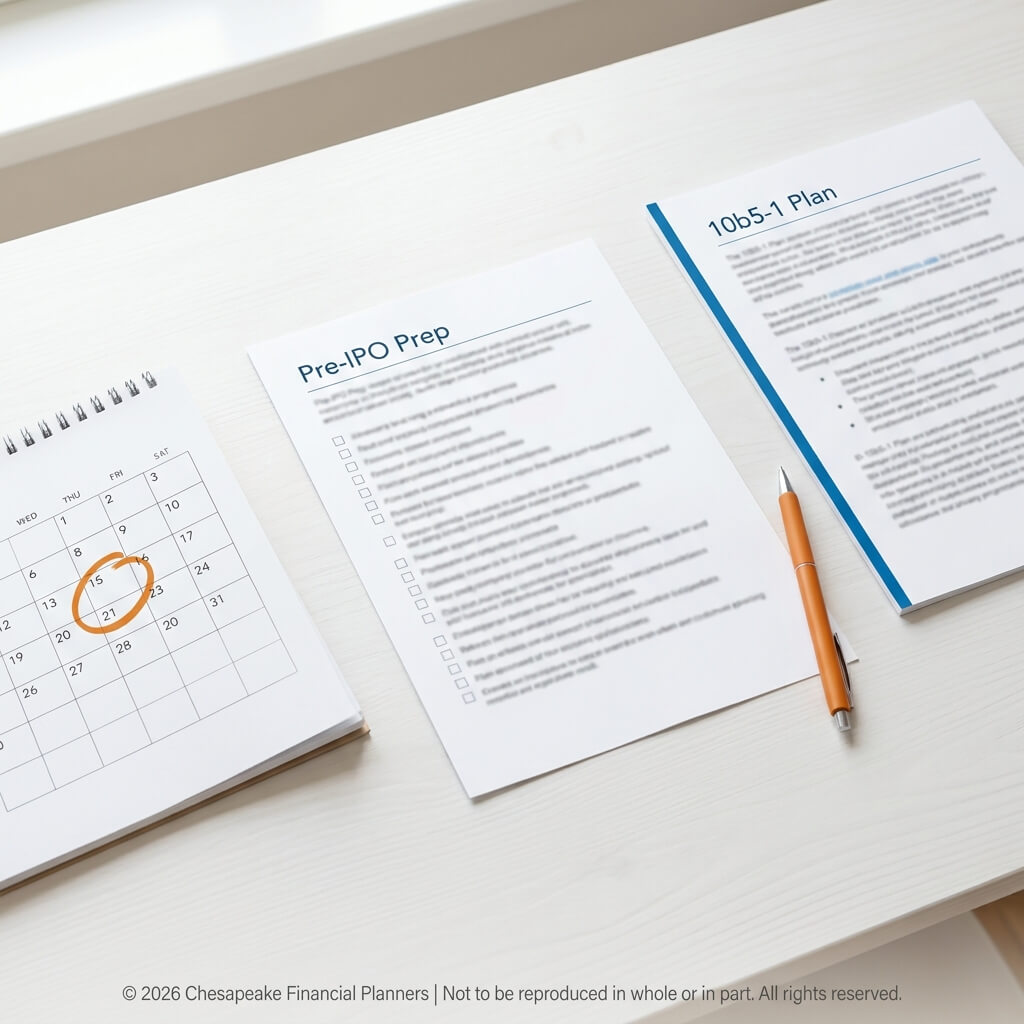
What Is a 10b5-1 Plan and Should I Use One?
A 10b5-1 plan is a pre-arranged trading schedule that lets company insiders buy or sell their own stock without running afoul of insider trading rules. You set the plan up while you do not possess material non-public information, specifying the price, amount, and timing in advance, and then trades execute automatically on that schedule even when you later learn inside information.
For someone holding a large concentrated position after an IPO, a 10b5-1 plan solves two problems at once. It lets you sell during what would otherwise be blackout periods, and it removes the temptation to time the market with your single biggest asset. Under the SEC's amended rules, most plans now carry a mandatory cooling-off period before the first trade can run, which is meant to prevent abuse and adds discipline to your selling strategy.
Jeff often tells clients that a 10b5-1 plan is less about beating the market and more about not letting a stock price control your financial life. Selling a fixed percentage on a set cadence usually beats trying to guess the top.
Frequently Asked Questions
How long is a typical IPO lockup period?
A typical IPO lockup period runs 90 to 180 days from the IPO date, with 180 days being the most common length. The exact term is set in the lockup agreement between underwriters and insiders and is disclosed in the company's S-1 filing. Executives often face longer restrictions than regular employees.
Do my RSUs vest automatically when my company goes public?
Your RSUs vest when both triggers of a double-trigger arrangement are met: the time-based schedule and the liquidity event. Going public satisfies the liquidity trigger, so any RSUs that already cleared their time requirement vest shortly after the IPO. This can stack years of income into one tax year, creating a large W-2 spike.
Will I owe AMT on my ISOs after the IPO?
You may owe alternative minimum tax if you exercise ISOs and hold the shares, because the spread between your strike price and the market price counts as an AMT preference item. After the IPO, that spread is based on the public price, which is often much higher. The 2026 AMT exemption is $90,100 for single filers before phaseout.
Should I sell all my shares as soon as the lockup expires?
Selling everything the day your lockup expires is rarely the best move, because it can push you into the highest tax brackets and forfeit long-term capital gains treatment. Spreading sales across tax years, holding qualifying shares longer, and using a 10b5-1 plan usually produce a better after-tax result than one large sale.
What is the difference between a lockup period and a blackout period?
A lockup period blocks insiders from selling for a set window right after the IPO, usually 90 to 180 days. A blackout period is an ongoing company restriction around earnings releases that limits insider trading to specific open windows. Both can apply, so your first real chance to sell may come months after the IPO date.
Ready to Plan Around Your Equity?
An IPO can change your financial life, but only if you handle the tax and timing decisions deliberately instead of reacting to the stock ticker. If this breakdown helped, our guide to managing concentrated stock positions and equity windfalls walks through the planning sequence in depth. Download it at chesapeakefp.com.
How do I invest the proceeds from selling my business?
What questions should I ask before hiring a financial advisor?
How Should Business Owners Pay Themselves Salary vs Distributions?
Want to go deeper? Our My Company's Going Public—Now What? walks through this step by step.
Disclosures
The information provided is for educational purposes only and should not be construed as investment advice. Investment strategies should be tailored to individual circumstances, risk tolerance, and goals. Past performance doesn't guarantee future results. Consult with qualified financial professionals regarding your specific situation.
This information is not intended to be a substitute for specific individualized tax, investment or legal advice. We suggest that you discuss your specific situation with a qualified tax, legal or financial advisor.
Advisors associated with Chesapeake Financial Planners may be either (1) LPL Financial Registered Representatives offering securities through LPL Financial, Member FINRA and SIPC, and investment advisor representatives offering investment advice through Great Valley Advisor Group; or (2) solely investment advisor representatives offering investment advice through Great Valley Advisor Group and not affiliated with LPL Financial. Great Valley Advisor Group, and Chesapeake Financial Planners are separate entities from LPL Financial.


