

How Do I Know If I'm On Track for Retirement?
Last reviewed: July 2026
You're on track for retirement when your current savings, your savings rate, and your projected income line up with the lifestyle you want at the age you plan to stop working. The fastest gut check: by 40 you want roughly 3 times your salary saved, by 50 you want 6 times, and you want to be putting away at least 15% of gross income every year. If both of those are true, you're in good shape. If not, you have a gap, and the sooner you measure it, the cheaper it is to close.
Key Takeaways
- You're on track if savings hit ~3x salary by 40 and ~6x by 50, with a 15%+ savings rate.
- The 4% rule reverse-engineered gives a target portfolio: annual spending times 25.
- In 2026, savers 50+ can add an $8,000 catch-up to a 401(k).
- Most online calculators use generic assumptions that don't reflect your real spending or income.
About the Author: Jeff Judge, CFP®, AEP®, ChFC®, CLU® is Managing Partner of Chesapeake Financial Planners in Forest Hill, Maryland. Jeff's view: most people who think they're behind are actually fine, and most people who feel comfortable are quietly under-saving for the life they describe. He has been helping families and business owners in Harford County and the Baltimore metro area develop comprehensive retirement strategies and secure their financial futures since earning his CFP® certification in 2013, by using Chesapeake Financial Planners’ signature process, the R.U.D.D.E.R. method™.
What Does "On Track for Retirement" Actually Mean?
Being on track for retirement means your projected retirement income, drawn from savings plus Social Security and any pension, can cover your expected spending for as long as you live. It is not a single magic number. It is the relationship between three things: how much you've saved, how much you keep adding, and how much you'll actually spend.
Here's the problem. Most online retirement calculators are blunt instruments. They plug in generic assumptions, a flat 7% return, a fixed retirement age, a one-size spending rate, and spit out a number that may have nothing to do with your life. Jeff Judge often tells clients the calculator isn't wrong, it just doesn't know you plan to pay off the mortgage at 62 or that half your retirement income will come from a rental property.
The honest answer to "am I on track" requires a framework, not a button. Two people earning the same salary can have wildly different targets depending on spending, debt, and when they want to walk away.
How Much Should I Have Saved by Age 40 or 50?
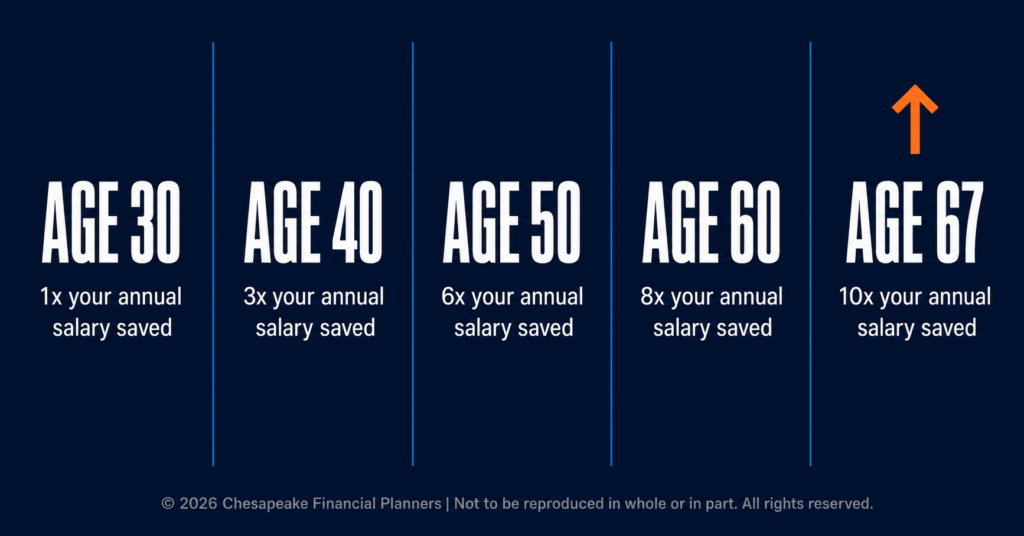
The most-cited benchmark comes from Fidelity, which suggests saving multiples of your salary by certain ages, assuming you retire around 67.
| Age | Target Saved |
|---|---|
| 30 | 1x salary |
| 40 | 3x salary |
| 50 | 6x salary |
| 60 | 8x salary |
| 67 | 10x salary |
For retirement planning age 40, that means someone earning $120,000 wants roughly $360,000 saved. For retirement planning age 50 at the same salary, the target jumps to about $720,000. These are starting points, not commandments.
The limitation is real. These multiples assume you keep spending at your current rate in retirement. Plan to downsize, relocate to a lower-cost state, or carry a paid-off house into retirement? You'll likely need less. Want to travel constantly or support adult children? You'll need more. Treat the multiples as a yardstick, then adjust for your actual plan.
How Do I Calculate My Real Retirement Number?
A better method than salary multiples is to reverse-engineer the 4% rule. The 4% rule, popularized by financial planner William Bengen's research, holds that you can withdraw about 4% of your portfolio in your first year of retirement, adjust for inflation, and have a low risk of running out over 30 years.
Work backward in three steps:
- Estimate your annual retirement spending. Start with 70 to 80% of current income as a placeholder, then refine it against your real budget.
- Subtract guaranteed income. Take out projected Social Security and any pension from that annual number first.
- Multiply the remainder by 25. That's the inverse of 4%, and it gives you the portfolio you need to fund.
Say you want $140,000 a year and expect $40,000 from Social Security. You need your portfolio to produce $100,000. Multiply $100,000 by 25 and your target is $2.5 million. This is the calculation a generic calculator skips, and it's why two people with identical balances can be in completely different shape.
This is exactly the kind of decision the R.U.D.D.E.R. Method™, Chesapeake Financial Planners' six-step planning process of Review and Recognize, Uncover and Understand, Design and Develop, Discuss and Decide, Execute and Empower, and Reassess and Refine, was built to work through.
How Much Should I Be Saving Each Year to Stay on Track?
A 15% savings rate is the standard target for staying on track for retirement, and that number includes any employer 401(k) match. If you started late, the rate climbs. Someone beginning serious saving at 45 often needs 20 to 25% of gross income to catch up.
The good news for older savers is the catch-up contribution. According to the IRS, in 2026 anyone age 50 or older can contribute an extra $8,000 to a 401(k) on top of the standard limit. Under SECURE 2.0, savers ages 60 through 63 get an even larger enhanced catch-up of $11,250 in 2026. That's a meaningful runway in the years most people earn the most.
Jeff has watched the same pattern for years: clients in their early 50s who feel behind, then realize that maxing catch-up contributions plus a few spending tweaks closes most of the gap in a decade. The lever is rarely investment returns. It's the savings rate in the final stretch before retirement.
If you're working through how much to save for retirement and want a sanity check, a retirement savings calculator and goal-setting walkthrough can pressure-test your assumptions.
Frequently Asked Questions
How much should I have saved for retirement by age 50?
By age 50, a common benchmark is roughly 6 times your annual salary saved for retirement. Someone earning $130,000 would target about $780,000. This assumes retirement near 67 and current spending levels, so adjust the figure if you plan to downsize, relocate, or travel heavily in retirement.
Is the 4% rule still reliable for retirement planning?
The 4% rule remains a reasonable planning starting point, suggesting you withdraw about 4% of your portfolio in year one and adjust for inflation. It assumes a roughly 30-year retirement and a balanced portfolio. Lower withdrawal rates add safety; longer retirements or early retirement may call for a more conservative 3.5%.
What savings rate keeps me on track for retirement?
A savings rate of 15% of gross income, including your employer match, keeps most people on track for retirement when they start in their 20s or 30s. Starting later raises the bar. Savers beginning in their 40s or 50s often need 20 to 25% of income, plus catch-up contributions, to reach their target.
Am I behind on retirement if I started saving late?
Starting late means you're behind a benchmark, not out of the game. According to the IRS, catch-up contributions in 2026 let savers 50 and older add an extra $8,000 to a 401(k), and ages 60 to 63 can add $11,250. Combined with a higher savings rate, late starters can close significant ground in 10 to 15 years.
How does Social Security factor into being on track?
Social Security replaces a meaningful share of pre-retirement income, so subtract it from your spending need before sizing your portfolio. The Social Security Administration bases your benefit on your 35 highest earning years. When you claim, between 62 and 70, dramatically changes the monthly amount, which is why claiming strategy belongs in any on-track assessment.
Why do retirement calculators give such different answers?
Retirement calculators give different answers because they use different default assumptions for return rates, inflation, retirement age, life expectancy, and spending. A one-point change in assumed returns can swing your target by hundreds of thousands of dollars. Reliable planning replaces generic defaults with your actual spending, income sources, and timeline.
Where to Go From Here
The fastest way to know if you're on track for retirement is to run your own numbers: your savings versus the age-based multiple, your savings rate versus 15%, and your real target using the 4% reverse calculation. Do that this week and you'll know within an hour whether you're ahead, in the ballpark, or behind.
If you found this helpful, our retirement readiness guide walks through each calculation step by step with worksheets you can fill in. Download it at chesapeakefp.com.
For related reading, see How do I know if I'm saving enough for retirement?, Should I Take Social Security at 62 or Wait Until 70?, and How Do I Create Multiple Income Streams for Retirement?.
Want to go deeper? Our Retirement Income Blueprint Workbook walks through this step by step.
Disclosures
The information provided is for educational purposes only and should not be construed as investment advice. Investment strategies should be tailored to individual circumstances, risk tolerance, and goals. Past performance doesn't guarantee future results. Consult with qualified financial professionals regarding your specific situation.
Advisors associated with Chesapeake Financial Planners may be either (1) LPL Financial Registered Representatives offering securities through LPL Financial, Member FINRA and SIPC, and investment advisor representatives offering investment advice through Great Valley Advisor Group; or (2) solely investment advisor representatives offering investment advice through Great Valley Advisor Group and not affiliated with LPL Financial. Great Valley Advisor Group, and Chesapeake Financial Planners are separate entities from LPL Financial.


