

How Does Public Service Loan Forgiveness Work for Federal Employees?
Last reviewed: July 2026
Public Service Loan Forgiveness (PSLF) erases the remaining balance on your federal Direct Loans after you make 120 qualifying monthly payments while working full-time for a government or eligible nonprofit employer. The forgiven amount is tax-free at the federal level. For federal employees and other public servants carrying student debt, public service loan forgiveness can wipe out tens of thousands of dollars, but only if every payment, loan type, and employer meets the program's strict rules.
Key Takeaways
- PSLF forgives your remaining Direct Loan balance after 120 qualifying monthly payments under a qualifying repayment plan.
- As of June 2026, over 1.1 million borrowers have received PSLF discharges totaling more than $78 billion.
- Only Direct Loans qualify; FFEL and Perkins Loans must be consolidated first, which resets your payment count.
- Certify your employment every year so you catch disqualifying payments early, when you can still fix them.
About the Author: Jeff Judge, CFP®, AEP®, ChFC®, CLU® is Managing Partner of Chesapeake Financial Planners in Forest Hill, Maryland. He has been helping families and business owners in Harford County and the Baltimore metro area navigate student loan and education funding decisions since earning his CFP® certification in 2013, by using Chesapeake Financial Planners’ signature process, the R.U.D.D.E.R. method™. Jeff has watched borrowers lose years of progress over a single avoidable mistake, usually the wrong repayment plan, and that pattern is exactly why annual certification matters more than people think.
What Is Public Service Loan Forgiveness?
Public service loan forgiveness is a federal program that cancels the remaining balance on Direct Loans after a borrower makes 120 qualifying monthly payments while employed full-time by a qualifying employer. Congress created it in 2007 to keep skilled professionals in lower-paying public service roles. According to Federal Student Aid, the forgiven balance is not treated as taxable income at the federal level, which separates PSLF from many other forgiveness paths.
The word "qualifying" appears four times in that definition, and each one is a place borrowers get tripped up. The program historically carried a high denial rate, largely because payments made under the wrong plan or on the wrong loan type simply do not count. Get the structure right early and PSLF becomes one of the most powerful tools available to public servants with federal student loans.

Who Qualifies for PSLF?
You qualify for PSLF when four conditions are met at the same time: you have the right loans, the right employer, the right repayment plan, and you make the right payments. Miss any one and the clock stops.
Qualifying loans. Only federal Direct Loans count, including Direct Subsidized, Direct Unsubsidized, Direct PLUS (for graduate students, not parents directly), and Direct Consolidation Loans. If you hold FFEL or Perkins Loans, you can consolidate them into a Direct Consolidation Loan to make them eligible, but payments made before consolidating do not carry over.
Qualifying employment. You must work full-time, generally at least 30 hours per week, for a federal, state, local, or tribal government agency or a 501(c)(3) nonprofit. Federal employees almost always meet this test automatically. Two part-time public service jobs that together total 30 hours can also qualify if documented properly.
Qualifying repayment plan. Only income-driven repayment (IDR) plans count toward PSLF, along with the 10-year Standard plan. The U.S. Department of Education lists the available IDR options, which cap your payment as a percentage of discretionary income.
Qualifying payments. You need 120 separate monthly payments, made on time, for the full amount due, while working for a qualifying employer. Payments do not need to be consecutive.
How Many Payments Do You Need and What Counts?
You need exactly 120 qualifying monthly payments, which is 10 years of payments if made without interruption. They do not have to run back to back. If you leave public service for two years and return, your earlier payments still count and you simply resume where you stopped.
Here is the detail that surprises people: a $0 monthly payment under an income-driven plan still counts as a qualifying payment, as long as you stay employed by a qualifying employer and the $0 amount is what the plan calculates. Borrowers with low income relative to their debt can rack up qualifying payments without writing a check. According to Federal Student Aid, payments made during in-school deferment, the grace period, general forbearance, or under non-qualifying plans do not count.
Jeff Judge often tells clients in government and nonprofit roles to treat the PSLF Help Tool the way they treat a tax return: file it on a schedule, not when a crisis forces it. The borrowers who get burned are almost always the ones who waited until they thought they were at 120 to look closely.
What Repayment Plan Should You Choose for PSLF?
Choose an income-driven repayment plan, not the Standard 10-year plan, if you are pursuing PSLF. The logic is simple. The Standard plan retires your loan in exactly 10 years, so by the time you hit 120 payments the balance is already gone and there is nothing to forgive.
An IDR plan caps your monthly payment at a slice of your discretionary income. That keeps your payments low across the 10 years and maximizes the balance left to forgive at the end. The lower your payments while you qualify, the more PSLF is worth to you.
Here is a comparison of the two paths for a borrower seeking forgiveness:
| Feature | Standard 10-Year Plan | Income-Driven Repayment |
|---|---|---|
| Monthly payment | Fixed, based on full balance | Percentage of discretionary income |
| Balance at payment 120 | Typically $0 | Often substantial |
| Counts toward PSLF | Yes | Yes |
| Smart for PSLF? | No, loan is already paid off | Yes, maximizes forgiveness |
| Annual recertification | No | Yes, income must be recertified |
The one ongoing task with IDR plans is annual income recertification. Miss that deadline and you can get bumped into a non-qualifying plan, which quietly stops your payment count.
Why Annual Employment Certification Matters
Submit the PSLF certification form every year, and any time you change employers, so you can verify your progress and catch problems early. This is the single habit that separates borrowers who get forgiven from borrowers who get denied at the finish line.
When you certify annually, your loan servicer confirms your employer qualifies and updates your official count of qualifying payments. If something is off, wrong plan, wrong loan type, an employer that does not actually qualify, you find out with years left to correct course. Wait until payment 120 to certify and you may discover that dozens of payments never counted, with no way to recover them.
For a deeper look at education funding strategy, see How Do I Pay for College Without Ruining My Retirement? and Who qualifies for student loan forgiveness and PSLF in 2026?.
Common PSLF Mistakes That Cost Borrowers Forgiveness
The most expensive PSLF errors are structural, and almost all of them are preventable with early certification. Watch for these:
- Wrong loan types. Paying on FFEL or Perkins Loans that were never consolidated into Direct Loans. Those payments never count.
- Wrong repayment plan. Graduated and extended plans do not qualify. Switch to an IDR plan immediately.
- Skipping annual certification. Waiting until year 10 to file paperwork is how borrowers learn too late that their payments did not count.
- Late or partial payments. Payments must be on time and for the full amount due. A payment one day late does not count.
- Missing recertification. IDR plans require yearly income recertification. Miss it and you can fall into a non-qualifying plan.
- Unnecessary consolidation. If you already have Direct Loans and qualifying payments, consolidating resets your count to zero. Only consolidate to fold in non-Direct Loans.
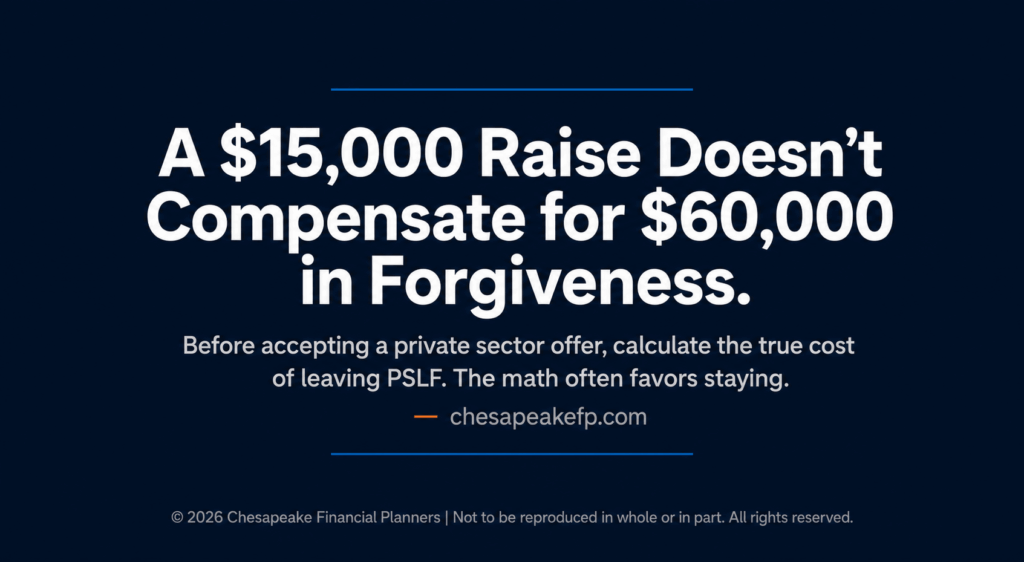
These mistakes connect directly to broader planning. If you are weighing public service against a higher-paying private role, run the numbers before you jump. Walking away from 80 qualifying payments and a $60,000 balance means giving up roughly $60,000 in tax-free forgiveness, which a modest raise rarely replaces. This is the kind of opportunity-cost math we work through using the R.U.D.D.E.R. Method™, Chesapeake Financial Planners' six-step planning process of Review and Recognize, Uncover and Understand, Design and Develop, Discuss and Decide, Execute and Empower, and Reassess and Refine. For families balancing debt against long-term goals, see What are my college funding options when my income disqualifies us from financial aid?.
Frequently Asked Questions
Do federal employees automatically qualify for PSLF?
Federal employees almost always meet the employment test for PSLF because the federal government is a qualifying employer at every level. You still must hold eligible Direct Loans, enroll in a qualifying income-driven repayment plan, work full-time, and make 120 qualifying payments. Employment alone does not complete the requirements, but it removes the biggest variable for most borrowers.
Does a $0 monthly payment count toward PSLF?
Yes, a $0 monthly payment counts toward your 120 qualifying payments as long as it is the amount calculated under a qualifying income-driven repayment plan and you remain employed full-time by a qualifying employer. Borrowers with low income relative to their loan balance can accumulate qualifying payments without paying anything, which makes IDR plans especially valuable for PSLF.
Is the forgiven amount under PSLF taxable?
No, the balance forgiven through Public Service Loan Forgiveness is not treated as taxable income at the federal level, according to Federal Student Aid. This is a meaningful advantage over some other forgiveness programs, where the canceled balance can be taxed as income. State tax treatment can vary, so confirm your state's rules with your tax advisor before assuming the full amount is tax-free.
What happens to my PSLF progress if I leave public service?
Your previously earned qualifying payments remain credited if you leave public service, but payments made during non-qualifying employment do not count. If you return to a qualifying employer later, you resume your count where you left off rather than starting over. PSLF does not require 120 consecutive payments, only 120 qualifying ones over time.
Should I consolidate my loans before pursuing PSLF?
Consolidate only if you need to convert FFEL or Perkins Loans into Direct Loans, since those are not eligible on their own. If you already hold Direct Loans with qualifying payments, consolidating resets your payment count to zero and erases your progress. Always confirm your loan types before consolidating so you do not forfeit qualifying payments you have already earned.
Take the Next Step
PSLF is worth real money, but only when the loans, the plan, and the paperwork line up year after year. If this breakdown was helpful, our college and student loan planning resources at chesapeakefp.com go deeper on weighing forgiveness against your wider financial picture. Download the guide and put a clear strategy around your debt before the next certification deadline.
Disclosures
The information provided is for educational purposes only and should not be construed as investment advice. Investment strategies should be tailored to individual circumstances, risk tolerance, and goals. Past performance doesn't guarantee future results. Consult with qualified financial professionals regarding your specific situation.
Advisors associated with Chesapeake Financial Planners may be either (1) LPL Financial Registered Representatives offering securities through LPL Financial, Member FINRA and SIPC, and investment advisor representatives offering investment advice through Great Valley Advisor Group; or (2) solely investment advisor representatives offering investment advice through Great Valley Advisor Group and not affiliated with LPL Financial. Great Valley Advisor Group, and Chesapeake Financial Planners are separate entities from LPL Financial.


