

Do I have to take my RMD before doing a Roth conversion?
Last reviewed: July 2026
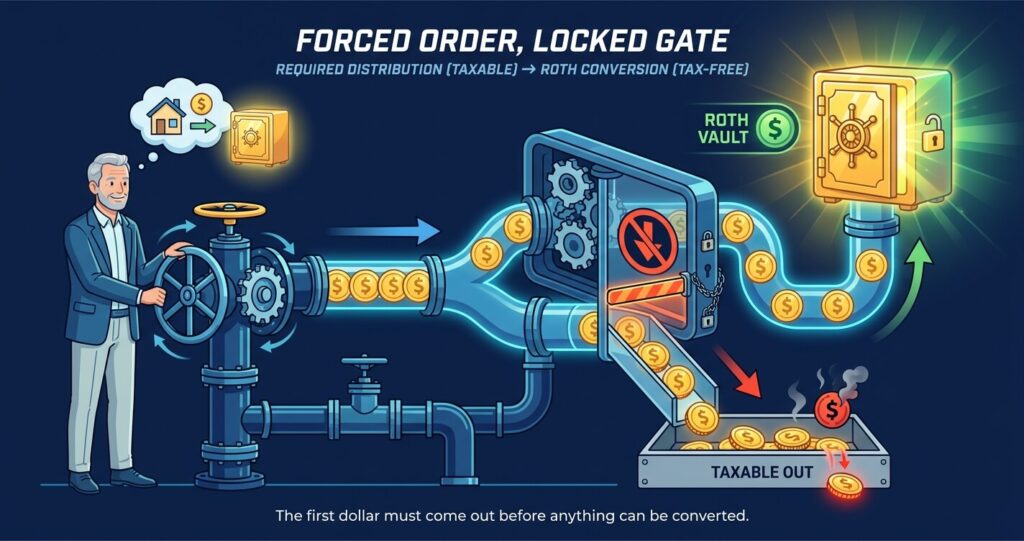
Yes. If you are 73 or older, you must take your full required minimum distribution (RMD) for the year before you convert any money to a Roth IRA. The RMD itself cannot be converted. The IRS treats your first dollars withdrawn from a traditional IRA in an RMD year as satisfying the RMD, so a conversion done before you take the RMD does not count and creates an excess contribution problem. Understanding the rules around an RMD before Roth conversion keeps you out of penalty territory and protects the tax efficiency of the conversion itself.
Key Takeaways
- If you are RMD-age, take your full RMD first; the RMD amount cannot be rolled into a Roth.
- The RMD age is 73 for anyone reaching that age between 2023 and 2032, rising to 75 in 2033.
- The annual RMD deadline is December 31; your very first RMD can be delayed to April 1 of the following year.
- Missing an RMD triggers a 25% excise tax, reduced to 10% if corrected promptly.
- Converting only after the RMD is satisfied lets you control your tax bracket without breaking the rules.
About the Author: Jeff Judge, CFP®, AEP®, ChFC®, CLU® is Managing Partner of Chesapeake Financial Planners in Forest Hill, Maryland. He has been helping families and business owners in Harford County and the Baltimore metro area navigate RMD and Roth conversion decisions since earning his CFP® certification in 2013, by using Chesapeake Financial Planners’ signature process, the R.U.D.D.E.R. method™. Jeff has watched more than one client try to convert in January and forget the RMD entirely, which turns a smart tax move into a paperwork mess that takes months to unwind.
Why does the RMD have to come out before a Roth conversion?
The rule comes down to ordering. The IRS uses a "first dollars out" principle: in any year you owe an RMD, the first money you withdraw from that traditional IRA counts toward satisfying the RMD until the full amount is met. A Roth conversion is technically a distribution followed by a rollover into a Roth. Since an RMD is never eligible to be rolled over, the IRS does not let you convert those first dollars.
If you convert before taking the RMD, the converted amount that should have covered the RMD becomes an excess contribution to your Roth IRA. That triggers a 6% excise tax each year the excess stays in the account, plus the hassle of removing it. Jeff Judge tells clients to think of the RMD as a toll you pay before the conversion road opens. You cannot skip the toll booth.
The simplest sequence: take the full RMD as a cash distribution first, let it settle, then convert whatever additional amount makes sense for your tax situation. Doing this in the right order is far cheaper than fixing it later. For a deeper look at sequencing tax moves across the year, see our year-round tax planning calendar.
What is a year-round tax planning calendar for retirees and pre-retirees?
What is the RMD age in 2026 and when did it change?
The RMD age is 73 in 2026. Under the SECURE 2.0 Act, anyone who reaches age 73 between 2023 and 2032 begins RMDs at 73. Starting in 2033, the age rises to 75. This is a meaningful change from the old rules, where the trigger age was 70½ and later 72.
According to the IRS, required minimum distributions generally must begin once you reach your applicable RMD age. The shift to 73 (and eventually 75) matters for conversion planning because it widens the pre-RMD window, the stretch of years between retirement and your first forced distribution. That window is often the best time to do larger Roth conversions, before RMDs push up your taxable income. Jeff Judge notes: "The years between retirement and your first RMD are often the most valuable window we have for Roth conversions, because once required distributions start layering onto your income, every dollar you convert is competing with dollars you had no choice but to recognize."
If you are in your 60s and not yet subject to RMDs, you have flexibility most people overlook. You can convert aggressively in low-income years without the RMD complicating the math. Once RMDs start, every conversion sits on top of income you are already required to recognize.
How do you use the years between retirement and RMDs to reduce lifetime taxes?
When is the RMD deadline, and what about my first year?
The annual RMD deadline is December 31. You must withdraw your full RMD by year-end every year you are subject to one. Miss it, and you face the excise tax. There is one exception for your very first RMD.
For the year you first turn 73, the IRS gives you until April 1 of the following year to take that initial RMD. This is the "required beginning date." It sounds generous, but it carries a trap. If you delay your first RMD to April 1, you still owe your second RMD by December 31 of that same year. That stacks two RMDs into one tax year and can push you into a higher bracket.
Jeff often advises clients to take the first RMD in the year they turn 73 rather than deferring it, precisely to avoid the double-distribution squeeze. The deferral helps only in narrow cases, usually when the following year's income will be much lower. For most retirees, spreading the income across two separate years keeps the marginal rate down.
How does taking the RMD first affect my conversion strategy?
Once the RMD is satisfied, the conversion question becomes a bracket-management exercise. The RMD already raised your taxable income for the year, so any conversion stacks on top of it. The goal is to convert up to the top of a target tax bracket without spilling into the next one.
Here is a simplified look at how the two interact:
| Step | Action | Tax effect |
|---|---|---|
| 1 | Take full RMD as cash | RMD amount added to ordinary income |
| 2 | Measure remaining room in target bracket | Determines safe conversion size |
| 3 | Convert up to that ceiling | Converted amount taxed at the target rate |
| 4 | Stop before crossing into the next bracket | Avoids a higher marginal rate |
The 2026 federal income tax brackets remain at seven rates topping out at 37%, per the IRS. Knowing your effective and marginal rates is essential here. A conversion is only worth doing if the rate you pay today is lower than the rate you expect later.
What Is the Difference Between Marginal and Effective Tax Rate?
Watch two ripple effects. A larger combined income (RMD plus conversion) can raise your Medicare Part B and Part D premiums through IRMAA two years down the road, and it can increase the share of your Social Security benefits subject to tax. Both are reasons to convert deliberately rather than in one giant move.
What happens if I convert before taking my RMD by mistake?
If you accidentally convert RMD dollars, the amount that should have satisfied the RMD becomes an excess contribution to your Roth IRA. You generally have two fixes. You can withdraw the excess (plus any earnings) before your tax filing deadline including extensions, or you can pay the 6% excise tax for each year the excess remains and remove it later.
The RMD obligation still stands either way. You must still take and report the RMD as a taxable distribution. The conversion error does not erase the requirement. According to the IRS, failing to take a full RMD triggers a 25% excise tax on the shortfall, which drops to 10% if you correct it within the correction window and file Form 5329.
This is exactly the kind of avoidable mistake Jeff Judge sees when people DIY a conversion in early January without checking the RMD box first. The fix is doable, but it costs time and sometimes money. Order the steps correctly and you skip the whole problem.
How can I potentially optimize my taxes as my income grows?
Frequently Asked Questions
Can I convert my RMD to a Roth IRA?
No, you cannot convert your RMD to a Roth IRA. The IRS does not allow required minimum distributions to be rolled over or converted. The RMD must be taken as a taxable distribution first. Only amounts above and beyond your RMD are eligible to convert to a Roth in that year.
What is the RMD age under SECURE 2.0?
Under the SECURE 2.0 Act, the RMD age is 73 for anyone reaching that age between 2023 and 2032. It rises to 75 starting in 2033. This replaced the older trigger ages of 70½ and 72, giving retirees a longer pre-RMD window to plan Roth conversions and manage taxable income.
When is the deadline to take my RMD each year?
The annual RMD deadline is December 31. You must withdraw the full amount by year-end every year you are subject to an RMD. Your very first RMD is an exception: you may delay it until April 1 of the year after you turn 73, though doing so stacks two RMDs into one tax year.
What is the penalty for missing an RMD?
The penalty for missing an RMD is a 25% excise tax on the amount you failed to withdraw, under SECURE 2.0. If you correct the shortfall promptly and file Form 5329 within the correction window, the IRS reduces the penalty to 10%. The missed RMD must still be taken and reported.
Should I take my RMD as cash or have it withheld for taxes?
Either works, and the right choice depends on your tax plan. Many retirees use RMD withholding as a convenient way to cover their full-year tax bill, since withholding is treated as paid evenly across the year. Others take the RMD as cash and pay quarterly estimates. Coordinate this with any conversion to avoid an underpayment penalty.
Does a Roth conversion count toward my RMD?
No, a Roth conversion does not count toward your RMD. The RMD and the conversion are separate transactions. You must satisfy the RMD with a regular taxable distribution first, then any additional amount you convert is taxed but does not reduce your RMD obligation for that year.
Take the next step
A clean Roth conversion starts with getting the RMD order right, but the bigger win comes from planning the whole sequence years in advance. If you want a framework for timing conversions around your RMDs and your tax brackets, our Pre-RMD Window planning guide walks through exactly how to use your 60s and early 70s to cut your lifetime tax bill. Download it at chesapeakefp.com and see how the right order on an RMD before Roth conversion fits into your larger plan.
How Can I Reduce Taxes When Earning $200K to $500K?
Want to go deeper? Our Roth Conversion Window walks through this step by step.
Disclosures
The information provided is for educational purposes only and should not be construed as investment advice. Investment strategies should be tailored to individual circumstances, risk tolerance, and goals. Past performance doesn't guarantee future results. Consult with qualified financial professionals regarding your specific situation.
Traditional IRA account owners have considerations to make before performing a Roth IRA conversion. These primarily include income tax consequences on the converted amount in the year of conversion, withdrawal limitations from a Roth IRA, and income limitations for future contributions to a Roth IRA. In addition, if you are required to take a required minimum distribution (RMD) in the year you convert, you must do so before converting to a Roth IRA.
A Roth IRA offers tax deferral on any earnings in the account. Qualified withdrawals of earnings from the account are tax-free. Withdrawals of earnings prior to age 59 ½ or prior to the account being opened for 5 years, whichever is later, may result in a 10% IRS penalty tax. Limitations and restrictions may apply.
This information is not intended to be a substitute for specific individualized tax, investment or legal advice. We suggest that you discuss your specific situation with a qualified tax, legal or financial advisor.
Advisors associated with Chesapeake Financial Planners may be either (1) LPL Financial Registered Representatives offering securities through LPL Financial, Member FINRA and SIPC, and investment advisor representatives offering investment advice through Great Valley Advisor Group; or (2) solely investment advisor representatives offering investment advice through Great Valley Advisor Group and not affiliated with LPL Financial. Great Valley Advisor Group, and Chesapeake Financial Planners are separate entities from LPL Financial.


