

Pay Off Mortgage Before Retirement, or Keep Investing?
Last reviewed: July 2026
There is no one-size-fits-all answer to the pay off mortgage before retirement question. The right call depends on four things: your mortgage rate, your cash flow, your taxes, and how much being debt-free matters to you personally. If your rate is low and your savings are healthy, keeping the mortgage and staying invested often wins on the math. If your rate is high, or a payment would strain a fixed retirement income, paying it off can be the smarter move.
Key Takeaways
- Whether to pay off your mortgage before retirement depends on your interest rate, cash flow, taxes, and comfort with debt.
- Paying down a mortgage earns a certain return equal to your interest rate, with none of the market's ups and downs.
- With 30-year mortgage rates near 6.48% in 2026, the math favors payoff more than it did for borrowers locked in at 3%.
- Carrying housing costs into retirement is increasingly common; cost-burdened homeowners 65 and older reached 7.9 million in 2025.
- Avoid draining retirement accounts to pay off a mortgage if it triggers a big tax bill or leaves you cash-poor.
About the Author: Jeff Judge, CFP®, AEP®, ChFC®, CLU® is Managing Partner of Chesapeake Financial Planners in Forest Hill, Maryland. He has been helping pre-retirees in Harford County and the Baltimore metro area make this exact call since earning his CFP® certification in 2013, by using Chesapeake Financial Planners’ signature process, the R.U.D.D.E.R. method™. Jeff has noticed that the spreadsheet answer and the right answer are not always the same, because how a client feels about debt is part of the math, not separate from it.
Pay Off Mortgage Before Retirement: The Core Tradeoff
The whole decision comes down to comparing two numbers: the interest rate on your mortgage and what you could reasonably earn on the money instead. Paying off the mortgage earns you a certain return equal to your interest rate. Investing the money instead might earn more, but those returns are uncertain and can swing with the market.
That is the heart of the mortgage vs invest debate. When mortgage rates were near 3%, the math leaned heavily toward keeping the loan, because even a conservative portfolio could be expected to outpace 3% over time. Today the picture is different. Freddie Mac reports the 30-year fixed averaging 6.48% (as of early 2026; updated weekly), with the 15-year near 5.87%. A 6.48% return with no market risk is a high bar to clear, which is why payoff looks more attractive for newer, higher-rate mortgages than it did a few years ago.
When Does Paying Off Your Mortgage Make Sense?
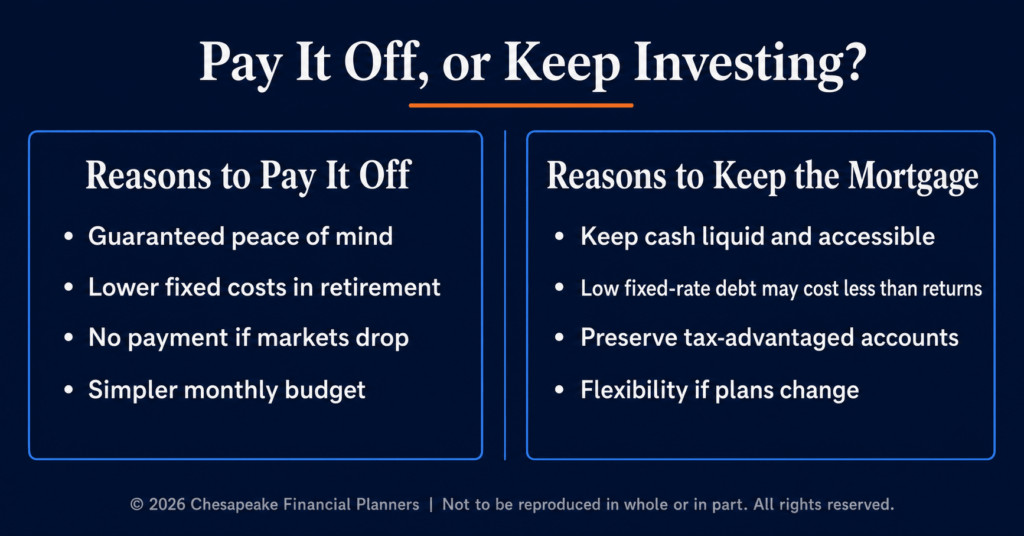
Paying off the mortgage before retirement makes the most sense in a few clear situations. The first is a high interest rate, since clearing a 6% or 7% loan is the equivalent of earning that rate with certainty. The second is a tight retirement budget, where eliminating the single largest fixed payment dramatically lowers the income you need to generate, and the income you need to withdraw and pay tax on.
It also fits people who are simply uncomfortable carrying debt into retirement. That comfort is real and worth weighing, not dismissing. Owning your home outright removes a major worry and shrinks your required cash flow if markets fall. With cost-burdened homeowners 65 and older reaching 7.9 million in 2025, according to the Harvard Joint Center for Housing Studies, a smaller fixed housing cost is genuinely valuable for many retirees on fixed incomes.
When Does Keeping the Mortgage Make More Sense?
Keeping the mortgage tends to win when your rate is low and your money has better places to be. If you locked in a sub-4% mortgage, that debt is cheap, and paying it off early means giving up the chance to keep that money invested or simply liquid. Liquidity itself is the underrated factor here: once you put cash into your home, getting it back out requires selling or borrowing against it.
There is also the tax trap to avoid. Pulling a large sum from a traditional 401(k) or IRA to pay off a mortgage can spike your taxable income for the year, pushing you into a higher bracket and even raising your Medicare premiums. Our What Is the Difference Between Marginal and Effective Tax Rate? explainer shows how a big withdrawal can cost more in tax than the mortgage interest it eliminates. For many, the smartest mortgage payoff retirement plan keeps the loan rather than triggering that bill, and instead directs cash flow toward the balance gradually.
How Do You Decide? A Practical Framework
Start by writing down your mortgage rate and comparing it honestly to what you can earn on low-risk money today. If your rate is meaningfully higher than low-risk yields, lean toward payoff; if it is lower, lean toward keeping it. Then layer in three checks: Do you have enough liquid savings outside retirement accounts, the kind our How Much Cash to Keep: What Belongs Outside Your Emergency Fund? guide covers, to pay it off without going cash-poor? Would the payoff create a large tax bill? And how much does being debt-free matter to you, honestly?
Jeff Judge often suggests a middle path that gets overlooked: a partial payoff or a recast, where you pay down a chunk and ask the lender to re-amortize the loan, lowering the payment without refinancing at today's higher rates. That can cut the fixed cost in retirement while keeping a healthy cash reserve intact. Whatever you choose, the worst version of this decision is emptying your investment and emergency savings to own the house outright, then having no cushion left for a surprise.
Frequently Asked Questions
Should I pay off my mortgage before retirement?
It depends on your rate, savings, and taxes. Paying off your mortgage makes sense if the rate is high, a payment would strain your retirement budget, or you strongly prefer being debt-free. Keeping it can be better if your rate is low, you would drain savings to do it, or a large account withdrawal would trigger a significant tax bill.
Is it better to pay off a mortgage or invest?
It depends on your mortgage rate versus your expected return. Paying off the mortgage delivers a certain return equal to your interest rate, while investing offers higher potential returns that are not guaranteed. When your rate is high, like the 6.48% average in 2026, payoff is a strong, low-risk choice; when it is low, investing the money often comes out ahead over time.
Should I use my 401(k) to pay off my mortgage?
Usually not in one large withdrawal. Pulling a big sum from a traditional 401(k) or IRA is taxed as ordinary income, which can push you into a higher bracket and raise Medicare premiums, often costing more than the mortgage interest you save. If you want to pay it down, doing so gradually or from taxable savings is generally far more tax-efficient.
Does paying off your mortgage hurt your taxes?
It can slightly reduce a deduction, but for most people the effect is small. Since the standard deduction is high, the majority of homeowners no longer itemize and get no benefit from the mortgage interest deduction anyway. The bigger tax issue is usually the opposite: a large retirement account withdrawal to fund the payoff can create a far costlier tax bill.
What is the downside of paying off your mortgage early?
The main downside is liquidity. Money used to pay off the house is locked in the walls, and getting it back requires selling the home or taking out a new loan. Paying off the mortgage can also mean giving up potential investment growth on that money, especially if your interest rate is low relative to what you could earn with little risk.
So when you weigh whether to pay off mortgage before retirement, treat it as both a math problem and a comfort problem. Compare your rate to low-risk returns, protect your liquidity and your tax picture, and give real weight to how debt makes you feel. If you want a simple framework for coordinating debt, income, and retirement, our What are the fundamentals of personal financial planning? walks through it step by step. Download it at chesapeakefp.com.
Want to go deeper? Our 10 Signs You're Ready for a Certified Financial Planner walks through this step by step.
This material is for educational purposes only and should not be considered tax or legal advice. Please consult with your tax advisor or attorney regarding your specific situation.
The opinions voiced in this material are for general information only and are not intended to provide specific advice or recommendations for any individual.
All investing involves risk including loss of principal. No strategy assures success or protects against loss.
There is no guarantee that a diversified portfolio will enhance overall returns or outperform a non-diversified portfolio. Diversification does not protect against market risk.
Disclosures
The information provided is for educational purposes only and should not be construed as investment advice. Investment strategies should be tailored to individual circumstances, risk tolerance, and goals. Past performance doesn't guarantee future results. Consult with qualified financial professionals regarding your specific situation.
Advisors associated with Chesapeake Financial Planners may be either (1) LPL Financial Registered Representatives offering securities through LPL Financial, Member FINRA and SIPC, and investment advisor representatives offering investment advice through Great Valley Advisor Group; or (2) solely investment advisor representatives offering investment advice through Great Valley Advisor Group and not affiliated with LPL Financial. Great Valley Advisor Group, and Chesapeake Financial Planners are separate entities from LPL Financial.


