

Should I Update My Financial Plan After a Big Life Event?
Last reviewed: July 2026
Yes, you should update your financial plan after a big life event, and ideally before you make any major decisions tied to that event. A marriage, business sale, inheritance, or death of a spouse changes the assumptions your original plan was built on, which means the plan stops working the moment those facts change. The faster you update financial plan details after a life event, the fewer expensive mistakes you make while the dust is still settling.
Key Takeaways
- Update your financial plan after any event that changes your income, assets, family structure, or tax situation.
- The federal estate and gift tax exemption rose to $15 million per individual in 2026, reshaping inheritance and business-sale planning.
- Update beneficiary designations immediately after marriage, divorce, or a death, because they override your will.
- Plan before a business sale or liquidity event, not after, to capture tax strategies that disappear at closing.
About the Author: Jeff Judge, CFP®, AEP®, ChFC®, CLU® is Managing Partner of Chesapeake Financial Planners in Forest Hill, Maryland. He has been helping families and business owners in Harford County and the Baltimore metro area navigate major financial transitions since earning his CFP® certification in 2013, by using Chesapeake Financial Planners’ signature process, the R.U.D.D.E.R. method™. Jeff has watched too many people treat a financial plan as a one-time document instead of a living one, and the cost of that mistake almost always shows up at tax time.
Why Does a Big Life Event Require Updating Your Financial Plan?
A financial plan is a set of assumptions wearing a suit. Your income, your expenses, your family structure, your business ownership, your risk tolerance, your timeline. When a major life event changes even one of those variables, the plan built around the old version stops being accurate. You don't notice right away. That's the dangerous part.
Think about what actually shifts. A marriage merges two separate financial lives, two tax situations, two sets of beneficiary forms. A business sale turns an illiquid asset into a pile of cash and erases your income source in the same afternoon. An inheritance grows your asset base and can pull you into estate-tax territory you never considered. A spouse's death can cut household income while creating a sudden liquidity event from life insurance or estate proceeds.
Continuing to follow an outdated plan is like driving across the state with last decade's map. You'll arrive somewhere. Probably not where you meant to go. Jeff Judge often tells clients that the plan isn't the binder on the shelf; it's the set of decisions you make when something changes, and those decisions are only as good as the information behind them.
This is why Chesapeake Financial Planners built the R.U.D.D.E.R. Method™, our six-step planning process: Review and Recognize, Uncover and Understand, Design and Develop, Discuss and Decide, Execute and Empower, and Reassess and Refine. That last step, Reassess and Refine, exists precisely because life events keep happening and a plan that never gets revisited quietly becomes wrong.
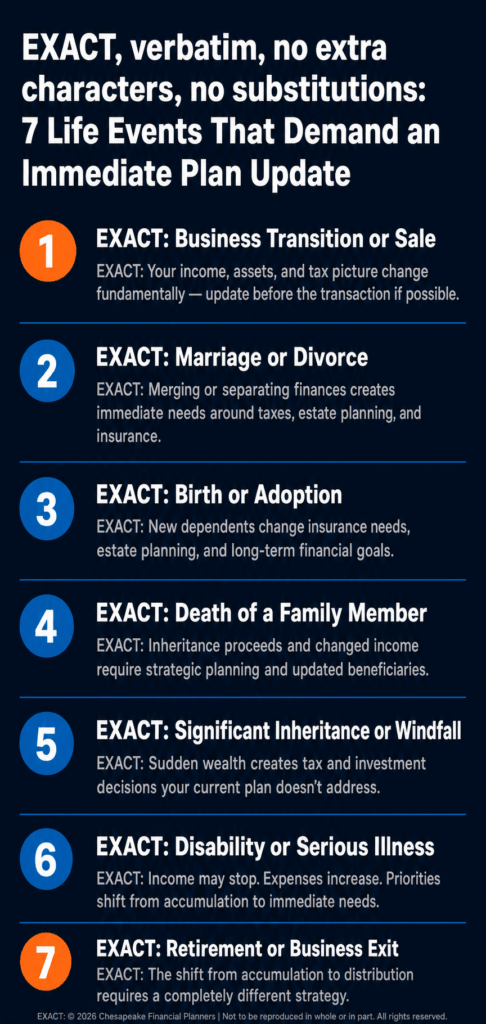
Which Life Events Demand an Immediate Financial Plan Update?
Not every change requires a full overhaul. A modest raise or a lateral job move within the same industry might only need a tune-up. But some events reset the board entirely, and these call for a comprehensive review of your financial plan:
- Business sale or transition. Selling, gifting to family, or closing a business reshapes your entire financial life. Update your plan before the transaction, not after, because the best tax strategies live on the front side of a closing.
- Marriage or divorce. Merging or splitting finances creates immediate needs around taxes, estate documents, insurance, and asset ownership.
- Birth or adoption. A new dependent changes insurance coverage, estate planning, and education funding goals overnight.
- Death of a spouse or family member. Income, beneficiary designations, and lifestyle expectations all shift at once.
- Inheritance or windfall. Sudden money creates tax opportunities and investment decisions your current plan never anticipated. The IRS reports the annual gift tax exclusion rose to $19,000 per recipient in 2026, which matters when you decide how to share new wealth.
- Disability or serious illness. Income may drop while expenses climb, pushing priorities toward immediate needs.
- Retirement or business exit. Moving from accumulation to distribution requires a different approach to taxes, allocation, and income.
If any of these happened in the past 12 months and your plan hasn't changed, you're steering with old information. According to the Bureau of Labor Statistics, millions of Americans change jobs and family circumstances every year, and each shift carries financial consequences that a static plan simply can't absorb.
What Should an Updated Financial Plan Actually Address?
Updating a plan isn't editing a few cells in a spreadsheet. It's reassessing your whole situation through the lens of the new reality. What that looks like depends on the event.
If you sold a business, you face an immediate tax bill and a once-in-a-career planning window. Should you fund charitable giving in a high-income year? How do you reinvest assets that were locked inside one company for decades? How do you replace the income the business used to produce? Your estate just grew, possibly past the 2026 federal estate tax exemption of $15 million per individual, so trusts and gifting may now be on the table when they never were before.
If you got married, update every beneficiary designation across retirement accounts, life insurance, and bank accounts. Decide whether to file jointly. Coordinate insurance so each spouse is protected, and align the goals you're now chasing together rather than apart.
If you received an inheritance, the planning hinges on what you inherited. Cash, appreciated stock, real estate, and inherited retirement accounts each carry different tax treatment. Under current rules, most non-spouse beneficiaries of an inherited IRA must empty it within 10 years, per IRS guidance, which can stack income into your highest-earning years if you're not careful.
The pattern Jeff sees most often is people reacting to the windfall before they've mapped the tax cost. The money feels permanent. The tax bill is what turns out to be permanent if you move too fast. For a deeper walkthrough, see What should you do when you suddenly receive a large sum of money? and What should I do with money I inherited from a relative?.
How Do You Update a Financial Plan Without Missing Anything?
Treat the update as a process, not a series of one-off reactions. First, document what changed: new income, lost income, new assets, changed expenses, a different family structure. Write it all down before you decide anything.
Second, reassess your goals. A business owner who just sold may shift from "grow wealth" to "preserve it and generate income." A newly married couple may need to merge two retirement timelines into one. Third, redesign the strategies, tax planning, investment allocation, insurance, and estate documents, so they match the new goals. Then execute, and put a date on the calendar to review again.
This is also the moment to loop in the rest of your team. A CFP® professional, a tax advisor, and an estate attorney working from the same updated facts will catch things any one of them would miss alone. If your event was a liquidity event, What happens to my finances after a liquidity event? covers the sequencing in detail.
Frequently Asked Questions
How soon should I update my financial plan after a major life event?
Update your financial plan as soon as possible, ideally before you make irreversible decisions tied to the event. For a business sale or windfall, that means planning before the transaction closes. For a marriage, death, or inheritance, aim to review within the first 30 to 90 days while strategies are still available.
Does getting married really require a full financial plan review?
Yes. Marriage merges two incomes, two tax situations, and two sets of beneficiary forms, which affects your tax bracket, insurance needs, and estate documents. Update beneficiary designations first, decide on a filing status, and align your shared goals. Skipping this step often leaves an ex-partner or parent listed on accounts.
What financial planning matters most after selling a business?
After a business sale, immediate tax planning matters most because the largest opportunities expire at closing. You also need an investment strategy for newly liquid assets, an income replacement plan, and updated estate documents, since your estate may now exceed the 2026 federal exemption of $15 million per individual and require trusts or gifting strategies.
How does an inheritance change my financial plan?
An inheritance changes your asset base, tax exposure, and sometimes your timeline for major goals. The planning depends on what you inherited, since cash, appreciated stock, and inherited retirement accounts each carry different tax rules. Many non-spouse IRA beneficiaries must withdraw the full balance within 10 years, which can spike your taxable income.
Do I need a financial advisor to update my plan, or can I do it myself?
You can handle minor updates yourself, but major life events usually warrant professional help because the tax and estate consequences are easy to miss. A financial planner coordinates your tax advisor and estate attorney around one updated set of facts, which catches gaps and timing issues a do-it-yourself approach typically overlooks during an already stressful period.
Where to Start
If you've had a major life event in the past year and your plan hasn't caught up, you're making decisions on outdated assumptions, and the cost of that gap usually surfaces at tax time. At Chesapeake Financial Planners, we work through these transitions with clients every week, from business sales to marriages to inheritances. If you're weighing one of these decisions, a second opinion costs you nothing. Visit chesapeakefp.com to learn more.
Want to go deeper? Our Life Transition Planning Kit Workbook walks through this step by step.
Disclosures
The information provided is for educational purposes only and should not be construed as investment advice. Investment strategies should be tailored to individual circumstances, risk tolerance, and goals. Past performance doesn't guarantee future results. Consult with qualified financial professionals regarding your specific situation.
Advisors associated with Chesapeake Financial Planners may be either (1) LPL Financial Registered Representatives offering securities through LPL Financial, Member FINRA and SIPC, and investment advisor representatives offering investment advice through Great Valley Advisor Group; or (2) solely investment advisor representatives offering investment advice through Great Valley Advisor Group and not affiliated with LPL Financial. Great Valley Advisor Group, and Chesapeake Financial Planners are separate entities from LPL Financial.


