

How Often Should I Meet With My Financial Planner?
Last reviewed: July 2026
Most people should meet with their financial planner two to four times per year once their plan is up and running, with more frequent meetings during the first six months and after major life events. The right number depends on how complex your finances are, what life stage you're in, and whether you're actively building a plan or maintaining one. There is no universal answer, but understanding what drives meeting frequency helps you get real value from the relationship instead of paying for check-ins you don't need.
Key Takeaways
- Most established clients meet with a financial planner two to four times per year, with more meetings early in the relationship.
- The first three to six months usually require monthly or bi-monthly meetings to build and implement your plan.
- Complex situations, including business owners, often justify quarterly meetings rather than annual ones.
- The IRS 2026 401(k) contribution limit rose to $24,500, making annual contribution reviews worthwhile.
- Major life events should trigger an immediate meeting, not a wait for the next scheduled review.
About the Author: Jeff Judge, CFP®, AEP®, ChFC®, CLU® is Managing Partner of Chesapeake Financial Planners in Forest Hill, Maryland. He has been helping families and business owners in Harford County and the Baltimore metro area navigate financial planning relationships since earning his CFP® certification in 2013, by using Chesapeake Financial Planners’ signature process, the R.U.D.D.E.R. method™. Jeff finds that the clients who get the most out of planning aren't the ones who meet most often, but the ones who meet at the right moments.
How Often Should You Meet With a Financial Planner?
When you first start to meet with a financial planner, expect more frequent contact. The opening phase usually runs monthly or every six to eight weeks for the first three to six months. That stretch covers gathering your full financial picture, setting goals, building the plan, presenting recommendations, and implementing them. It's intensive on purpose. A planner can't give you good advice until they actually understand your situation.
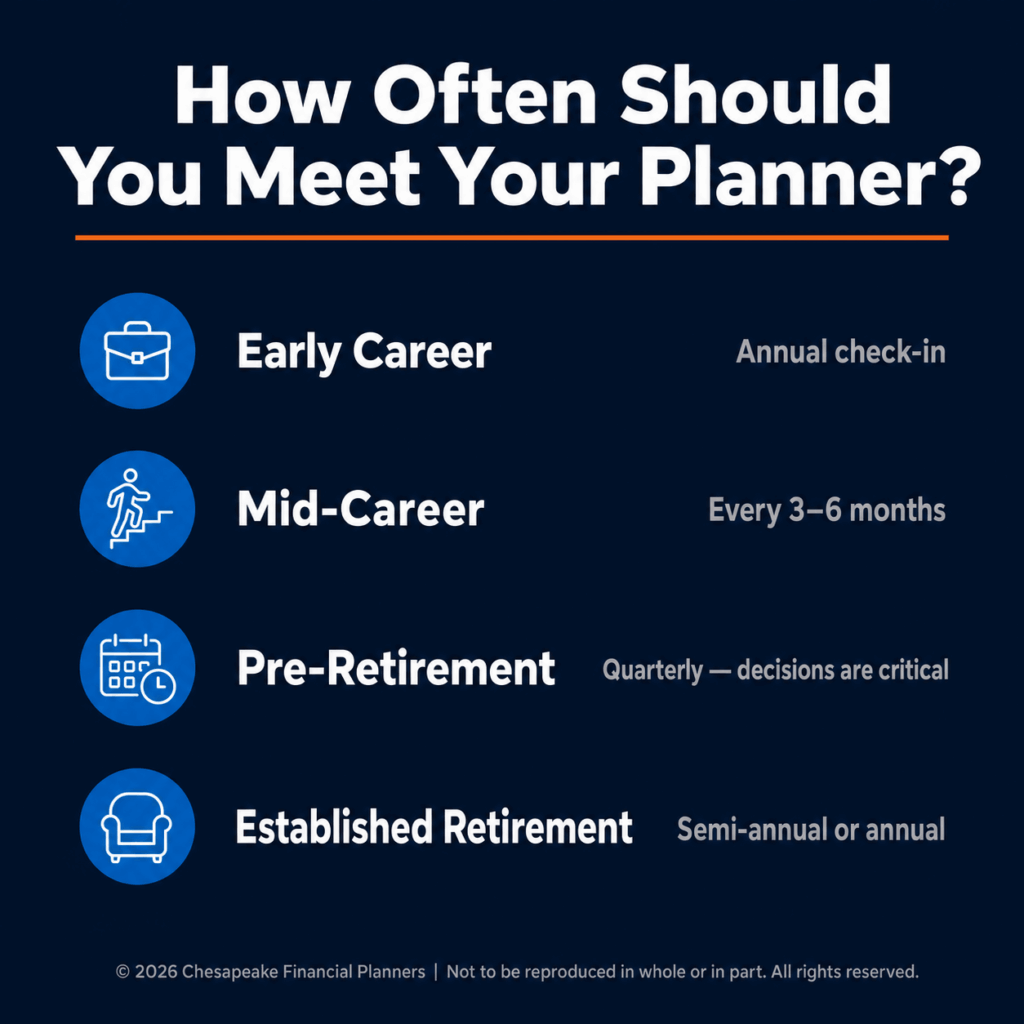
After your plan is built and implemented, most clients settle into two to four meetings a year:
- Quarterly (4x per year): Common for business owners, high-net-worth households, concentrated stock positions, or anyone who values close coordination.
- Semi-annual (2x per year): Typical for established clients with moderate complexity and a stable situation.
- Annual (1x per year): Reasonable for younger clients with simple finances and long time horizons.
According to the CFP Board, comprehensive financial planning is an ongoing process rather than a one-time event, which is why most planners recommend a minimum of one formal review each year. Jeff Judge often tells clients that an annual meeting is the floor, not the goal. Skip it entirely and your plan quietly drifts out of alignment with your life.
This is also where the R.U.D.D.E.R. Method™ matters. The R.U.D.D.E.R. Method™ is Chesapeake Financial Planners' six-step planning process: Review and Recognize, Uncover and Understand, Design and Develop, Discuss and Decide, Execute and Empower, and Reassess and Refine. That final step, Reassess and Refine, is exactly what regular meetings accomplish.
What Determines the Right Meeting Frequency for You?
Four factors decide how often you should sit down with your advisor, and they often pull in different directions.
Complexity. Business owners, households with multiple properties, trust structures, or concentrated equity positions generally need more frequent meetings. Complex situations move fast and require active coordination across tax, investment, and estate decisions. A planner managing a business exit strategy can't do that on an annual cadence. Jeff Judge notes: "A business owner coordinating a sale, a trust structure, and concentrated equity positions simply cannot keep all of those moving parts aligned on an annual meeting schedule, because the decisions that cost the most when missed rarely wait twelve months to surface."
Life stage. A 32-year-old with a steady salary and a 401(k) may genuinely only need one meeting a year. Pre-retirees and retirees usually need more, because they're juggling Social Security timing, Medicare enrollment, withdrawal sequencing, and estate updates all at once. The decisions get denser as you approach and enter retirement.
Your preferences. Some people find comfort in regular contact. Others want a hands-off relationship and only meet when something changes. Neither is wrong. Tell your advisor which one you are so the relationship is built around how you actually operate.
Whether you're planning or maintaining. If you're in the middle of a specific project, like a large Roth conversion sequence or restructuring your estate, you'll meet more often during that window and then dial it back once it's done. Frequency should follow the work, not a rigid calendar.
A practical example: the IRS raised the 2026 IRA contribution limit to $7,500 and the 401(k) employee limit to $24,500. Those numbers change most years, and an annual review is the natural place to make sure you're capturing the full contribution room you're entitled to.
Should I update my financial plan after a big life event?
What Should Happen During Each Meeting?
A good meeting is more than a portfolio update. It should move you toward a decision or confirm you're still on track. Expect your planner to cover several areas.
Your advisor reviews investment performance, asset allocation, and whether your portfolio still matches your target. They flag rebalancing needs and tax-loss harvesting opportunities. Then they look at progress toward goals: Are you on pace to retire when you want? Is your emergency fund adequate? Are education savings sufficient?
Tax planning is where many meetings earn their keep. Roth conversion timing, charitable giving strategy, and estimated payments all get discussed, ideally in coordination with your CPA. You'll also share what's changed in your life so the plan reflects your current reality, not the version from two years ago.
Jeff has watched clients treat reviews as a formality and then wonder why their plan never adapts. The meetings that matter are the ones where something actually gets decided.
Why Does a Financial Planning Process Matter More Than Investment Selection?
When Should You Meet Outside the Regular Schedule?
Scheduled reviews are the backbone, but they aren't the whole relationship. You should be able to reach your advisor when life shifts. Job changes, a business sale, a sizable bonus, an inheritance, marriage, divorce, a new child, a home purchase, a health event, or market turbulence that's keeping you up at night all warrant a conversation. Good advisors make themselves available for these without making you wait for the next quarterly slot.
What should I do with my 401(k) when I change jobs?
Frequently Asked Questions
How often should I meet with my financial planner each year?
Most established clients meet with their financial planner two to four times per year once the plan is built and implemented. Business owners and high-net-worth households often choose quarterly meetings, while clients with simpler finances may only need one or two annual reviews to stay on track.
How often should I meet with a financial advisor in the first year?
In the first three to six months you should meet more frequently, usually monthly or every six to eight weeks. This intensive period covers gathering your financial information, setting goals, building the plan, and implementing recommendations. After the first year, most clients settle into two to four meetings annually based on complexity and preference.
Is one annual meeting with a financial planner enough?
One annual meeting is the minimum most planners recommend, and it works for clients with simple, stable finances and long time horizons. For business owners, pre-retirees, or anyone with concentrated holdings or active tax strategies, a single yearly meeting often isn't enough to keep the plan aligned with a changing situation.
Should I have quarterly financial reviews?
Quarterly financial reviews make sense for complex situations, including business owners, high-net-worth households, concentrated stock positions, and anyone coordinating active tax strategies. If your finances are straightforward and stable, quarterly meetings may exceed what you actually need, and semi-annual or annual reviews can deliver the same value at lower cost.
When should I meet with my financial advisor outside of scheduled reviews?
You should meet with your financial advisor whenever a major life event occurs, including job changes, a business sale, inheritance, marriage, divorce, a new child, a home purchase, or a serious health issue. Significant market volatility that worries you also warrants a conversation rather than waiting for the next scheduled review.
Ready to Build the Right Meeting Rhythm?
The right frequency to meet with a financial planner is the one that matches your complexity, your stage of life, and the work in front of you. At Chesapeake Financial Planners, Jeff Judge and the team serve families and business owners across Harford County and the Baltimore metro area, and we build the cadence around your situation rather than a fixed template. Schedule a free fit call at chesapeakefp.com to talk through what makes sense for you.
Disclosures
The information provided is for educational purposes only and should not be construed as investment advice. Investment strategies should be tailored to individual circumstances, risk tolerance, and goals. Past performance doesn't guarantee future results. Consult with qualified financial professionals regarding your specific situation.
Advisors associated with Chesapeake Financial Planners may be either (1) LPL Financial Registered Representatives offering securities through LPL Financial, Member FINRA and SIPC, and investment advisor representatives offering investment advice through Great Valley Advisor Group; or (2) solely investment advisor representatives offering investment advice through Great Valley Advisor Group and not affiliated with LPL Financial. Great Valley Advisor Group, and Chesapeake Financial Planners are separate entities from LPL Financial.


