

What should I do about a concentrated stock position?
Last reviewed: July 2026
If a single stock dominates your portfolio, you should build a deliberate plan to diversify over time in a tax-smart way, rather than either ignoring the risk or selling everything at once. A concentrated position, often the very investment that built your wealth, exposes you to the failure of one company, and when that stock is your employer's, your income and your savings ride on the same business. The goal is not to abandon a winner overnight but to reduce the risk methodically while managing the tax bill that diversification can trigger.
Key Takeaways
- A concentrated stock position ties too much of your wealth to one company, exposing you to company-specific risk a diversified portfolio avoids.
- Employer stock is doubly risky, because your paycheck and your savings depend on the same company.
- You can diversify without a single massive tax hit using systematic selling, charitable tools, hedging, or exchange funds.
- Diversification does not ensure a profit or protect against loss, but it spreads risk so no one company can sink you.
About the Author: Jeff Judge, CFP®, AEP®, ChFC®, CLU® is Managing Partner of Chesapeake Financial Planners in Forest Hill, Maryland. He has helped executives and entrepreneurs across Harford County and the Baltimore area unwind concentrated positions tax-efficiently since earning his CFP® certification in 2013, by using Chesapeake Financial Planners’ signature process, the R.U.D.D.E.R. method™. Jeff's view: the hardest part of a concentrated position is rarely the math, it's the attachment, because the stock that made you wealthy feels like a friend, and friends are hard to sell even when they have become a risk.
Why do concentrated stock positions happen?
Concentrated stock positions usually happen as a byproduct of success, not reckless investing, which is part of what makes them so hard to address. The stock did exactly what you hoped, and that very success created a new risk.
There are a handful of common paths to concentration. Equity compensation, options, restricted stock units, and employee stock purchase plans, leaves employees and executives at successful companies holding large stakes. Founders and early employees watch a small equity position grow enormous as the company succeeds. Some people inherit a large holding a parent or grandparent owned for decades. A liquidity event like a business sale or IPO can leave a single dominant position, sometimes one that an SEC lockup agreement keeps you from selling for around 180 days. And sometimes an investment made years ago simply grows so much that it comes to dwarf everything else without a single additional purchase.
In every case the stock went up, which is the good news and the trap at once. The position represents real, earned wealth, and that emotional weight, gratitude, loyalty, the fear of selling a winner, is exactly what makes people hold on past the point of prudence. Recognizing how you got here is the first step to deciding what to do next.
Why are concentrated positions so risky?
Concentrated positions are risky because they tie a disproportionate share of your wealth to the fate of one company, with no cushion if that company stumbles. Even excellent companies face setbacks, and concentration removes the safety net diversification provides.
The core danger is company-specific risk. Leadership changes, product failures, regulatory trouble, new competition, or simply bad timing can sink a single stock, and history is full of once-blue-chip names, Enron, Lehman Brothers, and a sharply diminished General Electric among them, that were considered safe right up until they were not. When one stock is most of your net worth, a 30% decline in that stock is roughly a 30% decline in your wealth, with nothing else to offset it. Diversification is precisely the tool that prevents this. As the SEC's investor.gov explains, "The strategy involves spreading your money among various investments in the hope that if one loses money, the others will make up for those losses," though it does not guarantee a profit or protect against loss in a declining market. Jeff Judge notes: "I've sat with clients who held a stock through a 60% decline because they worked there for twenty years and couldn't separate their professional loyalty from a sound financial decision, and that emotional attachment is exactly what concentration risk exploits."
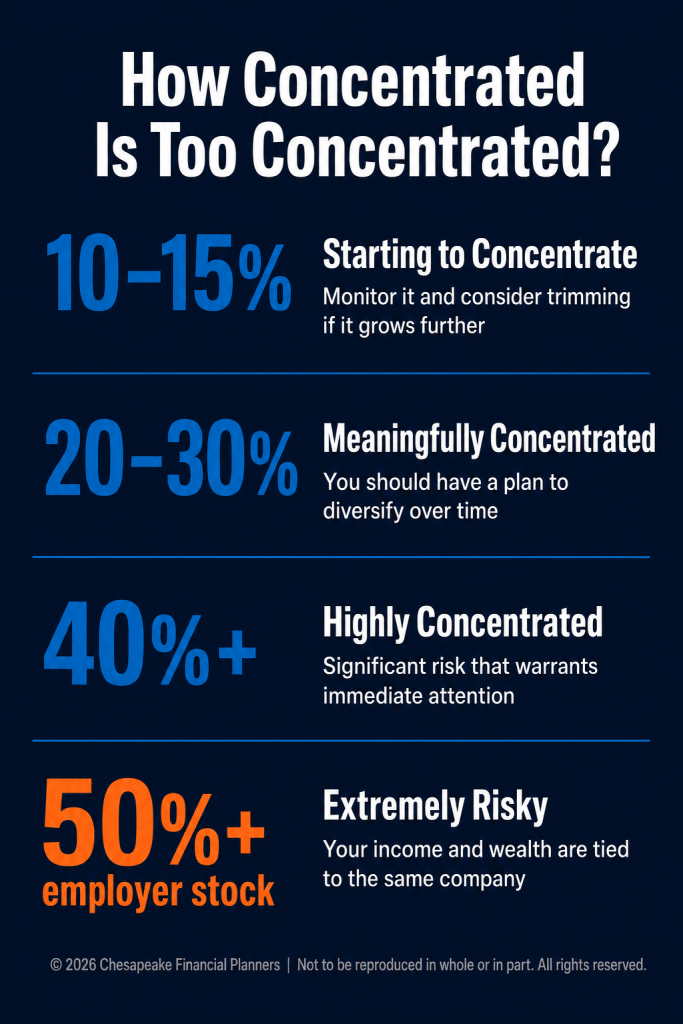
Two risks deserve special mention. If the concentrated stock is your employer's, you face correlation risk: a downturn at the company can cost you your job and tank your savings at the same time, which is not theoretical but a regular feature of economic downturns. And emotional decision-making compounds everything, because a stock that large is hard to view objectively, so people hold out of loyalty or sentiment when a clear-eyed plan would say otherwise. As a rough guide, a position is starting to concentrate around 10 to 15% of a portfolio, is meaningfully concentrated at 20 to 30%, and warrants urgent attention above 40%, or above 50% in employer stock.
How can you diversify without a huge tax bill?
You can diversify a concentrated position without a single massive tax hit by spreading the work across years and using strategies matched to your situation, rather than selling everything at once. The right mix depends on your taxes, time horizon, income needs, and goals.
The common approaches each have trade-offs:
- Systematic selling over time. Selling a set portion each year and reinvesting in a diversified portfolio is the simplest path, spreading the tax impact across years, though you stay partly exposed during the transition. Best for long horizons and moderate tax concern.
- Tax-loss harvesting offsets. Selling other holdings at a loss can offset the gains from trimming the concentrated stock, reducing the current-year tax, though it depends on having losses available.
- Gifting to family or charity. Gifting appreciated shares to family in lower brackets, within the $19,000 per recipient annual exclusion for 2026, or donating them to charity for a fair-market-value deduction, reduces both the position and your taxable estate, though you give up the asset.
- Hedging with options. Protective puts or collars can limit downside while you wait for a better time to sell, though they are complex, can be costly, and are usually temporary.
- Exchange funds. Contributing the stock to an exchange fund in return for a diversified portfolio can defer the gain, though these carry long lock-up periods, high minimums, and eligibility limits.
- Donor-advised funds. Contributing appreciated stock to a donor-advised fund gives an immediate deduction and removes the stock from your estate while you grant to charities over time, though the funds must go to charity.
Choosing and sequencing among these is exactly the kind of multi-variable, tax-sensitive work the R.U.D.D.E.R. Method™ is built for. The R.U.D.D.E.R. Method™ is Chesapeake Financial Planners' six-step planning process: Review and Recognize, Uncover and Understand, Design and Develop, Discuss and Decide, Execute and Empower, and Reassess and Refine, and a diversification plan lives in Design and Develop, modeled against your tax picture alongside your CPA, then executed gradually.

What should you avoid doing?
You should avoid the two extremes, doing nothing and dumping everything, and avoid letting either taxes or emotion drive the decision. The mistakes here are as consequential as the strategies.
The errors to sidestep are ignoring the problem, since hoping the stock keeps rising forever is not a plan; selling the entire position at once without a tax strategy, which can hand a large, avoidable share to the IRS; letting tax considerations paralyze you, because protecting your wealth sometimes justifies paying some tax now; and assuming it cannot happen to you, when even the strongest companies face real challenges. The throughline is balance: a concentrated position is a risk to be managed deliberately, neither denied nor panicked over.
A simple way to begin is to calculate your concentration by dividing the stock's value by your total portfolio, then assess your risk tolerance and time horizon, consider whether you hold losses to offset gains, and build a diversification plan with a financial planner who can coordinate timing with your CPA. You built this wealth through good decisions; protecting it deserves the same care.
Related Topics Worth Reading
Managing concentrated stock connects to equity comp, charitable, and estate strategy. These related topics go deeper.
- Why holding too much company stock is also a psychological trap. Why is it so hard to sell my company stock?
- A specialized tax break for selling certain company stock. What is net unrealized appreciation (NUA) on company stock in my 401(k)?
- Using a 10b5-1 plan to sell company stock on a schedule. What is a 10b5-1 plan, and how does it let me sell company stock safely?
- Donating appreciated stock to avoid capital gains. Should I donate appreciated stock instead of cash?
- Setting the right overall investment mix. How Should I Allocate My Investment Portfolio by Age?
Frequently Asked Questions
What counts as a concentrated stock position?
A concentrated stock position is generally one where a single stock makes up a large share of your portfolio, enough that its performance dominates your overall results. As a rough guide, a position starts to become concentrated around 10 to 15% of your portfolio, is meaningfully concentrated at 20 to 30%, and warrants urgent attention above 40%, or above 50% when it is your employer's stock. There is no universal threshold, but the larger the share, the greater the risk.
How do I reduce a concentrated stock position without a big tax bill?
You reduce it gradually rather than all at once, using strategies matched to your situation: systematic selling over several years, offsetting gains with tax-loss harvesting, gifting shares to family or charity, hedging with options to manage downside while you wait, or using exchange funds or donor-advised funds to defer or avoid some tax. Coordinating the timing with a financial planner and CPA spreads the tax impact and avoids a single large, avoidable hit.
Why is employer stock especially risky?
Employer stock is especially risky because it creates correlation risk: your income and your savings both depend on the same company. If the company struggles, you could face a layoff and a falling stock price at the same time, a double blow that diversified investors do not experience. The SEC notes that a stock portfolio is not truly diversified if you hold only a handful of names; its beginners' guide says you need at least a dozen carefully selected stocks to be truly diversified. This is why financial planners often encourage employees with large employer-stock holdings to diversify even when the stock has performed well.
Should I just hold my concentrated position if the company is strong?
Holding a large concentrated position even in a strong company is risky, because even excellent companies face setbacks, and once-safe names have collapsed before. Diversification is about managing risk, not doubting the company; spreading your wealth means no single company's troubles can sink your finances. A reasonable approach is to diversify gradually and tax-efficiently while keeping some exposure if you still believe in the stock.
Does diversifying guarantee better returns?
No, diversification does not ensure a profit or protect against loss in a declining market. Its purpose is to reduce risk by spreading your wealth across many companies and asset classes, so that the failure of any one investment does not devastate your finances. You may give up the chance of outsized gains from a single winning stock, but you also remove the chance that one company's collapse takes most of your wealth with it.
Protecting the wealth a single stock built
A concentrated stock position is a high-class problem, the reward for a good decision, but it is still a problem, because it leaves your financial future riding on one company. The answer is rarely to do nothing or to sell it all in a panic; it is to diversify deliberately and tax-efficiently, reducing the risk while managing the tax consequences across years. If a single stock makes up more than about a fifth of your portfolio, it is time for a plan. Jeff Judge and the Chesapeake Financial Planners team help executives and entrepreneurs across Harford County and the Baltimore metro do exactly that, alongside their CPAs. Schedule a complimentary consultation at chesapeakefp.com.
Want to go deeper? Our 10 Signs You're Ready for a Certified Financial Planner walks through this step by step.
This material is for informational purposes only and should not be construed as tax or legal advice. Please consult with a qualified professional regarding your individual situation.
Diversification does not ensure a profit or protect against loss in declining markets.
Disclosures
The information provided is for educational purposes only and should not be construed as investment advice. Investment strategies should be tailored to individual circumstances, risk tolerance, and goals. Past performance doesn't guarantee future results. Consult with qualified financial professionals regarding your specific situation.
This information is not intended to be a substitute for specific individualized tax, investment or legal advice. We suggest that you discuss your specific situation with a qualified tax, legal or financial advisor.
Advisors associated with Chesapeake Financial Planners may be either (1) LPL Financial Registered Representatives offering securities through LPL Financial, Member FINRA and SIPC, and investment advisor representatives offering investment advice through Great Valley Advisor Group; or (2) solely investment advisor representatives offering investment advice through Great Valley Advisor Group and not affiliated with LPL Financial. Great Valley Advisor Group, and Chesapeake Financial Planners are separate entities from LPL Financial.


