Last reviewed: August 2026
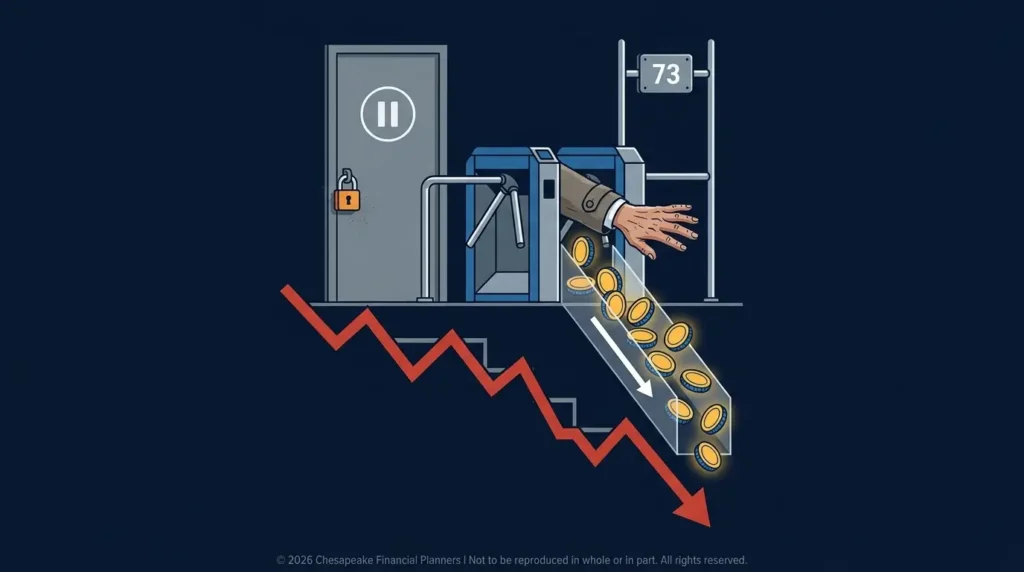
Sequence of returns risk in the RMD years is especially dangerous because once required minimum distributions begin at age 73, you are forced to sell assets every year to meet them, no matter what the market is doing. A down market during the RMD phase amplifies the damage: a mandatory withdrawal makes you sell more shares at depressed prices exactly when you have lost the flexibility to skip or shrink the distribution. The order of your returns, not the average, decides how long the money lasts, and the RMD years remove your best escape hatch.
Key Takeaways
- Once RMDs begin at age 73, you must sell assets every year to meet them, even in a down market.
- A down market during the RMD years amplifies sequence of returns risk because a forced withdrawal locks in losses you cannot defer.
- Holding one to two years of RMD cash in short-term instruments lets you fund distributions without selling equities at the bottom.
- A qualified charitable distribution of up to $111,000 in 2026 satisfies your RMD without adding taxable income.
About the Author: Jeff Judge, CFP®, AEP®, ChFC®, CLU® is Managing Partner of Chesapeake Financial Planners in Forest Hill, Maryland. He has helped families and business owners in Harford County and the Baltimore metro area plan retirement withdrawals since earning his CFP® certification in 2013, by using Chesapeake Financial Planners' signature process, the R.U.D.D.E.R. Method™. "The cruel part of RMDs," Jeff says, "is that they force your biggest mandatory sale in the exact years a bad market can do the most permanent harm, and most retirees never see it coming."
Why Is Sequence of Returns Risk in the RMD Years So Dangerous?
Sequence of returns risk in the RMD years is dangerous because required minimum distributions turn a voluntary withdrawal into a mandatory one. Before RMDs, if the market falls you can spend less or pull from cash instead of stocks. Once distributions start at age 73, that choice is gone. The IRS makes you take a set share of your traditional IRA and 401(k) balances every year, so if the market just dropped 20%, you sell more shares to raise the same required dollars. Those shares are gone and cannot rebound when prices recover, which permanently lowers the base your money compounds on.
Does a down market really do more damage once RMDs start than the same drop earlier in retirement?
Yes, because before RMDs you still control the size and timing of every withdrawal, and after 73 you do not. A retiree who can freeze withdrawals in a bad year gives the portfolio room to heal; a retiree under an RMD has to sell into the decline and turn a paper loss into a realized one. The damage still scales with the withdrawal rate you choose, but RMDs strip away your ability to lower it. Jeff Judge has watched clients who barely noticed the 2022 downturn while still working get rattled the first time an RMD forced them to sell into a falling market. For how the distributions work, our guide to the rules and strategies for required minimum distributions covers the calculation and deadlines.
How Does a Cash Bucket Protect Your RMDs in a Down Market?
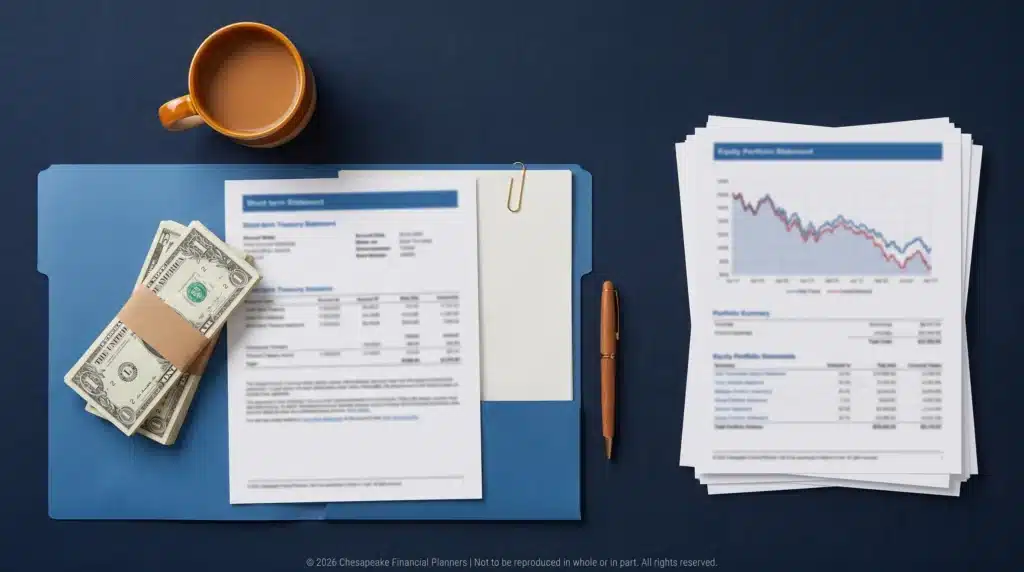
A cash bucket protects your RMDs by giving you distribution money that is not tied to the stock market, so a downturn never forces you to sell equities at a loss. Carve out one to two years of expected RMD dollars in cash, a short-term Treasury, or a short-bond position. When markets fall, you fund the required distribution from that reserve instead of liquidating stocks that just dropped.
This breaks the chain that makes sequence risk so damaging in the RMD years. The RMD still comes out, but from the cash bucket, not the equity sleeve, so your stocks stay invested and get time to recover. In Jeff's experience, the retirees who sleep best in a downturn set this up a year or two before RMDs begin, not after the market has already fallen. A reserve is cheapest to build when stocks are high, which is exactly when nobody feels they need it. A ready cash bucket is the simplest defense against sequence of returns risk in the RMD years.
Can Roth Conversions Before Age 73 Shrink Your Future RMDs?
Yes. Roth conversions in the years before age 73 directly shrink your future RMDs, because every dollar you move from a traditional IRA to a Roth is a dollar that will never face a required distribution. Roth IRAs have no lifetime RMDs for the original owner, so converting during the low-income gap between retiring and 73 lowers the traditional balance your RMDs are calculated on. Smaller future RMDs mean smaller forced sales in the RMD years, which is exactly the flexibility a down market takes away.
When is the best time to convert to a Roth to lower future RMDs?
The best window is usually the low-income years between retiring and age 73, before required distributions begin. Size each conversion to fill, not exceed, your target bracket, and if you owe an RMD in the year you convert, take that RMD first.
This gap-year window is especially valuable for our clients in Maryland. Maryland taxes withdrawals from traditional IRAs and 401(k)s, including RMDs, as income, while qualified Roth withdrawals are not taxed by the state. For retirees in Harford County and across the Baltimore metro, converting in the pre-RMD years can trim both the federal and Maryland tax bill on money that would otherwise be forced out later. Maryland offers a pension exclusion of up to $40,600 for those age 65 or older in 2026, but it phases down as Social Security rises, so it rarely covers a large RMD alone. From our Forest Hill office, we spend many gap years mapping conversions, and our retirement income drawdown strategy guide lays out the sequencing.
How Do Qualified Charitable Distributions Satisfy an RMD Without the Tax Hit?
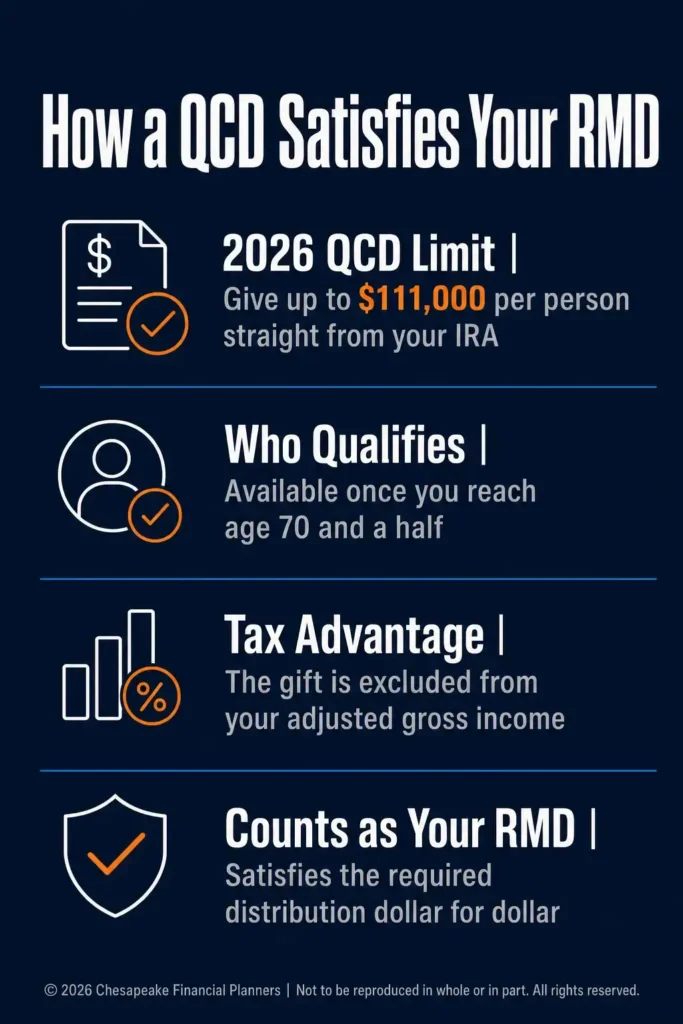
A qualified charitable distribution, or QCD, lets you send money straight from your IRA to a charity and count it toward your RMD, without the distribution ever landing on your tax return as income. For 2026 you can give up to $111,000 per person this way once you reach age 70 and a half, and the amount you donate satisfies your required distribution dollar for dollar.
That is a powerful tool in a down market. If your RMD is forcing money out anyway, routing part of it to charity as a QCD meets the requirement without selling extra shares to cover the tax. The donated amount is excluded from your adjusted gross income, which can also ease Medicare premium surcharges and reduce how much of your Social Security is taxed. The money must move directly from the custodian to a qualifying public charity, and donor-advised funds and private foundations do not qualify. Our explainer on qualified charitable distributions covers the mechanics and the common mistakes.
Should You Take Your RMD In Kind Instead of Selling?
Taking your RMD in kind means transferring shares out of the IRA into a taxable account rather than selling them to raise cash. You still owe income tax on the value you move, and it still counts toward your RMD, but you are not locking in a loss by selling at the bottom. The shares stay invested and can recover in the taxable account instead of the IRA.
An in-kind RMD does not erase the tax bill, so it separates the RMD requirement from the decision to sell. In a down market you satisfy the rule while keeping your market exposure, then choose when to sell on your own timeline. No single move solves sequence of returns risk in the RMD years; the defenses work best stacked. The R.U.D.D.E.R. Method™ is Chesapeake Financial Planners' six-step planning process: Review and Recognize, Uncover and Understand, Design and Develop, Discuss and Decide, Execute and Empower, and Reassess and Refine. The cash bucket, the gap-year conversions, and the choice between a QCD and an in-kind RMD all live in Design and Develop, put in place before the down year arrives.
| Defense | What it does | Best used when |
|---|---|---|
| RMD cash bucket | Funds the required distribution from cash so you avoid selling stocks in a downturn | Every year; built before RMDs begin |
| Pre-73 Roth conversions | Shrinks the traditional balance that future RMDs are based on | Low-income gap years between retiring and 73 |
| Qualified charitable distribution | Satisfies the RMD and excludes the amount from taxable income | You are 70 and a half or older and give to charity anyway |
| In-kind RMD | Meets the RMD by moving shares out instead of selling them at a low | A down market when you do not need the cash now |
Frequently Asked Questions
At what age do RMDs begin, and why does that raise sequence of returns risk?
Required minimum distributions begin at age 73 under current law for anyone who reaches 73 between 2023 and 2032. Once they start, you must withdraw a set amount from traditional IRAs and 401(k)s every year, even in a down market, so a drop forces you to sell more shares to meet the requirement, which amplifies sequence risk.
How much cash should I hold to cover RMDs in a down market?
Most retirees benefit from holding roughly one to two years of expected RMD dollars in cash or short-term instruments. The right amount depends on how much of your spending is already covered by Social Security or a pension. The goal is to fund a distribution from that reserve during a downturn instead of selling stocks at depressed prices.
Can I avoid selling investments to take my RMD?
You can avoid selling by taking your RMD in kind, which transfers shares out of the IRA into a taxable account instead of liquidating them. You still owe income tax on the transferred value, and it still counts toward your RMD, but the shares stay invested and can recover rather than being sold at a market low.
Do Roth conversions before 73 really reduce sequence risk in the RMD years?
Yes. Converting traditional IRA money to a Roth before age 73 lowers the balance your future RMDs are calculated on, because Roth IRAs have no lifetime required distributions for the owner. Smaller RMDs mean smaller forced sales during a downturn, which restores flexibility that required distributions otherwise remove in the RMD years.
Does a QCD count toward my RMD?
Yes. A qualified charitable distribution counts toward your required minimum distribution dollar for dollar, up to $111,000 per person in 2026, once you are age 70 and a half or older. Because the donated amount is excluded from your taxable income, a QCD lets you satisfy the RMD without adding to your adjusted gross income.
Does Maryland tax my RMDs?
Yes. Maryland taxes distributions from traditional IRAs and 401(k)s, including RMDs, as ordinary income, while qualified Roth withdrawals are not taxed by the state. Maryland offers a pension exclusion of up to $40,600 for residents age 65 or older in 2026, but it phases down as Social Security income rises, so it often does not cover a full RMD.
The bottom line on the RMD years
Sequence of returns risk in the RMD years is the one stretch of retirement where a bad market and a forced sale collide, and the fix is to build your escape routes before you need them. A cash bucket for the distributions, Roth conversions in the gap years, QCDs to meet the RMD without the tax, and in-kind transfers to avoid selling low all give back the flexibility the rules take away. Ready to put a plan around sequence of returns risk in the RMD years? Jeff Judge and the Chesapeake Financial Planners team serve families and business owners across Harford County and the Baltimore metro. Schedule a free fit call to stress-test your withdrawal plan.
Disclosures
The information provided is for educational purposes only and should not be construed as investment advice. Investment strategies should be tailored to individual circumstances, risk tolerance, and goals. Past performance doesn't guarantee future results. Consult with qualified financial professionals regarding your specific situation.
Traditional IRA account owners have considerations to make before performing a Roth IRA conversion. These primarily include income tax consequences on the converted amount in the year of conversion, withdrawal limitations from a Roth IRA, and income limitations for future contributions to a Roth IRA. In addition, if you are required to take a required minimum distribution (RMD) in the year you convert, you must do so before converting to a Roth IRA.
Advisors associated with Chesapeake Financial Planners may be either (1) LPL Financial Registered Representatives offering securities through LPL Financial, Member FINRA and SIPC, and investment advisor representatives offering investment advice through Great Valley Advisor Group; or (2) solely investment advisor representatives offering investment advice through Great Valley Advisor Group and not affiliated with LPL Financial. Great Valley Advisor Group, and Chesapeake Financial Planners are separate entities from LPL Financial.
Chesapeake Financial Planners | 2402 Scotlon Ct, Forest Hill, MD 21050 | (410) 652-7868 | www.chesapeakefp.com
© 2026 Chesapeake Financial Planners | Not to be reproduced in whole or in part. All rights reserved.


