

Which Expenses Disappear After You Retire?
Last reviewed: August 2026
When you stop working, a large share of your paycheck's obligations stop with it. The expenses that disappear in retirement, from payroll taxes and retirement-plan contributions to commuting costs and often the mortgage, can pull your real cost of living well below what you spent during your career. That is the piece most people miss when they try to figure out how much they need to retire, and it is why the familiar 70 to 80 percent income replacement rule usually runs high.
Key Takeaways
- Household spending peaks between ages 45 and 54 and declines with age, so replacement targets built on peak-earning budgets overstate the need.
- Payroll taxes of 7.65 percent come off your wages while you work but not off retirement-account withdrawals or Social Security benefits.
- At 65, Medicare often replaces employer family coverage that averaged $26,993 in 2025, though out-of-pocket and long-term care costs stay.
- Maryland does not tax Social Security benefits, which lowers the after-tax income a Harford County retiree actually needs.
About the Author: Jeff Judge, CFP®, AEP®, ChFC®, CLU® is Managing Partner of Chesapeake Financial Planners in Forest Hill, Maryland. He has been helping families and business owners in Harford County and the Baltimore metro area navigate retirement income planning since earning his CFP® certification in 2013, by using Chesapeake's signature process, the R.U.D.D.E.R. Method™. "Most of the pre-retirees I meet have quietly decided they need to replace their entire paycheck, when a big chunk of that paycheck was never money they got to keep in the first place."
Why does the 70 to 80 percent income replacement rule run high?
The income replacement rule assumes your retirement budget looks like your working budget minus a fixed slice, and that assumption breaks down because it ignores which specific costs go away. Bureau of Labor Statistics research shows that household spending peaks in the 45 to 54 age band and steps down through the older age groups. Your highest-spending years are usually your peak-earning years, when you are funding a mortgage, raising children, and saving hard for the retirement that has not arrived yet. Strip those out and the baseline changes.
Jeff Judge puts it plainly with clients: the 70 to 80 percent figure is a napkin estimate, useful for a first pass and misleading if you stop there. Two people who earned the same salary can need very different incomes in retirement depending on whether the house is paid off and whether they were saving 5 percent or 25 percent of pay.
Does that make the rule useless? No, it makes it a starting point. The rule gives you a rough target in about ten seconds, which is fine for someone in their thirties who just wants a savings direction. It becomes a problem when a household five years from retirement treats it as gospel, oversaves out of fear, or undershoots because the percentage happened to look comfortable. The fix is to replace the percentage with your actual line items.
Which of the expenses that disappear in retirement matter most?
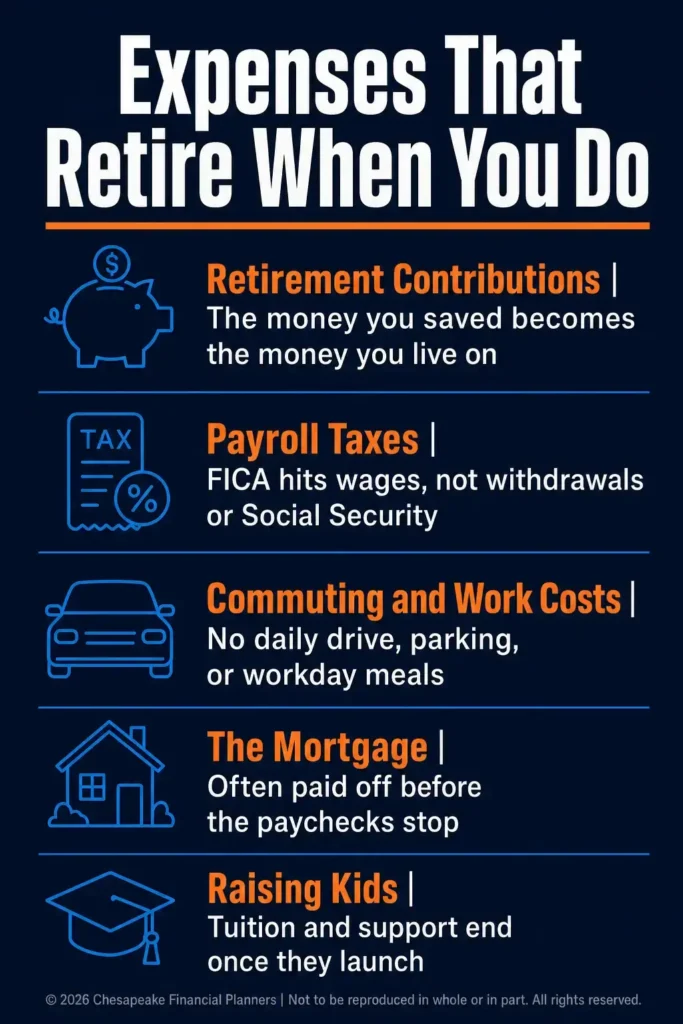
Several recurring costs are tied directly to earning a paycheck, and they end when the paycheck does. The biggest ones are the money you were setting aside for retirement, the taxes on your wages, and the daily cost of getting to and from a job.
| Expense that stops | Why it goes away |
|---|---|
| Retirement-plan contributions | You draw down savings in retirement instead of adding to them |
| Payroll taxes (7.65%) | FICA applies to wages, not to withdrawals or Social Security |
| Commuting and vehicle costs | No daily drive, parking, tolls, or work fuel |
| Work wardrobe and dry cleaning | No professional dress code to fund |
| Workday meals | No bought lunches or daily coffee runs |
Start with saving itself. A worker earning $120,000 who puts 15 percent into a plan is sending $18,000 a year toward retirement. The day they retire, that $18,000 is no longer an expense, because the goal it funded is now the paycheck. Add commuting: AAA pegs the average cost to own and operate a new vehicle at $11,577 a year, and a retiree who no longer drives to an office trims a real slice of that.
Do payroll taxes really stop in retirement? Yes, and this is the surprise for most people. The 7.65 percent FICA tax, 6.2 percent for Social Security up to the 2026 wage base of $184,500 plus 1.45 percent for Medicare, is a tax on earned wages. It does not apply to 401(k) or IRA withdrawals, to Social Security benefits, or to investment income. That is one reason payroll taxes in retirement are effectively zero for most households, and it means a dollar of retirement income stretches further than a dollar of salary did.
How much does clearing your mortgage and your kids' costs change the math?
Eliminating a mortgage and the cost of raising children removes two of the largest line items in a working household's budget, which is why so many retirees find they need far less than they feared. The mortgage is usually the single biggest monthly bill, and most homeowners 65 and older own their homes free and clear. Wiping out that payment can cut the required income sharply, and it is worth reading through the tradeoffs of paying off the mortgage before retirement rather than assuming it always makes sense.
Children are the other big one. The USDA's most recent estimate put the cost of raising a child born in 2015 at $233,610 through age 17, and that figure does not include college. Once the kids are launched, that spending falls off the budget. Two more costs often go with it: life-insurance premiums, which many people carry to replace income for dependents and can revisit once there is no income to replace, and career expenses like licenses, professional dues, conferences, and continuing education.
Does everyone's mortgage disappear by retirement? No, and this is where a rule of thumb gets people into trouble. A growing number of retirees still carry a mortgage, and some support adult children well past 18. Jeff Judge tells clients to set that expectation first: if you are retiring with six years left on the loan or a 25-year-old still on the family plan, your number is different, and pretending otherwise is how a plan cracks in year three. The point is to count your actual obligations, not the average household's.
What happens to your healthcare costs when Medicare takes over from employer coverage?
At 65, most people move from employer coverage to Medicare, and the monthly premium usually drops, though healthcare does not become free. The 2026 standard Medicare Part B premium is $202.90 a month, a fraction of what family coverage costs a working household. The KFF Employer Health Benefits Survey found the average employer family premium reached $26,993 in 2025, with workers paying $6,850 of that out of their own paychecks. For a couple moving onto Medicare, the swing in premiums alone can be meaningful.
Two caveats keep this honest. Higher earners pay more through IRMAA: for 2026, an income above $109,000 for a single filer or $218,000 for a married couple triggers a surcharge on Part B and Part D. And Medicare does not cover long-term care, which is a separate planning problem entirely. Out-of-pocket costs, supplemental coverage, and dental also add up. A health savings account can help here, and money you built in an HSA during your working years can cover Medicare premiums and qualified costs later. The premium relief is real, but it is not the whole healthcare picture.

How do Maryland's tax rules change the income a Harford County retiree needs?
For retirees in Bel Air, Forest Hill, and the rest of Harford County, Maryland's tax treatment quietly lowers the income you need, because the state does not tax Social Security benefits and offers a pension exclusion for residents 65 and older. That matters when you calculate how much income you need to retire: a gross withdrawal target and an after-tax spending target are not the same number, and Maryland's rules move them closer together for local retirees than the federal picture alone would suggest. It pays to plan the order and timing of withdrawals, which is where coordinating Social Security, RMDs, and pension income does real work.
This is exactly the kind of individualized math the R.U.D.D.E.R. Method™ is built for. The R.U.D.D.E.R. Method™ is Chesapeake Financial Planners' six-step planning process: Review and Recognize, Uncover and Understand, Design and Develop, Discuss and Decide, Execute and Empower, and Reassess and Refine. Consider a hypothetical couple in Harford County earning $200,000. Once you subtract the roughly $30,000 they were saving, the payroll taxes on their wages, the commuting costs, a paid-off mortgage, and the children who have moved out, the income they need to hold their lifestyle steady can land closer to $101,000 than to $200,000. That is an illustration, not a promise, and your figure depends on your own line items. The goal here is not to shrink your lifestyle. It is to see clearly that the cost to maintain your lifestyle in retirement is often lower than the rule of thumb implies, so you neither oversave for years you cannot get back nor undershoot the number you land on.
Frequently Asked Questions
Do you still pay Social Security and Medicare taxes in retirement?
For most retirees, no. The 7.65 percent FICA tax is charged on earned wages, so it applies while you are working but not to 401(k) or IRA withdrawals, Social Security benefits, or investment income. If you keep working part time in retirement, the tax applies to those wages, but money you draw from savings and Social Security is not subject to payroll tax.
Does the 70 to 80 percent income replacement rule ever make sense?
It works as a rough first estimate, not a final plan. The rule is a fast way to set a savings direction when retirement is decades away. Within about five years of retiring, replace it with your actual expenses, because whether your mortgage is paid off and how much you were saving can move your real number by tens of thousands of dollars a year.
What retirement expenses go up instead of down?
Healthcare and leisure spending often rise even as other costs fall. Bureau of Labor Statistics data shows healthcare's share of the budget increases with age, and many new retirees spend more on travel and hobbies in the first years. Long-term care is the largest wild card, since Medicare does not cover it and costs can be substantial.
Does Maryland tax retirement income?
Maryland does not tax Social Security benefits, and it offers a pension exclusion for residents who are 65 or older. Maryland does tax withdrawals from traditional retirement accounts like 401(k)s and IRAs as income. Because the rules interact with your Social Security, a Harford County retiree's after-tax income need is often lower than the gross number alone suggests.
How do I figure out my real retirement number?
Start from your current spending and subtract the costs that end when you stop working: retirement contributions, payroll taxes, commuting, and any mortgage you will have paid off. Then add back the costs that rise, mainly healthcare and travel. That personalized figure, not a percentage of your old salary, is the number worth planning around with an advisor.
Do children's expenses really end at retirement?
For most households, yes, though the timing is not automatic. Once children finish school and become financially independent, that spending leaves your budget. The catch is that some retirees still support adult children or carry college costs into their sixties, so it is worth confirming your own situation rather than assuming the expense has ended on schedule.
Ready to Find Your Real Retirement Number?
The expenses that disappear in retirement are the reason a confident retirement often costs less than the headline rules suggest, but only your line items can tell you by how much. If you are within a few years of retiring and want a number built on your actual budget instead of a percentage, schedule a no-obligation call with Jeff Judge to walk through what changes for you.
A version of this article originally appeared in Kiplinger.
Disclosures
The information provided is for educational purposes only and should not be construed as investment advice. Investment strategies should be tailored to individual circumstances, risk tolerance, and goals. Past performance doesn't guarantee future results. Consult with qualified financial professionals regarding your specific situation.
This material is for educational purposes only. Insurance products contain exclusions, limitations, and terms for keeping them in force. Please contact a qualified insurance professional for costs and complete details.
This information is not intended to be a substitute for specific individualized tax, investment or legal advice. We suggest that you discuss your specific situation with a qualified tax, legal or financial advisor.
Advisors associated with Chesapeake Financial Planners may be either (1) LPL Financial Registered Representatives offering securities through LPL Financial, Member FINRA and SIPC, and investment advisor representatives offering investment advice through Great Valley Advisor Group; or (2) solely investment advisor representatives offering investment advice through Great Valley Advisor Group and not affiliated with LPL Financial. Great Valley Advisor Group, and Chesapeake Financial Planners are separate entities from LPL Financial.
Chesapeake Financial Planners | 2402 Scotlon Ct, Forest Hill, MD 21050 | (410) 652-7868 | www.chesapeakefp.com
© 2026 Chesapeake Financial Planners | Not to be reproduced in whole or in part. All rights reserved.


