

Should You Do Roth Conversions Before RMDs Begin?
Last reviewed: August 2026
Roth conversions before RMDs are usually the difference between paying tax on your own schedule and paying it on the government's. If you are retired, in your early sixties, and in a low bracket because your paycheck stopped but your required withdrawals have not, the years ahead are the cheapest tax environment you will ever get on that traditional IRA. Most people let them pass without converting a dollar.
Key Takeaways
- Roth conversions before RMDs move IRA money out during low-tax gap years, so it is never forced out later at a higher rate.
- Required minimum distributions begin at age 73, or 75 if you were born in 1960 or later, whether you need the income or not.
- A large traditional balance can push a first RMD past the 2026 top of the 22% joint bracket, $211,400, before Social Security lands.
- Converting does not erase the tax; it moves the payment to lower-rate years on an amount you choose and shrinks future forced withdrawals.
About the Author: Jeff Judge, CFP®, AEP®, ChFC®, CLU® is Managing Partner of Chesapeake Financial Planners in Forest Hill, Maryland. He has been helping families and business owners in Harford County and the Baltimore metro area navigate retirement tax planning since earning his CFP® certification in 2013, by using Chesapeake's signature process, the R.U.D.D.E.R. Method™. "The conversion decision is rarely about the market. It is about which bracket the money leaves in, and whether you or a formula gets to pick the year."
Why are the pre-RMD gap years the cheapest tax environment you will ever see?
The gap years run from the day your paycheck stops to the day required withdrawals and Social Security begin. Picture a couple in their early sixties: about $2.4 million across a traditional IRA and an old 401(k), roughly $58,000 of taxable income, and a comfortable seat in the 12% bracket. They have never converted a dollar, because nobody told them the clock was running.
Here is the part that surprises them. The IRS does not require them to touch that money until age 73, or 75 for anyone born in 1960 or later, so until then it compounds untouched. That decade is the cheapest tax environment they will ever see on those dollars: wages gone, the 2026 standard deduction of $32,200 for a married couple and the wide 12% and 22% brackets sitting mostly empty. Our complete guide to the pre-RMD gap years covers it, and almost nobody uses that room on purpose.
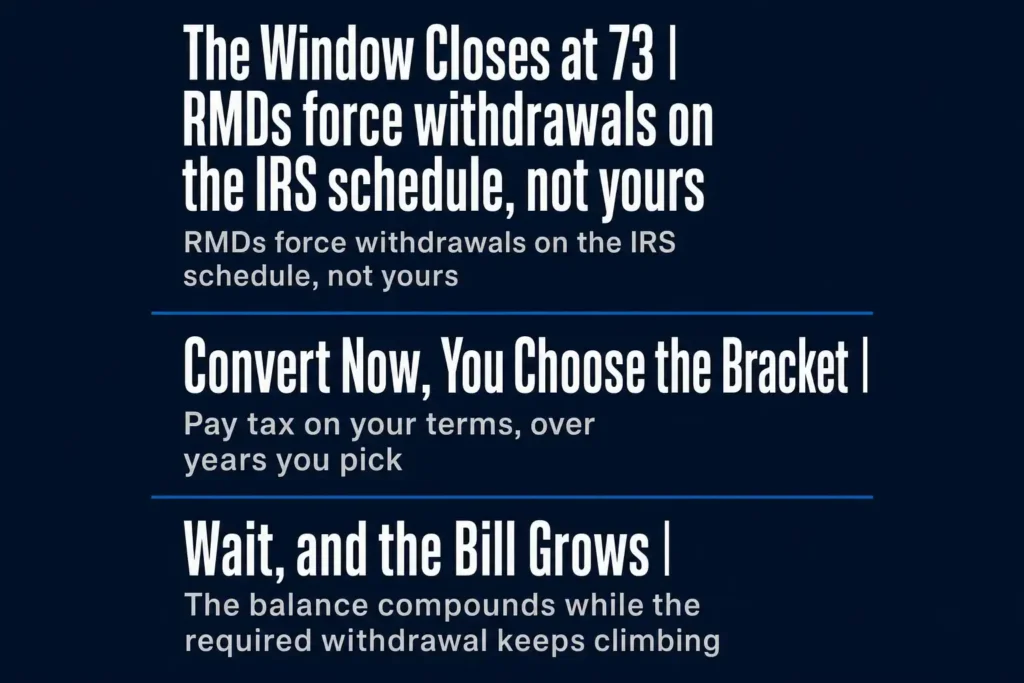
Why does the window close instead of staying open? Because required minimum distributions are mandatory, taxed as ordinary income, and timed by the IRS rather than by you. The gap years are the only stretch where a withdrawal is voluntary; once RMDs start, your baseline income jumps and that cheap room is gone. Pre-RMD tax planning is just deciding to fill those empty brackets before someone else does.
How does a Roth conversion before RMDs actually work?
A Roth conversion moves money from a traditional IRA into a Roth IRA. You pay ordinary income tax on the amount this year, and in exchange that money, plus everything it earns, comes out tax-free later. The IRS gets paid now instead of later, and the only question is whether later would have been cheaper. For a couple in the 12% bracket, it rarely is.
"I have watched retirees with four million dollars turn down a conversion that would have saved them six figures, because writing a check to the IRS in April felt like a loss and leaving the IRA untouched felt like nothing. That is the trap."
Jeff Judge, CFP®
The R.U.D.D.E.R. Method™ is Chesapeake Financial Planners' six-step planning process: Review and Recognize, Uncover and Understand, Design and Develop, Discuss and Decide, Execute and Empower, and Reassess and Refine. A conversion lives in the Design and Develop and Discuss and Decide steps, where the multi-year tax projection gets built before anyone moves a dollar. Deciding to convert before age 73 is worth modeling several years at once. Our Roth conversion strategy guide walks through when, how much, and in what order.
What does doing nothing actually cost by age 73?
Doing nothing has a price tag; it just arrives later and larger. Say that $2.4 million grows at about 6% a year with no conversions; by 73 it is worth roughly $5.1 million. The first required minimum distribution is that balance divided by the IRS Uniform Lifetime Table divisor of 26.5 at age 73, about $193,000 in one year, enough to clear the 2026 top of the 22% joint bracket at $211,400 once you stack even modest other income, before Social Security arrives. These dollar figures are an illustration, not a promise about any real account.
It gets worse each year. The divisor shrinks as you age, so the required percentage climbs even as the account is drained.
| Age | Uniform Lifetime divisor | Approx. required withdrawal |
|---|---|---|
| 73 | 26.5 | ~$193,000 |
| 74 | 25.5 | ~$205,000 |
| 75 | 24.6 | ~$216,000 |
| 80 | 20.2 | higher still |
The withdrawal keeps climbing because roughly 6% growth outpaces a sub-4% starting withdrawal rate, so the balance the tax is figured on rises faster than the money leaving it. Waiting does not shrink the problem; it grows that balance and hands the timing to a formula.
Convert now or pay later, which one costs less?
Convert on purpose during the gap years instead. Suppose the couple converts about $120,000 a year for ten years, from 62 to 71, filling the 22% bracket and part of the 24%, moving roughly $1.2 million into the Roth. They pay the tax from a taxable brokerage account, so the full amount keeps compounding, and at a blended rate near 23% the total runs around $276,000, on their own schedule. Do nothing, and that $2.4 million compounds to about $5.1 million with a first RMD near $193,000 taxed around 24% once Social Security lands, climbing every year after. Again, these are illustrative figures, not a forecast.
| Planning factor | Convert during the gap years | Wait for RMDs |
|---|---|---|
| Who controls the timing | You do | The IRS formula |
| Amount recognized each year | Chosen, bracket-capped | Whatever the divisor forces |
| Rough lifetime tax on this money | ~$276,000, spread and controlled | Larger, front-loaded at 24% or more |
| Effect on the balance | Shrinks the future RMD base | Grows the base every year |
| Later Maryland and Medicare exposure | Lower, by design | Higher, and involuntary |
Does this only pay off if tax rates go up? No, none of it assumes rates rise. The 2017 individual tax brackets were made permanent rather than sunsetting, so even at flat rates the math holds: a voluntary 12% or 22% conversion today beats a forced 24% withdrawal later, and if rates rise, converting looks better still. The conversion does not erase the tax; it moves the payment to lower-rate years and shrinks the balance that forces income for life.

Why do smart retirees still skip this, and how do you convert before RMDs the right way?
Two reasons people skip it, and neither is about the math. A conversion is a visible, immediate cost; writing a check to the IRS in April feels like a loss. An RMD is a quiet, deferred cost, until it is not, and by then the balance is bigger, the bracket higher, and the window closed. The second reason is coordination: the CPA sees the return once a year, after the decisions are locked, and the advisor sees the portfolio but rarely runs the multi-year conversion math. It is a "nobody was driving" problem, and the most common reason a good conversion never happens.
There is also a threat most couples never model. What happens to the tax bill when one spouse dies? The survivor moves to single-filer brackets the next year, and single brackets are roughly half as wide. The 2026 top of the 22% bracket is $211,400 for a couple but only $105,700 for a single filer. An RMD that sat in a couple's 24% bracket can push a survivor into 32% on the same withdrawal. Converting while both spouses are alive and filing jointly helps no matter who ends up managing the money alone.
For a Maryland retiree, the gap years are worth even more. Maryland taxes traditional IRA and 401(k) withdrawals as ordinary income, does not tax qualified Roth distributions at all, and its pension exclusion does not cover IRA money. So a Harford County couple in Bel Air or Forest Hill pays the state rate plus the local county tax on every forced IRA dollar at 73, while dollars converted to Roth come out free of Maryland tax for life. In a state that taxes retirement withdrawals, the pre-RMD conversion window is worth more than in a no-income-tax state. See the details in our guide to how Maryland taxes retirement income.
In Jeff Judge's experience with Harford County retirees, the couples who win are not the ones who convert the most in one year. They are the ones who convert a steady amount every year, inside a bracket target they set on purpose. Doing it well comes down to a few disciplines:
- Do not convert the whole balance in one year; a lump sum can push you through several brackets.
- Pick a bracket ceiling in advance, say the top of the 24% bracket, and convert up to that line each year the window is open.
- Coordinate your CPA and advisor on the same numbers before December 31, because a conversion cannot be undone once the calendar year closes.
- Watch Medicare's IRMAA thresholds, $109,000 for a single filer and $218,000 for a couple in 2026, since a large conversion can trip a premium surcharge two years later.
Frequently Asked Questions
At what age do RMDs force money out of a traditional IRA?
Required minimum distributions begin at age 73 for anyone born between 1951 and 1959, and at 75 for those born in 1960 or later. From that age on, the IRS makes you withdraw a set portion of your traditional IRA and 401(k) each year, taxed as ordinary income, whether you need it or not. Roth IRAs carry no such requirement while you are alive.
How much should I convert to a Roth before RMDs begin?
Convert only enough each year to fill your target tax bracket without spilling into the next one. For many retired couples in their sixties that means converting a portion of the IRA annually across the gap years, rather than the whole balance at once. The right number depends on your other income, your filing status, and how many low-income years you have before age 73.
Does a Roth conversion before RMDs actually reduce my required withdrawals?
Yes. Every dollar you move from a traditional IRA into a Roth is removed from the balance your future RMDs are calculated on, and Roth IRAs carry no lifetime required distributions for the original owner. Converting during the gap years shrinks the pre-tax balance while you still control the timing, which lowers the taxable income later forced onto your return at 73.
Can I undo a Roth conversion if I change my mind?
No, a Roth conversion is permanent once the calendar year closes. The ability to reverse, or recharacterize, a conversion was eliminated under the 2017 tax law, so there is no take-back. That is exactly why the tax planning has to be right before you convert, and why many advisors execute late in the year, once the year's actual income is nearly final.
How does a Roth conversion affect Medicare premiums?
A Roth conversion raises your modified adjusted gross income, which can push you over an IRMAA threshold and increase your Medicare Part B and Part D premiums about two years later. In 2026 those thresholds start at $109,000 for a single filer and $218,000 for a married couple. Size each conversion against those limits, not just your tax bracket, so a surcharge does not surprise you.
Is Maryland retirement income taxed differently for Roth accounts?
Yes. Maryland taxes traditional IRA and 401(k) withdrawals as ordinary income, but qualified Roth distributions are not taxed by the state at all. Maryland's pension exclusion for residents 65 and older does not apply to IRA money, so converting to Roth during the gap years can remove those dollars from your Maryland tax bill for life, on top of the federal benefit.
Ready to run your own numbers?
If you are in the gap years between retirement and age 73, the most expensive thing you can do is nothing. Roth conversions before RMDs are a multi-year decision that touches your brackets, your Medicare premiums, your Social Security, and your heirs at once, and the room to act closes a little more each year. Jeff Judge and the Chesapeake team run these projections with Harford County families every week. Schedule a no-obligation conversion review with Jeff and find out what waiting is really costing you.
A version of this article was originally published on Jeff Judge's LinkedIn.
Disclosures
The information provided is for educational purposes only and should not be construed as investment advice. Investment strategies should be tailored to individual circumstances, risk tolerance, and goals. Past performance doesn't guarantee future results. Consult with qualified financial professionals regarding your specific situation.
Traditional IRA account owners have considerations to make before performing a Roth IRA conversion. These primarily include income tax consequences on the converted amount in the year of conversion, withdrawal limitations from a Roth IRA, and income limitations for future contributions to a Roth IRA. In addition, if you are required to take a required minimum distribution (RMD) in the year you convert, you must do so before converting to a Roth IRA.
A Roth IRA offers tax deferral on any earnings in the account. Qualified withdrawals of earnings from the account are tax-free. Withdrawals of earnings prior to age 59 ½ or prior to the account being opened for 5 years, whichever is later, may result in a 10% IRS penalty tax. Limitations and restrictions may apply.
Advisors associated with Chesapeake Financial Planners may be either (1) LPL Financial Registered Representatives offering securities through LPL Financial, Member FINRA and SIPC, and investment advisor representatives offering investment advice through Great Valley Advisor Group; or (2) solely investment advisor representatives offering investment advice through Great Valley Advisor Group and not affiliated with LPL Financial. Great Valley Advisor Group, and Chesapeake Financial Planners are separate entities from LPL Financial.
Chesapeake Financial Planners | 2402 Scotlon Ct, Forest Hill, MD 21050 | (410) 652-7868 | www.chesapeakefp.com
© 2026 Chesapeake Financial Planners | Not to be reproduced in whole or in part. All rights reserved.


