

Your income is climbing; congratulations. But so is your tax bill. And if you're not careful, taxes can quietly erode your wealth faster than you realize.
High earners often face marginal tax rates of 35-50% (federal + state + payroll). That means for every additional dollar you earn, you might keep only 50 cents.
But here's the good news: as your income grows, so do your tax opportunities. The key is shifting from reactive tax filing to proactive tax strategy.
Let's break down how high earners can potentially keep more of what they make.
The Problem: Your Tax Bill Is Growing Faster Than Your Income
When your income increases, your taxes don't just go up they accelerate.
Here's why:
Progressive tax brackets
The more you earn, the higher your marginal tax rate. Federal rates range from 10% to 37%, plus state taxes (0-13% depending on where you live).
Phaseouts and surtaxes
High earners lose access to certain deductions and credits. The 3.8% Net Investment Income Tax kicks in above certain thresholds. Social Security payroll taxes hit the first $184,500 of wages (for 2026).
Ordinary income is taxed at higher rates than capital gains
Your salary, bonus, and consulting income are taxed as ordinary income. Long-term capital gains and qualified dividends get preferential rates (0%, 15%, or 20%).
Without a strategy, you're leaving tens of thousands, or more, on the table every year.
Strategy 1: Max Out Tax-Advantaged Accounts

This is the foundation. Tax-advantaged accounts let you reduce taxable income now and grow wealth tax-deferred or tax-free.
401(k) or 403(b)
Contribute up to $24,500 for 2026 ($32,500 if you're 50+). Every dollar reduces your taxable income. If you're in the 35% bracket, a $20,000 contribution saves you $7,000 in taxes.
Traditional IRA
Deductibility depends on your income and whether you have a workplace plan. If eligible, contribute $7,500 ($8,500 if 50+).
Backdoor Roth IRA
If your income is too high for a direct Roth contribution, use the backdoor strategy: contribute to a non-deductible Traditional IRA, then convert it to Roth. This gives you tax-free growth forever. (Make sure you don't have other pre-tax IRA balances, or the pro-rata rule complicates things.)
HSA (Health Savings Account)
If you have a high-deductible health plan, max out your HSA ($4,400 individual, $8,750 family for 2026). It's triple-tax-advantaged: deductible contributions, tax-free growth, and tax-free withdrawals for medical expenses.
Mega Backdoor Roth
If your 401(k) plan allows after-tax contributions and in-plan conversions, you can potentially contribute an additional $47,500+ annually to a Roth. Not every plan offers this, but if yours does, it's a massive opportunity.
Strategy 2: Leverage Workplace Benefits
Many high earners overlook the tax-smart benefits buried in their compensation packages.
Employer Stock Purchase Plan (ESPP)
If your company offers an ESPP with a discount (typically 15%), that's an instant return. Just be mindful of concentration risk and tax treatment when you sell.
Equity compensation (RSUs, stock options, ISOs)
These can be tax nightmares if mismanaged. Strategies include:
- Timing RSU vesting and sales to minimize tax brackets
- Exercising ISOs strategically to avoid AMT
- Tax-loss harvesting to offset gains
Deferred compensation plans
If you're an executive or highly compensated employee, deferred comp lets you push income into future years when you might be in a lower bracket. It's risky (your money is tied to your employer's financial health), but it can be powerful.
Dependent Care FSA
Contribute up to $5,000/year pre-tax to cover childcare or elder care expenses.
Commuter benefits
Pre-tax contributions for parking and transit.
Strategy 3: Get Strategic With Charitable Giving
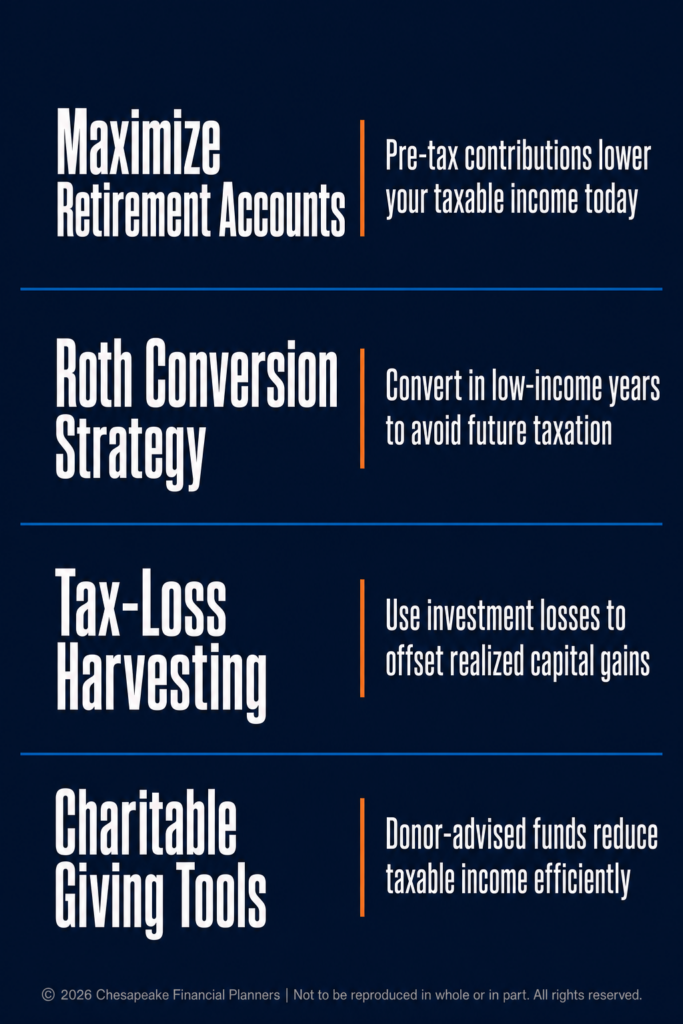
If you're charitably inclined, smart giving can reduce your tax bill and amplify your impact.
Donor-Advised Fund (DAF)
Contribute a lump sum (cash, appreciated equities, or other assets) to a DAF in a high-income year. You get an immediate tax deduction. Then, you can recommend grants to charities over time.
This is especially powerful if you're "bunching" donations giving multiple years' worth in one tax year to exceed the standard deduction threshold.
Donate appreciated equities
If you've held equities for over a year, donate them directly to charity (or a DAF). You get a deduction for the full market value and avoid capital gains tax. Win-win.
Qualified Charitable Distributions (QCDs)
If you're 70½ or older, you can donate up to $111,000/year directly from your IRA to charity. It counts toward your RMD and is excluded from taxable income. (This is more relevant later in life, but worth knowing.)
Strategy 4: Use Tax-Efficient Investing Strategies
How you invest, and where you invest, matters for taxes.
Asset location
Place tax-inefficient investments (bonds, REITs, actively managed funds) in tax-advantaged accounts. Place tax-efficient investments (index funds, long-term growth equities) in taxable accounts.
Tax-loss harvesting
Sell investments at a loss to offset gains elsewhere. You can use up to $3,000 in excess losses to offset ordinary income annually, and carry forward unused losses indefinitely.
Low-turnover funds
Actively managed funds that trade frequently trigger short-term capital gains (taxed as ordinary income). Passively managed index funds have minimal turnover and generate fewer taxable events.
Hold long-term
Long-term capital gains (assets held over a year) are taxed at preferential rates (0%, 15%, or 20%) vs. ordinary income rates (up to 37% federal).
Avoid mutual fund capital gains distributions
Some mutual funds distribute capital gains to shareholders at year-end, even if you didn't sell anything. ETFs are generally more tax-efficient in taxable accounts.
Strategy 5: Time Income and Deductions
If you have control over when you receive income or incur expenses, timing can save you money.
Defer income
If you're having a high-income year, consider deferring bonuses, consulting fees, or business income into the following year (if possible).
Accelerate deductions
Bunch deductible expenses (charitable donations, property taxes, medical expenses) into high-income years to maximize their impact.
Harvest losses in high-income years
If you're in a higher bracket this year than usual, tax-loss harvesting is even more valuable.
Strategy 6: Consider Roth Conversions in Lower-Income Years
If you have a year with lower income, job transition, sabbatical, early retirement, it might be a great time to convert Traditional IRA dollars to Roth.
You'll pay taxes on the conversion amount, but at a lower rate than you would in high-income years. Then, your Roth grows tax-free forever.
This is advanced planning and requires careful modeling to avoid pushing yourself into a higher bracket. Work with a financial planner to execute this correctly.
Strategy 7: Optimize Your Business Structure (If Self-Employed)
If you're self-employed, a consultant, or a business owner, entity structure can dramatically impact your taxes.
Sole proprietorship vs. S-Corp
Operating as an S-Corp can reduce self-employment taxes (15.3%) by paying yourself a reasonable salary and taking the rest as distributions.
SEP IRA or Solo 401(k)
Self-employed individuals can contribute significantly more to retirement accounts than W-2 employees. For 2026, you can potentially contribute up to $72,000 to a Solo 401(k).
Home office deduction
If you have a dedicated workspace, you can deduct a portion of rent, utilities, and other home expenses.
Qualified Business Income (QBI) deduction
Pass-through business owners may qualify for a 20% deduction on qualified business income. Eligibility and limits depend on income level and business type.
Consult a CPA or tax strategist to structure your business optimally.
Strategy 8: Understand the Alternative Minimum Tax (AMT)
If you have ISOs, significant deductions, or other AMT triggers, you could be subject to the Alternative Minimum Tax: a parallel tax system designed to ensure high earners pay a minimum amount.
AMT planning is complex, but strategies include:
- Timing ISO exercises to avoid AMT
- Managing deductions to stay below AMT thresholds
- Using AMT credits in future years
This is one area where professional guidance is invaluable.
Strategy 9: Plan for State Taxes
Don't overlook state taxes. Depending on where you live, state income taxes can range from 0% (Florida, Texas, Washington) to over 13% (California).
If you're mobile, strategic relocation can save you hundreds of thousands over a lifetime. Even if you're not moving, strategies like:
- Domicile planning
- Allocating income across states (if you work remotely or have multiple residences)
- Understanding state-specific deductions
…can make a difference.
Strategy 10: Work With a Financial Planner
Tax optimization isn't a one-time event; it's an ongoing strategy that evolves with your income, life stage, and goals.
A financial planner can:
- Model your tax situation across multiple scenarios
- Coordinate with your CPA to execute strategies
- Identify opportunities you're missing
- Keep you proactive instead of reactive
At Chesapeake Financial Planners, we act as your strategic tax partner—not just at year-end, but year-round.
The Bottom Line
As your income grows, so does your tax complexity—and your opportunity to optimize.
The difference between reactive tax filing and proactive tax strategy can be tens of thousands of dollars annually. Over a career, that compounds into hundreds of thousands—or even millions—of additional wealth.
You've worked hard to earn your income. Now it's time to make sure you keep as much of it as possible.
Ready to build a tax-smart financial plan? Let's talk.
Tax laws are subject to change and may vary based on individual circumstances. This material is for general information only and is not intended to provide specific advice or recommendations for any individual. Please consult your tax advisor or financial professional prior to making tax-related decisions.
This material is for general information only and is not intended to provide specific advice or recommendations for any individual.
Advisors associated with Chesapeake Financial Planners may be either (1) LPL Financial Registered Representatives offering securities through LPL Financial, Member FINRA and SIPC, and investment advisor representatives offering investment advice through Great Valley Advisor Group; or (2) solely investment advisor representatives offering investment advice through Great Valley Advisor Group and not affiliated with LPL Financial. Great Valley Advisor Group, and Chesapeake Financial Planners are separate entities from LPL Financial.
Chesapeake Financial Planners | 2402 Scotlon Ct, Forest Hill, MD 21050 | (410) 652-7868 | www.chesapeakefp.com
© 2026 Chesapeake Financial Planners | Not to be reproduced in whole or in part. All rights reserved.


