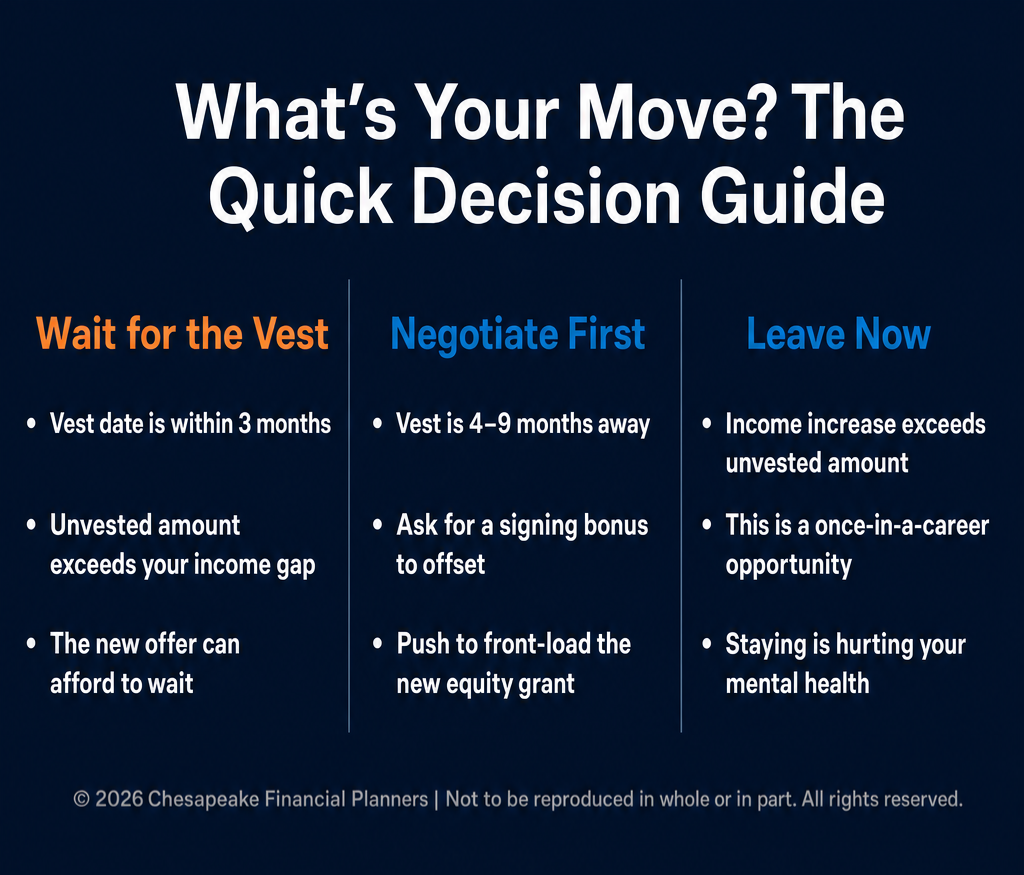
You have a $200K equity grant. $100K vests in 6 months. You just got an offer for a better role at a better company.
Do you wait for the vest and risk losing the offer? Or do you leave now and forfeit the $100K?
Welcome to the golden handcuffs problem.
The Math Everyone Gets Wrong
Most people think the decision is simple: "I'm not giving up $100K. I'll wait."
But that's not the right math.
The right math is:
What's the opportunity cost of staying 6 more months?
Let's say:
- Current job: $200K total comp
- New job offer: $300K total comp (including signing bonus)
- Unvested equity at current job: $100K in 6 months
If you stay 6 months:
- Earn: $100K (half of $200K annual) + $100K (equity vest) = $200K
- Miss: $150K (half of $300K annual at new job) + potential signing bonus
- Opportunity cost: You gave up $150K+ to collect $200K
Wait, that math says staying is worth it.
But you're also forgetting:
- Career trajectory at the new role
- Learning and growth
- The chance that the new offer disappears
- The fact that you're miserable at your current job
Now the math gets fuzzy.
The Framework: Net Present Value of Staying vs. Leaving
Here's how to actually think about this:
Option 1: Stay for the vest
- Collect $100K in 6 months (pre-tax: $100K, after-tax: ~$55K)
- Stay at a job you want to leave
- Risk: new opportunity might not be available later
- Career growth: 6 more months of stagnation
Option 2: Leave now
- Forfeit $100K unvested
- Start new job immediately
- Earn $150K in the next 6 months (pre-tax, ~$95K after-tax)
- Career growth: 6 months of acceleration at new company
- Potential signing bonus to offset unvested equity
Net difference: You "lose" $55K after-tax by leaving now, but you gain 6 months of career momentum.
Is 6 months of career momentum worth $55K?
Depends on the opportunity.
The Break-Even Analysis
Here's the rule: If the new job's comp increase is more than the unvested equity (annualized), leave now.
Example 1:
- Current comp: $250K/year
- New comp: $350K/year (+$100K/year)
- Unvested equity: $80K in 4 months
Annualized increase at new job: $100K/year
Opportunity cost of waiting 4 months: $33K
You're forfeiting $80K to gain $33K in the next 4 months. Bad trade. Wait for the vest.
Example 2:
- Current comp: $250K/year
- New comp: $400K/year (+$150K/year)
- Unvested equity: $50K in 6 months
Annualized increase at new job: $150K/year
Opportunity cost of waiting 6 months: $75K
You're forfeiting $50K to gain $75K in the next 6 months. Good trade. Leave now.
The Non-Financial Factors (That Actually Matter More)
1. The new opportunity might disappear
If you tell the new company "I need to wait 6 months," they might:
- Withdraw the offer
- Hire someone else
- Change the role
- Lower the comp package
Is the unvested equity worth the risk of losing a once-in-a-career opportunity?
2. Your current job is making you miserable
Six months of hating your job is a long time. Burnout, stress, and career stagnation have real costs that don't show up in a spreadsheet.
If staying 6 more months will crush your mental health, leave now. Your well-being is worth more than $100K.
3. The new role is a step-function change
Some opportunities are career-defining:
- Joining a rocketship startup pre-IPO
- Moving into a new domain (IC to management, eng to product)
- Working with a legendary team or mentor
These have long-term value that far exceeds the short-term equity loss.
4. You're vesting into a declining stock
If your equity is in company stock and the stock is down 30% since grant, that $100K grant is now worth $70K. Are you really willing to wait 6 months for $70K?
The Negotiation Leverage
Here's what most people don't know: you can negotiate the new offer to offset your unvested equity.
When you get the offer, say:
"I'm very excited about this role. I have $X in unvested equity at my current company that vests in [timeframe]. Can we structure the offer to offset some or all of that?"
The new company can:
- Increase the signing bonus
- Front-load your equity grant (more in year 1)
- Offer a retention bonus after year 1
Not every company will do this. But if they want you, they'll negotiate.
Example:
You have $80K unvested equity in 4 months. The new company offers a $50K signing bonus. You counter: "Can we make it $100K to offset my unvested equity?" They agree. Now you've closed the gap to $30K, which is much easier to stomach.
The Scenarios
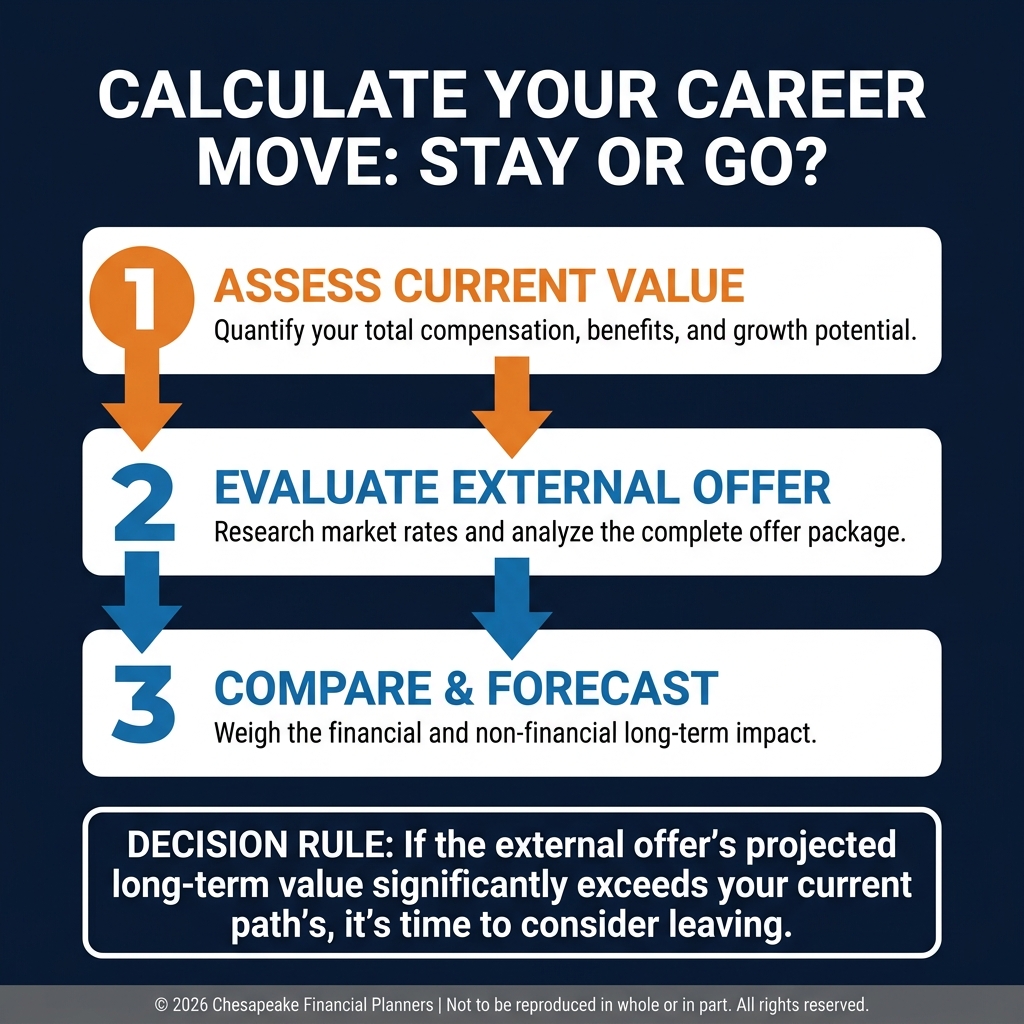
Scenario 1: Large vest in <3 months
You have $150K vesting in 2 months. New job comp increase is $50K/year.
Recommendation: Wait for the vest.
Two months is short. The opportunity cost is low ($8K). Waiting to collect $150K makes sense unless the new role is truly once-in-a-lifetime.
Scenario 2: Medium vest in 6-9 months
You have $100K vesting in 6 months. New job comp increase is $100K/year.
Recommendation: Negotiate or leave now.
Six months is a long time. Try to negotiate a signing bonus to offset the unvested equity. If they won't budge and the new role is significantly better, leave now.
Scenario 3: Small vest in 3-6 months
You have $30K vesting in 4 months. New job comp increase is $80K/year.
Recommendation: Leave now.
The opportunity cost of waiting is higher than the unvested equity. Don't let $30K hold you back from a $80K/year raise.
Scenario 4: Vesting cliff coming up (big vest soon)
You have $200K vesting in 1 month (end of year 1 cliff). New job is offering $350K vs. your current $250K.
Recommendation: Wait 1 month.
One month is nothing. Wait for the $200K vest, then leave. The new company will understand if you say "I can start in 5 weeks" (after giving 2 weeks notice).
The Career Capital Framework
Here's the real question: Which decision maximizes your career capital over the next 5 years?
Career capital = skills, network, reputation, trajectory.
Staying at your current job for 6 more months to collect equity is optimizing for cash now. Leaving for a better opportunity is optimizing for career capital.
Cash now is worth less than career capital compounded over 5 years.
If the new role will:
- Teach you skills that make you more valuable
- Connect you with people who will open doors
- Put you on a faster trajectory
Then the $50-100K you're forfeiting is an investment in your future earning power.
And that investment has a much higher ROI than waiting for the vest.
What to Do Right Now
If you're in this situation:
- Calculate the after-tax value of your unvested equity
- Calculate the opportunity cost of waiting (new comp – current comp, annualized)
- Assess the non-financial factors (misery, opportunity risk, career trajectory)
- Negotiate with the new company to offset the unvested equity
- Make the call: if new comp increase > unvested equity, leave now
If you're considering leaving soon:
- Check your vesting schedule (when's your next big vest?)
- Time your job search to start 3-4 months before a cliff vest
- Negotiate your start date to land right after a vest if possible
If you're negotiating an offer:
- Be transparent about your unvested equity
- Ask for a signing bonus or front-loaded equity to offset it
- Don't be afraid to push if they want you, they'll work with you
The Bottom Line
Golden handcuffs are real. But they're only handcuffs if you let them be.
Don't stay at a job you hate just to collect $100K in 6 months. The opportunity cost is higher than you think.
Negotiate the new offer. Offset the unvested equity. And if the new role is significantly better, leave now.
Your career trajectory is worth more than one equity vest. <!– block:32ffd
© 2026 Chesapeake Financial Planners | Not to be reproduced in whole or in part. All rights reserved.