

You're staring at paperwork from your employer offering you a choice: take your pension as a monthly payment for life, or accept a one-time lump sum. The decision feels enormous, because it is. This choice will shape your financial security for the next 20, 30, or even 40 years.
Should you seek financial advice before deciding? The short answer: almost certainly yes. But not just any advice the right advice from the right person.
Why This Decision Is So Complex
On the surface, choosing between a pension and lump sum seems straightforward: guaranteed monthly income versus a pile of cash you manage yourself. But beneath that simplicity lies layers of complexity:
- Actuarial calculations: Is the lump sum offer actuarially fair, or is your employer low-balling you?
- Life expectancy: Your health, family history, and longevity assumptions dramatically change the math.
- Tax implications: Pension payments and lump sum withdrawals are taxed differently, affecting your after-tax income.
- Survivor benefits: How does your choice affect your spouse if you predecease them?
- Investment returns: Can you invest a lump sum well enough to match or beat the pension income?
- Inflation protection: Does your pension include cost-of-living adjustments? If not, inflation erodes fixed payments over time.
- Estate planning: What happens to remaining assets when you die under each scenario?
Most people aren't equipped to analyze all these variables simultaneously, and that's okay. This is exactly what financial advisors are trained to do.

What a Financial Advisor Can (and Can't) Do
What Good Financial Advice Provides:
- Objective analysis of the offer: A qualified advisor can calculate whether your lump sum offer is generous, average, or below market. Employers sometimes offer less-than-actuarially-fair lump sums to encourage workers to take the pension instead.
- Personalized projections: Run scenarios based on your specific situation your age, health, other income sources, expenses, and goals.
- Tax planning: Model how each choice affects your taxes over your lifetime, including RMDs, Social Security taxation, and Medicare premium surcharges (IRMAA).
- Risk assessment: Evaluate your comfort with investment risk, sequence of returns risk, and longevity risk.
- Integration with overall plan: Show how the pension decision fits with Social Security claiming, other retirement accounts, healthcare planning, and estate goals.
- Behavioral coaching: Help you avoid emotional decision-making and stay focused on what the numbers actually say.
What Financial Advice Can't Do:
- Guarantee the future: No advisor can predict market returns, interest rates, or how long you'll live.
- Remove all uncertainty: Both choices have risks. Advice helps you understand them, not eliminate them.
- Make the decision for you: Ultimately, this is your choice. A good advisor presents options and recommendations, not mandates.
Types of Financial Advisors: Not All Are Equal
Not every financial advisor is qualified to help with pension decisions. You want:
A Fiduciary Advisor
Fiduciaries are legally required to act in your best interest. Fee-only or fee-based advisors (like Registered Investment Advisors) typically operate under fiduciary standards.
Avoid advisors who:
- Only work on commission (they may be incentivized to recommend the lump sum so they can manage it)
- Can't explain how they're compensated
- Push products like annuities without thoroughly analyzing your pension option first
Someone with Retirement Planning Expertise
Look for designations like:
- CFP® (Certified Financial Planner): Comprehensive financial planning training
- RICP® (Retirement Income Certified Professional): Specialized in retirement income strategies
- CPA with PFS (Personal Financial Specialist): Tax-focused financial planning
Experience matters. Ask: "How many pension vs. lump sum analyses have you done in the last year?"
Someone Who Uses Financial Planning Software
Quality advisors use sophisticated software (like MoneyGuidePro, eMoney, or RightCapital) to run Monte Carlo simulations and tax projections. If someone's just using a calculator and gut instinct, keep looking.
What to Expect From a Consultation
A thorough pension decision analysis typically involves:
Initial Data Gathering (Week 1)
You'll provide:
- Pension offer details (both monthly payment and lump sum amount)
- Survivor benefit options and costs
- Current age, health status, family longevity history
- Other retirement accounts and savings
- Expected Social Security benefits
- Current and projected expenses
- Other income sources
- Estate planning goals
Analysis Phase (Week 2)
The advisor will:
- Calculate the "internal rate of return" implied by your pension offer
- Run break-even analyses (how long until each option pays more)
- Model tax implications under each scenario
- Stress-test different investment return assumptions for the lump sum
- Evaluate survivor benefit adequacy
- Assess estate planning consequences
Presentation and Recommendation (Week 3)
You'll receive:
- A detailed written analysis
- Visual projections showing cash flow under each scenario
- Clear recommendation with reasoning
- Discussion of risks and trade-offs
- Opportunity to ask questions and explore "what-if" scenarios
What It Typically Costs
Expect to pay one of these ways:
- Hourly rate: $200-$400 per hour. A comprehensive pension analysis might take 5-10 hours ($1,000-$4,000).
- Flat fee: Many advisors offer pension analysis as a standalone service for $1,500-$3,500.
- Percentage of assets: If you're also hiring them to manage your investments going forward, they might include the pension analysis as part of onboarding. Typical ongoing fees are 0.75%-1.5% of assets under management annually.
Yes, this costs money. But consider: a suboptimal pension decision could cost you $50,000, $100,000, or more over your lifetime. Quality advice is usually worth far more than it costs.
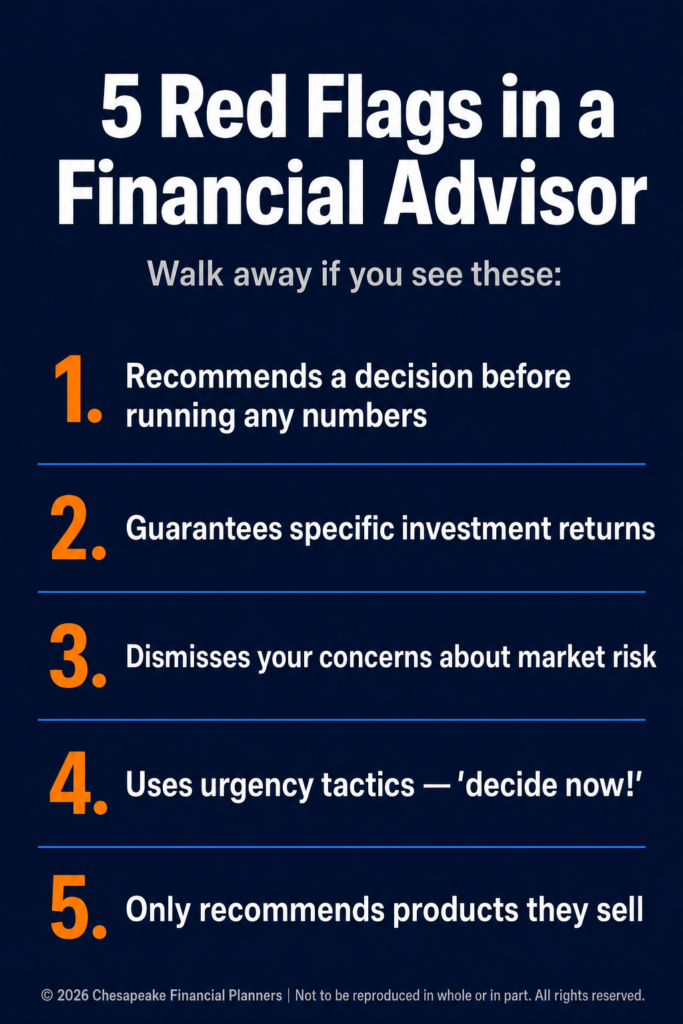
Red Flags to Watch For
Walk away if an advisor:
- Pushes a decision before completing thorough analysis: "Just take the lump sum" without running numbers is malpractice.
- Guarantees specific investment returns: "We'll get you 8% easily" is either overconfident or dishonest.
- Dismisses your concerns: You're worried about market crashes? That fear is valid and should be addressed, not dismissed.
- Uses high-pressure tactics: "This offer expires soon, decide now!" Good advisors help you make timely, not hasty, decisions.
- Only talks about products they sell: If every answer involves buying an annuity or whole life insurance from them, they may not be operating in your best interest.
Can You Do This Yourself?
Honestly? Maybe, if you:
- Have strong financial and investment knowledge
- Are comfortable with Excel or financial calculators
- Understand present value, discount rates, and actuarial concepts
- Can objectively assess your own risk tolerance and biases
- Have time to thoroughly research all variables
But even financially sophisticated people often hire advisors for pension decisions because:
- Blind spots: It's hard to be objective about your own money
- Time: Comprehensive analysis takes 10-20 hours if you're learning as you go
- Consequences: The stakes are too high for trial and error
- Peace of mind: External validation from a professional is worth something
The Bottom Line
A pension versus lump sum decision is one of the most consequential financial choices you'll make. The difference between the optimal and suboptimal choice can easily be six figures over your lifetime.
Seeking advice from a qualified, fiduciary financial planner isn't weakness; it's wisdom. You wouldn't perform surgery on yourself or represent yourself in a complex legal matter. Why make a decision worth hundreds of thousands of dollars without professional guidance?
The key is finding the right advisor: fiduciary, experienced in retirement planning, transparent about compensation, and equipped with the tools to do thorough analysis.
Your pension decision deserves more than guesswork. It deserves a plan.
This information is for educational purposes only and should not be considered financial, tax, or legal advice. Pension decisions involve complex personal and financial factors. Consult with qualified professionals before making any decisions.
Advisors associated with Chesapeake Financial Planners may be either (1) LPL Financial Registered Representatives offering securities through LPL Financial, Member FINRA and SIPC, and investment advisor representatives offering investment advice through Great Valley Advisor Group; or (2) solely investment advisor representatives offering investment advice through Great Valley Advisor Group and not affiliated with LPL Financial. Great Valley Advisor Group, and Chesapeake Financial Planners are separate entities from LPL Financial.
Chesapeake Financial Planners | 2402 Scotlon Ct, Forest Hill, MD 21050 | (410) 652-7868 | www.chesapeakefp.com
© 2026 Chesapeake Financial Planners | Not to be reproduced in whole or in part. All rights reserved.


