

You've left your job and now you're wondering: Should I roll over my old 401(k), or just leave it where it is?
It's tempting to leave it. After all, it's already invested, and dealing with financial paperwork after a job transition feels like one more thing on an already overwhelming to-do list.
But leaving your 401(k) behind isn't always the best move. Let's break down your options, the pros and cons of each, and how to decide what's right for you.
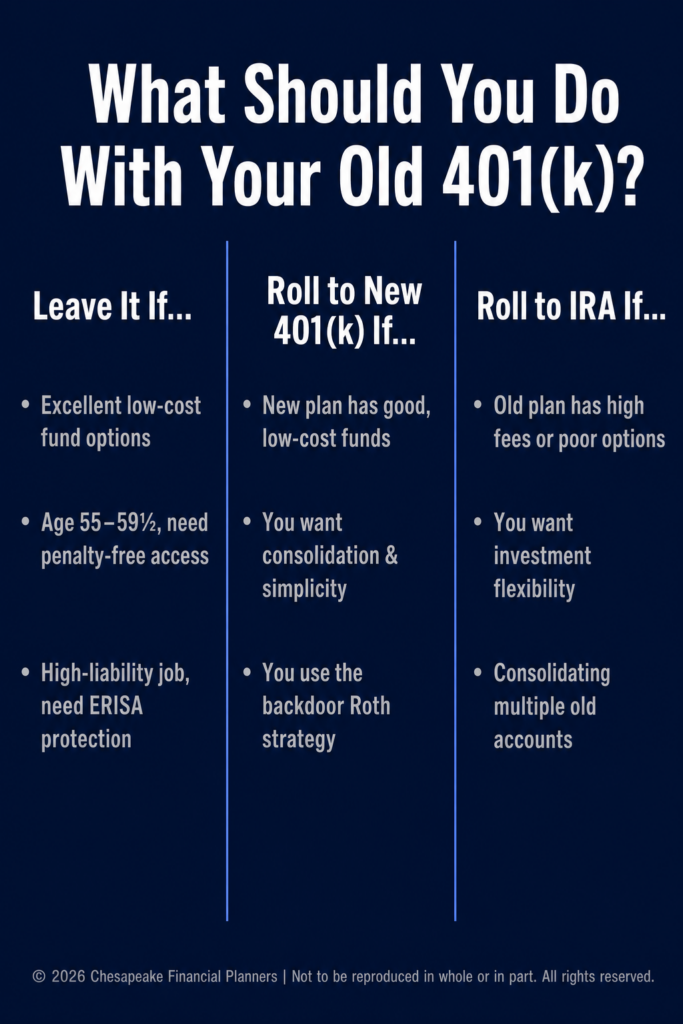
Your 401(k) Rollover Options
When you leave a job, you have four main choices:
- Leave it in your old employer's plan If your balance is over $5,000, most plans allow this.
- Roll it into your new employer's 401(k) — Consolidate your old account with your new one.
- Roll it into an IRA — Transfer it to an Individual Retirement Account, giving you more control and flexibility.
- Cash it out (don't do this) — Take the money now and pay taxes + penalties. Almost always a bad idea.
Let's focus on options 1, 2, and 3—and help you figure out which makes sense.
Option 1: Leave It in Your Old Employer's Plan
Pros:
- Simple and easy — It's already there. No paperwork, no hassle.
- Strong creditor protection — 401(k)s have robust federal protection under ERISA. If you're in a high-liability profession (doctor, business owner), this matters.
- Access to institutional funds — Some 401(k) plans offer institutional-class funds with rock-bottom expense ratios (0.01-0.05%) that aren't available to retail investors.
- Rule of 55 applies — If you left your job at age 55 or later, you can take penalty-free withdrawals from this 401(k) (but not from an IRA until 59½).
Cons:
- Limited investment options — You're stuck with whatever funds your old employer offers—often 10-30 choices, many of which may be mediocre or expensive.
- Forgotten accounts — Out of sight, out of mind. People often forget about old 401(k)s, miss important notices, or lose track during moves.
- No new contributions — You can't add money once you've left the company.
- Poor customer service — Many 401(k) providers have terrible customer service. Good luck getting someone on the phone.
- Potential fees — Some plans charge maintenance fees to former employees. Check your plan documents.
When to leave it:
- Your old 401(k) has excellent low-cost funds
- You're between 55-59½ and may need penalty-free withdrawals
- You value strong creditor protection
- You're organized and won't forget about it
Option 2: Roll It Into Your New Employer's 401(k)
Pros:
- Consolidation — One account is simpler than multiple scattered 401(k)s.
- Easier to manage — Track everything in one place with one login.
- Maintain creditor protection — 401(k)s have strong ERISA protection.
- Simplify RMDs later — When you hit 73, having everything in one account makes Required Minimum Distributions easier.
- Backdoor Roth strategy — If you do backdoor Roth IRA contributions, keeping retirement money in 401(k)s (not IRAs) avoids the pro-rata rule complication.
Cons:
- New plan might have worse options — If your new employer's 401(k) has high fees or limited choices, consolidating there could hurt you.
- Still limited investment options — You're trading one restricted menu for another.
- May have waiting periods — Some plans don't allow rollovers until you've been employed for a certain period.
When to roll into your new 401(k):
- Your new plan has good, low-cost options
- You want simplicity and consolidation
- You're doing backdoor Roth contributions
- You value strong asset protection

Option 3: Roll It Into an IRA
Pros:
- Unlimited investment options — IRAs give you access to thousands of investments—individual equities, bonds, ETFs, mutual funds, and more. You're not limited to your employer's pre-selected menu.
- Lower fees (often) — Many IRAs at low-cost brokerages (Vanguard, Fidelity, Schwab) offer funds with expense ratios as low as 0.03-0.10%. Your 401(k) might charge 0.50-1.00%+.
- Consolidation with other IRAs — If you have existing IRAs, you can combine everything into one account.
- More control — You choose the custodian, the investments, and the strategy. You're not at the mercy of your former employer's plan changes.
- Better customer service — Direct access to your brokerage's support team, not a third-party 401(k) administrator.
Cons:
- Weaker creditor protection — IRAs have some protection (varies by state), but it's generally not as strong as 401(k) ERISA protection.
- No Rule of 55 — If you're 55+ and left your job, rolling to an IRA means losing penalty-free withdrawal access until 59½.
- Potential for higher fees if you choose poorly — If you pick expensive funds or work with a high-fee advisor, an IRA can be more expensive than a 401(k).
- Can complicate backdoor Roth — If you do backdoor Roth contributions, having a Traditional IRA balance triggers the pro-rata rule, making conversions taxable.
When to roll into an IRA:
- Your old 401(k) has high fees or poor investment options
- You want maximum investment flexibility
- You're comfortable managing investments (or working with an advisor)
- You're over 59½ (so Rule of 55 doesn't matter)
- You value control and simplicity
Option 4: Cash It Out (Almost Always a Bad Idea)
Why it's tempting:
You just left your job. Maybe you're unemployed. Cash sounds good.
Why it's terrible:
- The entire distribution is taxable income
- If you're under 59½, you owe an additional 10% penalty
- You lose years (or decades) of tax-deferred growth
Example:
You cash out $50,000 at age 35.
- Taxes (24% bracket): $12,000
- Penalty (10%): $5,000
- You net: $33,000
If you'd left that $50,000 invested for 30 years at 7% returns, it would grow to $380,000+.
You just gave up $347,000 for $33,000 today.
Only cash out if: You're facing true financial catastrophe and have exhausted every other option.
How to Decide: A Simple Framework
Here's how to think through your decision:
Step 1: Does your old 401(k) have excellent options?
- Low-cost index funds (expense ratios under 0.20%)?
- Good fund variety?
If yes: Consider leaving it or rolling to your new 401(k) (if it's equally good).
If no: Roll to an IRA.
Step 2: Are you between 55 and 59½?
- Do you need penalty-free access to this money?
If yes: Leave it in the 401(k).
If no: Rolling to an IRA is fine.
Step 3: Do you have multiple old 401(k)s?
- Are they scattered across several former employers?
If yes: Consolidate them into one IRA or your current 401(k).
If no: You have more flexibility.
Step 4: Do you value simplicity or control?
- Do you want hands-off investing, or do you want full control?
Simplicity: Roll to your new 401(k).
Control: Roll to an IRA.
Step 5: Are you doing backdoor Roth contributions?
- High earner using the backdoor Roth strategy?
If yes: Keep retirement money in 401(k)s (not IRAs) to avoid pro-rata rule.
If no: IRA rollover is fine.
Real-Life Example
Scenario: You're 42, left your job, and have $150,000 in your old 401(k). Your new employer has a decent 401(k) with low-cost index funds. You're comfortable with investing and want flexibility.
Best move: Roll your old 401(k) into an IRA.
Why?
- You're not 55+ (Rule of 55 doesn't apply)
- You want investment flexibility
- You can consolidate any other IRAs
- You're comfortable managing it (or working with an advisor)
Alternative: Roll into your new employer's 401(k) if you value simplicity and want everything in one place.
What If You Have Multiple Old 401(k)s?
If you've changed jobs several times, you might have 401(k)s at 3, 4, or even 5 former employers.
Problem: Scattered accounts are hard to track, prone to being forgotten, and difficult to manage cohesively.
Solution: Consolidate them.
Option A: Roll them all into one IRA. Simplest and gives you full control.
Option B: Roll them all into your current employer's 401(k). Keeps everything in one 401(k) with strong ERISA protection.
Don't Forget About Roth 401(k) Accounts
If your old 401(k) includes Roth 401(k) contributions, roll them into a Roth IRA (not a Traditional IRA).
Why? This preserves the tax-free treatment and eliminates RMDs (Roth 401(k)s have RMDs, but Roth IRAs don't).
How to Execute a Rollover
- Step 1: Choose where to roll it (new 401(k) or IRA).
- Step 2: Open the receiving account (if you don't have one).
- Step 3: Contact your old 401(k) provider and request a direct rollover.
- Step 4: Provide your new account information.
- Step 5: Wait 1-3 weeks for the transfer.
- Step 6: Invest the money (don't let it sit in cash).
Important: Choose a direct rollover, not an indirect one. Direct rollovers avoid taxes and penalties.
The Bottom Line
Should you roll over your old 401(k) or leave it?
Leave it if:
- It has excellent low-cost options
- You're 55-59½ and may need penalty-free withdrawals
- You value strong ERISA protection
Roll it to your new 401(k) if:
- Your new plan has good options
- You want consolidation and simplicity
- You're doing backdoor Roth contributions
Roll it to an IRA if:
- Your old plan has high fees or poor options
- You want investment flexibility and control
- You're consolidating multiple accounts
At Chesapeake Financial Planners, we help clients evaluate their 401(k) rollover options and make smart decisions that align with their goals—not generic advice.
Not sure what to do with your old 401(k)? Let's review your options.
This material is for general information only and is not intended to provide specific advice or recommendations for any individual.
Before rolling over, consider all of your options including leaving assets in your former employer's plan, rolling into a new employer's plan, or taking a cash distribution (taxes and possible withdrawal penalties may apply).
Advisors associated with Chesapeake Financial Planners may be either (1) LPL Financial Registered Representatives offering securities through LPL Financial, Member FINRA and SIPC, and investment advisor representatives offering investment advice through Great Valley Advisor Group; or (2) solely investment advisor representatives offering investment advice through Great Valley Advisor Group and not affiliated with LPL Financial. Great Valley Advisor Group, and Chesapeake Financial Planners are separate entities from LPL Financial.
Chesapeake Financial Planners | 2402 Scotlon Ct, Forest Hill, MD 21050 | (410) 652-7868 | www.chesapeakefp.com
© 2026 Chesapeake Financial Planners | Not to be reproduced in whole or in part. All rights reserved.


