

- Moderate property taxes
The dream is vivid: palm trees, warm winters, maybe a beachfront condo where you can watch the sunset without shoveling snow. But before you list your Maryland home and head south, there's a critical question that deserves more than a passing thought: how will state taxes impact your retirement finances?
Relocating for retirement can offer lifestyle benefits, proximity to family, or a lower cost of living. But state tax differences can mean tens of thousands of dollars over a 25-30 year retirement. The challenge is that "tax-friendly" isn't one-dimensional. A state with no income tax might have high property or sales taxes that offset the savings.
Here's what you need to know to make an informed decision about whether relocating for tax purposes makes financial sense for your retirement.
The State Tax Landscape: What Matters for Retirees
State taxes come in multiple forms, and retirees face a different tax profile than working-age households:
- Income tax: Some states have no income tax, others exempt retirement income, and some tax everything
- Property tax: Often a retiree's largest annual tax expense, especially if the home is paid off
- Sales tax: Impacts daily spending, though groceries and prescriptions are often exempt
- Estate and inheritance taxes: Only a handful of states impose these, but they can significantly impact legacy planning
States With No Income Tax
Nine states have no state income tax: Alaska, Florida, Nevada, New Hampshire (taxes dividends and interest only), South Dakota, Tennessee, Texas, Washington, and Wyoming.
The appeal: Your Social Security benefits, pension income, IRA withdrawals, and investment income are all free from state income tax. For high-income retirees, this can mean $10,000-$20,000+ in annual savings.
The trade-off: These states often make up revenue through higher property taxes, sales taxes, or other fees. Texas, for example, has some of the highest property tax rates in the nation. Washington has a 6.5% state sales tax (higher with local taxes).
Who benefits most: Retirees with substantial taxable retirement income (large 401(k)/IRA balances, pensions, investment income) but moderate home values and spending benefit most from no-income-tax states.
States That Don't Tax Retirement Income
Several states with income taxes fully exempt retirement income, including Social Security, pension income, and IRA/401(k) distributions:
- Full exemptions: Illinois, Iowa, Mississippi, Pennsylvania
- Partial or generous exemptions: Alabama, Georgia, Hawaii, South Carolina
Pennsylvania stands out: No tax on retirement income, but property and sales taxes are moderate. This makes Pennsylvania particularly attractive for retirees with high retirement income but who want to stay in the Mid-Atlantic region.
The Most Tax-Friendly States for Retirees

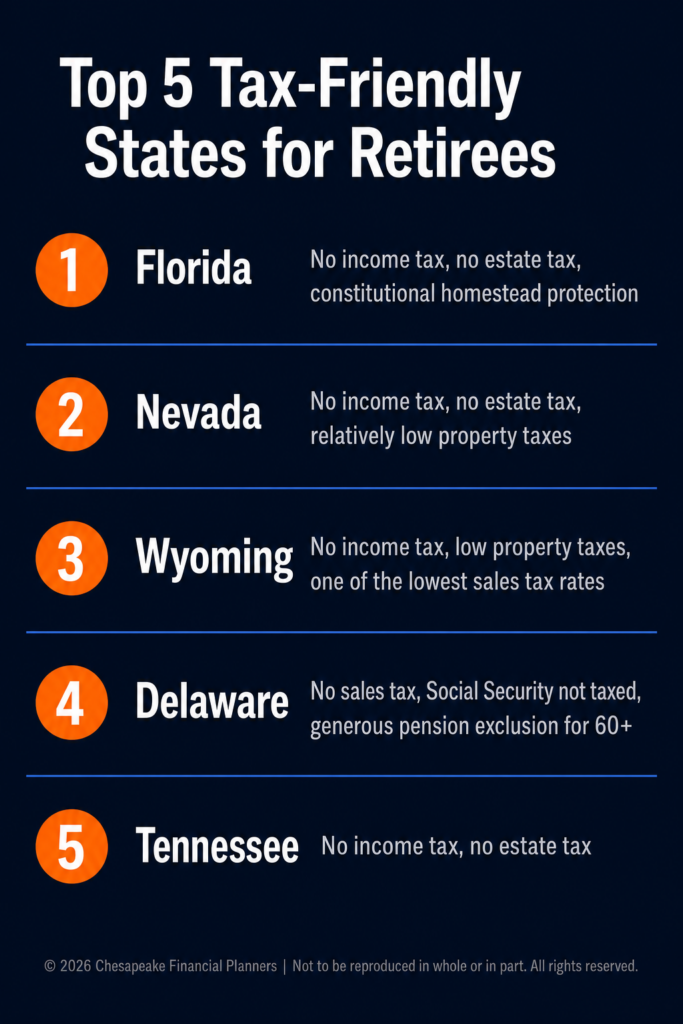
When combining income, property, and sales taxes, these states consistently rank as most tax-friendly for retirees:
Florida
- No state income tax
- No estate or inheritance tax
- Moderate property taxes (though rising in popular areas)
- Constitutional homestead protection for primary residence
- 6% sales tax (exempts groceries and prescriptions)
Ideal for: Retirees with substantial retirement income, especially those who don't need high property values
Nevada
- No state income tax
- No estate or inheritance tax
- Relatively low property taxes
- 6.85% sales tax
- Lower overall cost of living in many areas
Ideal for: Active retirees seeking lower cost of living with tax benefits
Wyoming
- No state income tax
- Low property taxes
- 4% sales tax (one of the lowest)
- No estate tax
- Excellent for outdoor enthusiasts
Ideal for: Retirees seeking rural or small-town living with minimal taxation
Delaware
- No sales tax
- Moderate income tax (2.2%-6.6%)
- Generous pension exclusion ($12,500 for those over 60)
- Social Security benefits not taxed
- Moderate property taxes
Ideal for: Retirees who want to stay on the East Coast with lower overall tax burden and no sales tax
Tennessee
- No state income tax (eliminated tax on investment income in 2021)
- No estate or inheritance tax
- Moderate property taxes
- 7% sales tax (but groceries taxed at lower rate)
Ideal for: Retirees seeking lower cost of living in the South with no income tax
The Least Tax-Friendly States for Retirees
On the opposite end, these states impose relatively high tax burdens on retirees:
- California: High income tax (up to 13.3%), high sales tax, expensive property taxes in popular areas
- New York: High income tax (up to 10.9%), high property taxes, estate tax ($7.35 million exemption)
- Connecticut: Income tax on retirement income, estate tax ($13.61 million exemption), high property taxes
- New Jersey: High property taxes (among the nation's highest), estate tax was eliminated but inheritance tax remains
- Minnesota: Taxes Social Security benefits for higher earners, high income tax rates
Beyond the Tax Bill: Hidden Costs of Relocating
Cost of living differences: A low-tax state with a high cost of living may not save you money. Compare housing costs, insurance (homeowners and auto can vary dramatically), healthcare access and costs, and everyday expenses.
Healthcare quality and access: Medicare works nationwide, but provider networks, hospital quality, and access to specialists vary. Don't sacrifice healthcare quality for tax savings.
Estate planning complications: Owning property in multiple states can complicate estate administration. If you maintain a home in Maryland and buy in Florida, your estate may need to go through probate in both states.
Residency requirements: Establishing legal residency isn't as simple as buying a home. You'll need to prove domicile by registering to vote, obtaining a driver's license, updating your will, and spending more than six months per year in the new state. States like California and New York are aggressive about auditing claimed relocations.
The Maryland Factor: Is Leaving Worth It?
Maryland's tax structure (combined state and local income tax up to 8.95%) makes it one of the higher-tax states, but it offers specific exemptions:
- Social Security fully exempt if AGI is under $125,000 (married) or $100,000 (single)
- Pension exclusion up to $40,600 per person age 65+ (reduced by Social Security benefits)
- Strong property tax credits for seniors
- Excellent healthcare infrastructure
When leaving Maryland makes sense:
- Your retirement income significantly exceeds the Social Security exemption thresholds
- You're paying high property taxes in a desirable area with appreciated home value
- You have strong personal reasons to relocate (family, lifestyle, health)
- You're in good health and won't need frequent specialist care
When staying in Maryland makes sense:
- Your income qualifies for Social Security exemption and pension exclusion
- You're established in a community with strong social ties
- You value proximity to family in the region
- You benefit from Maryland's healthcare infrastructure (Johns Hopkins, University of Maryland Medical Center, etc.)
How to Evaluate a Potential Move
Step 1: Calculate Your Current Tax Burden
Add up your Maryland state income tax, local income tax, property tax, and estimated sales tax paid annually. This is your baseline.
Step 2: Project Taxes in Target States
Use online calculators or work with a tax professional to estimate your total state and local tax burden in states you're considering. Don't just compare income taxes factor in property and sales taxes.
Step 3: Compare Total Cost of Living
Use tools like Bankrate or NerdWallet's cost of living calculators. A state with lower taxes but 30% higher housing costs may not be a financial win.
Step 4: Visit (Multiple Times)
Visit your target destination in different seasons. Snowbirds love Florida in February but may not realize how oppressive the heat and humidity are from June to September.
Step 5: Consider a Trial Run
Rent for six months to a year before selling your primary residence. This lets you test the lifestyle, climate, and community before making an irreversible decision.
Snowbird Strategy: Best of Both Worlds?
Some retirees split time between two states, six months in Maryland (spring and fall) and six months in Florida (winter) or Arizona. This offers lifestyle benefits but comes with complications:
Tax residency: You can only be a tax resident of one state. To claim Florida residency and avoid Maryland taxes, you must establish Florida as your domicile and spend more than six months per year there.
Two homes: Maintaining two properties means double property taxes, insurance, maintenance, and utilities. Make sure the tax savings justify these costs.
Medicare and healthcare: Your Medicare coverage is nationwide, but if you have Medicare Advantage, check network coverage in both locations.
The Non-Financial Factors
Taxes matter, but they're not everything. Consider:
- Family proximity: Are you near children and grandchildren? Will you regret being 1,000 miles away?
- Social networks: Established friendships and community ties have immense value in retirement
- Climate preferences: Do you genuinely prefer the target state's climate year-round?
- Activities and lifestyle: Does the location support your hobbies and interests?
Next Steps
Relocating for retirement is a major life decision that deserves careful analysis. Tax savings can be substantial, but only if the total picture (cost of living, healthcare access, lifestyle fit, and family proximity) makes sense.
If you're seriously considering a relocation for tax reasons, a comprehensive analysis should compare your current tax burden with projected taxes in target states, factor in total cost of living differences, and stress-test the decision against various retirement scenarios.
The goal isn't to chase the lowest tax bill. It's to find the location where your retirement dollars go furthest while supporting the lifestyle and priorities that matter most to you.
This content is for educational purposes only and should not be construed as specific tax or legal advice. State tax laws are complex and subject to change. Relocation and tax residency decisions should be made in consultation with qualified tax and legal professionals who understand your complete financial situation.
Advisors associated with Chesapeake Financial Planners may be either (1) LPL Financial Registered Representatives offering securities through LPL Financial, Member FINRA and SIPC, and investment advisor representatives offering investment advice through Great Valley Advisor Group; or (2) solely investment advisor representatives offering investment advice through Great Valley Advisor Group and not affiliated with LPL Financial. Great Valley Advisor Group, and Chesapeake Financial Planners are separate entities from LPL Financial.
Chesapeake Financial Planners | 2402 Scotlon Ct, Forest Hill, MD 21050 | (410) 652-7868 | www.chesapeakefp.com
© 2026 Chesapeake Financial Planners | Not to be reproduced in whole or in part. All rights reserved.


