

You're thinking about selling your business in the next 2-5 years. You know preparation matters, but you're not sure where to start or what actually moves the needle on value.
Here's what most business owners don't realize: the work you do in the years before you sell can add hundreds of thousands, or even millions, to your sale price. But starting six months before you list the business is too late. The changes that create real value take time to implement and demonstrate.
The uncomfortable truth: Many businesses sell for 30-50% less than they could have because owners waited until they were ready to exit before thinking about maximizing value.
Smart preparation focuses on the specific factors buyers care about most and begins years in advance, not months.
Why Preparation Dramatically Impacts Sale Price
Buyers evaluate risk and opportunity. Every weakness they identify becomes a negotiating point to reduce price. Every strength you demonstrate increases what they're willing to pay.
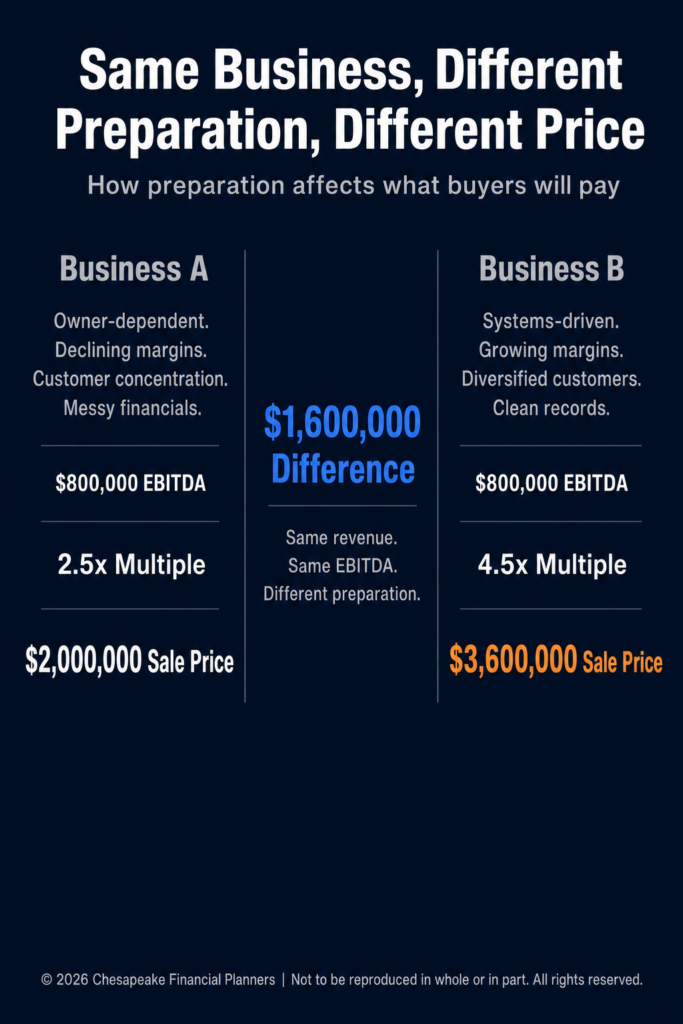
Two businesses with identical revenue:
- Business A: Owner-dependent, declining margins, customer concentration, messy financials → Sells for 2.5x EBITDA
- Business B: Systems-driven, growing margins, diversified customers, clean records → Sells for 4.5x EBITDA
On $800,000 EBITDA, that's a $1.6 million difference in sale price. Same business, different preparation.
The High-Impact Preparation Areas
Focus your energy where it creates the most value:
Clean, Growing Financial Statements
Buyers want three years of clean, audited or reviewed financial statements showing consistent profitability and growth.
What "clean" means:
- Accurate accounting on accrual basis (not just cash)
- Clear separation of business and personal expenses
- Well-documented add-backs for owner compensation and one-time expenses
- Consistent accounting methods across years
- No unexplained anomalies or irregularities
What "growing" means:
- Revenue growth over 3-5 years (even modest 5-10% annually)
- Stable or improving profit margins
- Strong cash flow generation
- Clear story explaining any down years
Action steps:
- Hire experienced CPA if you don't have one
- Move to accrual accounting if still on cash basis
- Stop running personal expenses through the business
- Build financial statements that buyers can trust without extensive due diligence
Timeline: 3+ years before sale. Buyers want to see multi-year trends.
Reduce Owner Dependence
The #1 buyer fear: "If the owner leaves, the business collapses."
High owner dependence looks like:
- Owner is the primary salesperson
- Owner maintains all key customer relationships
- Owner makes all operational decisions
- Owner possesses unique technical knowledge
- No written systems or procedures
Low owner dependence looks like:
- Management team runs day-to-day operations
- Sales team generates new business
- Customer relationships are institutional, not personal
- Systems and procedures are documented
- Business operates smoothly when owner is away
Action steps:
- Hire or develop strong management team
- Document all systems and procedures
- Transition customer relationships to company, not just you
- Build sales team and processes
- Test by taking extended vacation does business run smoothly?
Timeline: 2-5 years. Management teams need time to prove themselves.
Diversify Customer Base
Customer concentration is a massive risk factor buyers discount heavily for.
Problem scenarios:
- Top 3 customers represent 60%+ of revenue
- Losing any single customer would severely harm the business
- Few long-term contracts or recurring revenue
- High customer churn
Attractive scenarios:
- No single customer exceeds 10-15% of revenue
- Broad, diversified customer base
- High customer retention (90%+)
- Recurring contracts providing revenue predictability
Action steps:
- Actively develop new customer relationships
- Avoid over-dependence on any single account
- Create recurring revenue through subscriptions or retainers
- Measure and improve customer retention
- Document customer relationships and satisfaction
Timeline: 3-5 years. Building diverse customer base takes time.
Document Systems and Processes
Businesses with documented, repeatable processes are worth significantly more than those relying on tribal knowledge.
What to document:
- Sales and marketing processes
- Operations and delivery workflows
- Customer service procedures
- Financial management systems
- Hiring and training protocols
- Vendor and supplier relationships
- Technology systems and infrastructure
How to document:
- Standard operating procedures (SOPs) for key functions
- Employee handbooks and training materials
- Process flowcharts and checklists
- Video tutorials for complex procedures
- Clear organizational charts and role descriptions
Action steps:
- Start with most critical processes first
- Involve employees who do the work
- Test documentation by having new hires use it
- Update regularly as processes evolve
- Store in accessible, organized system
Timeline: 2-3 years. Proper documentation is extensive work.
Build Management Depth
Buyers pay premiums for businesses with strong management teams, not lone-wolf operators.
Signs of weak management:
- Owner is the only senior leader
- Key employees are near retirement with no succession plan
- High employee turnover
- Lack of clear roles and responsibilities
- No formal performance management
Signs of strong management:
- Capable COO, CFO, or VP-level team
- Clear succession plans for key roles
- Low employee turnover
- Well-defined org chart
- Professional HR practices
Action steps:
- Identify gaps in management team
- Hire or promote capable leaders
- Delegate significant responsibility to management
- Create succession plans for critical roles
- Implement professional management practices
Timeline: 3-5 years. Hiring and proving management takes time.
Grow Revenue and Profitability
Nothing increases value more than demonstrated growth with healthy margins.
Focus areas:
- Revenue growth through new customers, products, or markets
- Margin improvement through operational efficiency
- Pricing optimization (many businesses are underpriced)
- Cost reduction without sacrificing quality
- Clear growth opportunities buyers can pursue
Action steps:
- Implement strategies that demonstrably improve financial performance
- Track and improve key metrics (revenue per employee, gross margin, EBITDA margin)
- Eliminate unprofitable products or services
- Invest in growth initiatives with measurable ROI
- Create documented growth strategy for buyers
Timeline: 2-5 years. Buyers want to see sustained trends, not one-time spikes.
Clean Up Legal and Compliance Issues
Due diligence will uncover every skeleton in your closet. Address issues before buyers find them.
Common problems:
- Outstanding litigation or disputes
- Environmental liabilities
- Unclear ownership or equity structure
- Missing intellectual property protection
- Vendor or customer contract issues
- Regulatory compliance gaps
- Employment law violations
- Tax issues or audits
Action steps:
- Conduct internal audit of legal and compliance issues
- Resolve outstanding disputes
- Clean up corporate structure and documentation
- Protect intellectual property (trademarks, patents, copyrights)
- Review and update key contracts
- Address regulatory compliance proactively
- Resolve tax issues before they become problems
Timeline: 2-3 years. Some issues take time to fully resolve.
Establish Recurring Revenue Streams
Predictable, recurring revenue dramatically increases valuation multiples.
Transformation examples:
- Product business adds subscription support plans
- Service business converts to retainer model
- Software business moves to SaaS subscription
- Maintenance and support contracts for equipment sales
Why it matters:
- Reduces buyer risk through predictable cash flow
- Improves margins (recurring revenue often has higher margins)
- Increases customer lifetime value
- Demonstrates pricing power and customer satisfaction
Action steps:
- Analyze opportunities to create recurring revenue
- Test subscription or retainer models with existing customers
- Build infrastructure to support recurring billing
- Measure and optimize churn rates
- Grow recurring revenue as percentage of total
Timeline: 2-4 years. Transitioning business model takes time.
The 18-Month Sprint: Final Preparation
Once you're 12-18 months from listing:
Assemble your transaction team:
- M&A advisor or business broker
- Transaction attorney
- CPA specializing in business sales
- Financial advisor for post-sale planning
Complete final preparation:
- Get professional business valuation
- Prepare detailed CIM (Confidential Information Memorandum)
- Address any remaining value gaps
© 2026 Chesapeake Financial Planners | Not to be reproduced in whole or in part. All rights reserved.


