
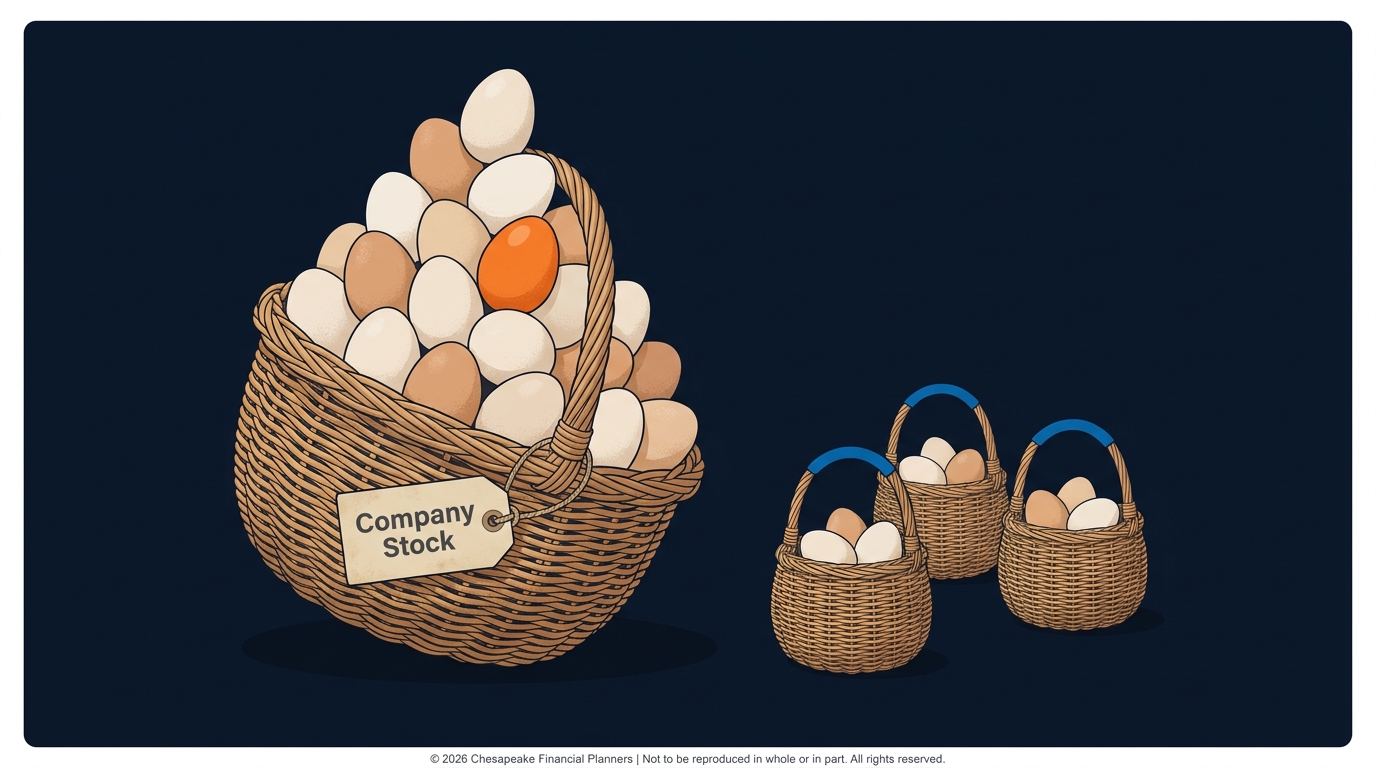
You log into your brokerage for the first time in months. Between vested RSUs, ESPP shares, and exercised options, your company stock is now 73% of your net worth.
Your advisor says diversify. Your colleague says "just hold it look at our performance." Your spouse gets nervous every time the stock dips 5%.
So what's the right number?
The Industry Standard: 10-15% Maximum
Financial advisors typically recommend limiting any single stock to 5-10% of your portfolio. For employer stock, most suggest below 10-15% maximum.
Why so conservative? Because holding company stock creates double jeopardy:
Risk 1
Risk 2
When both income and wealth depend on one company, you're not diversified; you're making a leveraged bet.
Enron, Lehman Brothers, WeWork employees lost both jobs and savings. Even at stable companies like GE, employees holding concentrated positions through the 70% decline (2016-2020) lost decades of wealth.
What Does 10% Actually Mean?
Calculate your concentration:
(Company stock value ÷ Total investable assets) × 100
Example: Safe Concentration
- 401(k): $200,000
- IRA: $50,000
- Diversified brokerage: $100,000
- Company stock: $50,000
- Concentration: 12.5% ✅
Example: Dangerous
- 401(k): $75,000
- Diversified brokerage: $25,000
- Company stock: $300,000
- Concentration: 75% ⚠️
A 40% stock drop wipes out 30% of total net worth.
Warning Signs You're Too Concentrated
- Red Flag 1: You check stock price multiple times daily
- Red Flag 2: Can't buy a house without selling company stock
- Red Flag 3: Defending position emotionally ("I know the company better than the market")
- Red Flag 4: A 50% drop would derail your financial plan
Your executives sell regularly through 10b5-1 plans. They diversify. You should too.
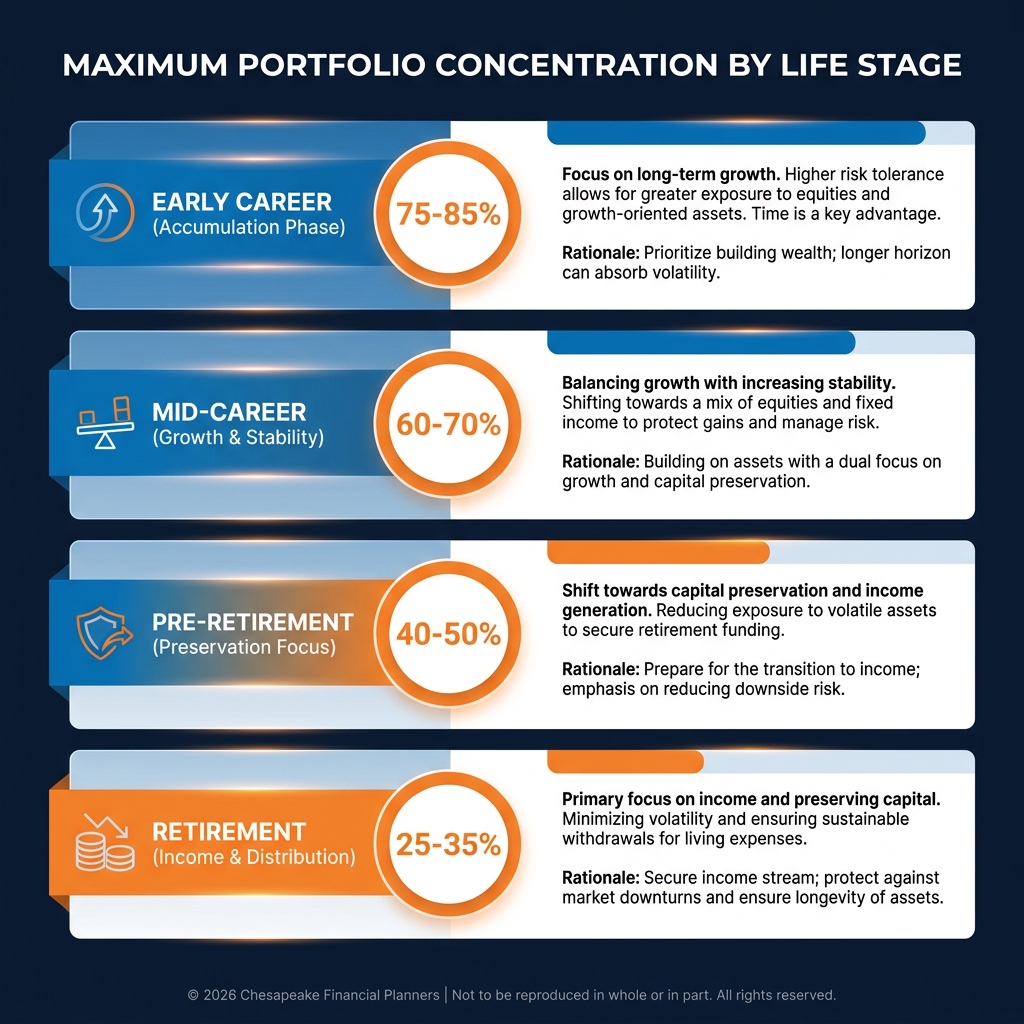
How Much at Different Life Stages?
- In your 20s and early 30s: 15-25% acceptable (time to recover, higher risk tolerance)
- Mid-30s to 40s: 10-15% (peak earning years, but growing obligations)
- Late 40s and 50s: 5-10% (approaching retirement, reducing risk)
- Within 10 years of retirement: 0-5% (no time to recover from major loss)
How to Get from Overconcentrated to Diversified
Strategy 1: Systematic Liquidation
Sell fixed percentage every quarter until hitting target.
Example: 60% concentration, target 15%
- Sell 10% of holdings every quarter for 5 quarters
- Result: Diversified in 15 months
Strategy 2: Hard Cap
- Set dollar cap (e.g., "max $500K in company stock")
- Anytime vesting/appreciation pushes over cap, sell excess immediately
Strategy 3: Trigger-Based
Sell when events occur:
- Stock hits price target
- After earnings (when windows open)
- After hitting 1-year capital gains period
Strategy 4: Tax-Optimized
- Donate appreciated shares to charity (avoid gains, get deduction)
- Gift shares to family in lower brackets
- Tax-loss harvest other positions to offset gains
What to Do With Proceeds
Reinvest immediately:
- 60-70% diversified stock index funds
- 20-30% bonds
- 10% alternatives or cash
Don't sit in cash waiting. Markets trend up—you'll miss growth.

The Mindset Shift
Selling feels like disloyalty or betting against your employer.
But your company gave you equity because it's cheaper than cash. Your executives? They diversify regularly.
Diversification isn't pessimistic—it's prudent. It's how you build lasting wealth that survives market cycles, disruption, and company-specific problems.
You worked hard for that equity. Don't gamble it all on a single bet.
This content is for educational purposes only and should not be considered as investment, tax, or legal advice. Every situation is unique. Consult with a qualified financial advisor before making investment decisions.
Diversification does not guarantee profit or protect against loss. All investments carry risk, including potential loss of principal.
Concentration percentages are general guidelines and may not be appropriate for all investors.
Advisors associated with Chesapeake Financial Planners may be either (1) LPL Financial Registered Representatives offering securities through LPL Financial, Member FINRA and SIPC, and investment advisor representatives offering investment advice through Great Valley Advisor Group; or (2) solely investment advisor representatives offering investment advice through Great Valley Advisor Group and not affiliated with LPL Financial. Great Valley Advisor Group, and Chesapeake Financial Planners are separate entities from LPL Financial.
Chesapeake Financial Planners | 2402 Scotlon Ct, Forest Hill, MD 21050 | (410) 652-7868 | www.chesapeakefp.com
© 2026 Chesapeake Financial Planners | Not to be reproduced in whole or in part. All rights reserved.


