

You're ready to sell your business. You've built something valuable, and now it's time to exit. So you start researching the process and discover a frustrating reality: nobody can tell you exactly how long it will take.
"Six months to two years" is the typical answer. That's an enormous range. If you're trying to plan retirement, coordinate with a new opportunity, or simply want to move forward with life, uncertainty about timeline creates stress and complicates decision-making.
Here's the truth: Business sale timelines vary dramatically based on factors within your control and factors beyond it. Understanding what drives timing helps you set realistic expectations and optimize the process.
Some businesses sell in 4-6 months. Others sit on the market for years. The difference isn't luck it's preparation, pricing, market conditions, and deal complexity.
The Typical Business Sale Timeline
Here's how the process typically unfolds for a well-prepared small to mid-sized business:
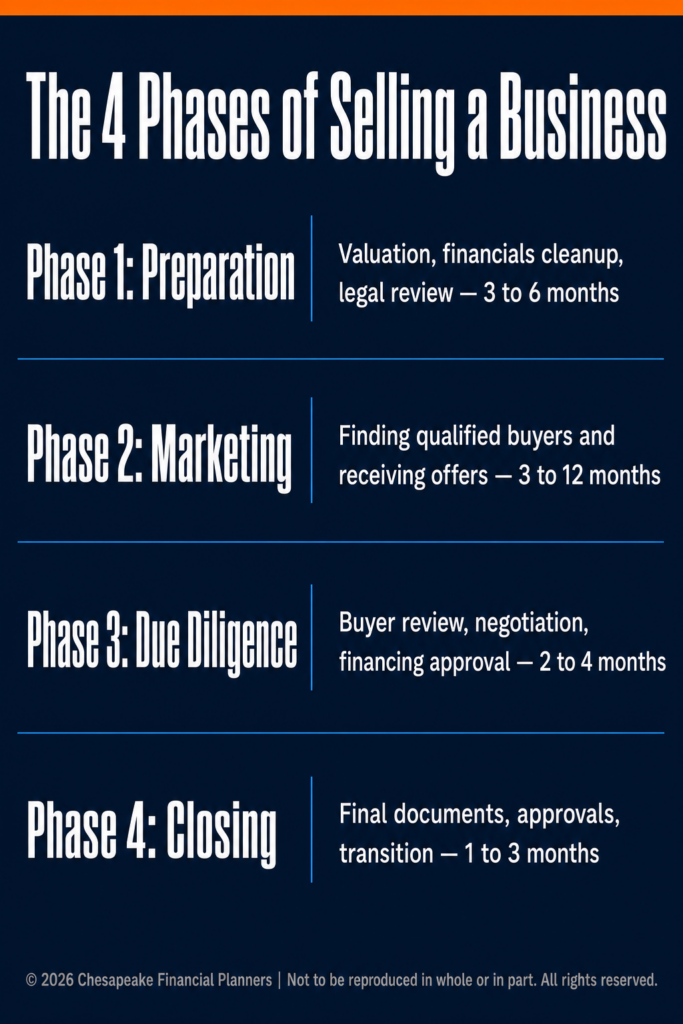
Phase 1: Preparation (3-12 Months Before Listing)
Before you even list the business, you need:
- Business valuation: 2-4 weeks
- Financial statement preparation: 4-8 weeks
- Legal and compliance cleanup: 4-12 weeks
- Marketing materials (CIM) creation: 2-4 weeks
- Advisor engagement (broker, attorney, CPA): 2-4 weeks
Total preparation time: 3-6 months if you're starting from a reasonably clean position. Add 6-12 months if you have significant issues to address (weak financials, legal problems, operational gaps).
Key insight: Businesses that skip thorough preparation often waste months fixing issues during due diligence or negotiating from a weak position. Time invested in preparation pays dividends in faster sales and better terms.
Phase 2: Marketing and Finding Buyers (3-12 Months)
Once you list the business:
- Market outreach and advertising: Ongoing
- Initial buyer inquiries and screening: 4-8 weeks
- Serious buyer meetings and presentations: 4-8 weeks
- Receiving offers or LOIs (Letters of Intent): 6-16 weeks
Total marketing time: 3-12 months depending on business complexity, market conditions, and buyer pool size.
Key variables:
- Businesses under $1 million typically sell faster (larger buyer pool)
- Businesses over $5 million often take longer (fewer qualified buyers)
- Niche businesses can take longer to find right buyer
- Well-marketed businesses generate offers faster
Phase 3: Due Diligence and Negotiation (2-4 Months)
After accepting an offer:
- LOI negotiation and execution: 1-3 weeks
- Buyer due diligence: 4-12 weeks
- Final purchase agreement negotiation: 2-6 weeks
- Financing approval (if buyer needs it): 4-8 weeks
Total due diligence and negotiation: 2-4 months for straightforward deals. Complex businesses, multiple entities, or significant issues can extend this to 6-9 months.
Key insight: 30-50% of deals fall apart during due diligence. Issues that weren't addressed in preparation become deal-killers or result in significant price reductions.
Phase 4: Closing and Transition (1-2 Months)
- Final documentation: 2-4 weeks
- Regulatory approvals (if needed): 2-8 weeks
- Closing: 1-2 days
- Post-closing transition: Varies (often 30-90 days)
Total closing time: 1-3 months from final agreement to closing.
Total Timeline: 9-24 Months
From beginning preparation to closing:
- Fast track (well-prepared, easy sale): 9-12 months
- Typical (some preparation needed, normal process): 12-18 months
- Slow track (significant prep needed, complex deal): 18-36+ months
Factors That Speed Up the Sale

You can influence several factors to accelerate your timeline:
Strong Financial Performance
Businesses with consistent, growing profitability and clean financial statements sell faster. Buyers can quickly assess value and move to offers.
Reasonable Pricing
Businesses priced at or slightly below market value sell much faster than those priced aggressively. Overpriced businesses sit on the market for months, then sell at discounts anyway.
Owner Readiness
Sellers who are emotionally and financially ready to exit negotiate more efficiently and don't drag out the process with indecision or frequent term changes.
Multiple Qualified Buyers
Competition among buyers creates urgency. Businesses marketed effectively to multiple prospects move faster than those quietly offered to one or two parties.
Minimal Complexity
Simpler businesses with straightforward operations, one location, and clean legal structures close faster than complex, multi-entity businesses with regulatory issues.
Professional Representation
Experienced M&A advisors or business brokers know how to navigate the process efficiently, anticipate issues, and keep deals moving forward.
Factors That Slow Down the Sale
Several factors extend timelines significantly:
Poor Financial Documentation
Messy books, cash-basis accounting, or missing records force lengthy cleanup during due diligence. Some buyers walk away rather than wait.
Unrealistic Pricing
Overpriced businesses waste 6-12 months on the market before sellers accept reality and reduce price. By then, serious buyers have moved on.
Owner Dependence
Businesses that can't operate without the owner create buyer hesitation. Proving the business will succeed post-sale takes time.
Limited Buyer Pool
Highly specialized or niche businesses have fewer qualified buyers. Finding the right match takes longer.
Financing Challenges
If buyers need SBA loans or bank financing, add 2-4 months to the timeline. Cash buyers close much faster.
Legal or Compliance Issues
Environmental problems, litigation, regulatory violations, or intellectual property disputes can stall deals for months or kill them entirely.
Seller Ambivalence
Owners who aren't truly ready to sell unconsciously sabotage deals through unreasonable demands, moving goalposts, or simply dragging their feet.
Industry and Size Considerations
Small Businesses ($500K – $2M)
- Typical timeline: 6-12 months
- Why: Larger buyer pool, simpler structures, often sold through brokers with established processes
Mid-Sized Businesses ($2M – $10M)
- Typical timeline: 12-18 months
- Why: More complex, require sophisticated buyers, extensive due diligence, often involve earnouts or seller financing
Larger Businesses ($10M+)
- Typical timeline: 18-36 months
- Why: Limited buyer pool (usually private equity or strategic acquirers), extensive due diligence, complex deal structures
Industry-Specific Timing
- Fast-selling industries: Established franchises, healthcare practices, successful restaurants
- Slow-selling industries: Manufacturing with specialized equipment, businesses in declining industries, highly regulated businesses
When Deals Fall Apart (And How to Recover)
30-50% of business sales fall through. Common reasons:
- Buyer financing falls through: 2-3 months wasted, restart with backup buyer
- Due diligence reveals problems: Can kill deal or force major price reduction
- Buyer develops cold feet: Common with first-time business buyers
- Seller changes mind: Sometimes owners realize they're not ready
Recovery strategy: Have backup buyers in the pipeline, address issues quickly, keep alternatives open during due diligence.
How to Accelerate Your Timeline
- Start preparation early (12-24 months before listing)
- Price competitively based on professional valuation
- Market broadly to multiple qualified buyers simultaneously
- Respond quickly to buyer requests and questions
- Use experienced professionals who know how to keep deals moving
- Address issues proactively before they become deal-killers
- Stay flexible on terms while protecting core interests
- Maintain business performance throughout the process (buyers notice if performance drops)
Setting Realistic Expectations
If you need to close within 6 months: Unless you have a ready buyer, this is unlikely for most businesses. Consider whether you're truly ready to sell or need more time.
If you have 12-18 months: This is a realistic timeline for well-prepared businesses with proper pricing and marketing.
If you're in no rush: Take 24-36 months to thoroughly prepare, maximize value, and find the ideal buyer on favorable terms.
Your Action Plan
12-18 months before target sale:
- Get professional business valuation
- Address value gaps and preparation needs
- Clean up financial and legal issues
- Strengthen management team
6-12 months before target sale:
- Engage M&A advisor or broker
- Prepare comprehensive marketing materials
- Begin confidential buyer outreach
- Assemble transaction team (attorney, CPA, advisor)
During active marketing:
- Respond promptly to qualified buyer inquiries
- Conduct professional meetings and presentations
- Negotiate terms efficiently
- Maintain business performance
The timeline for selling your business isn't fixed, but it's also not entirely unpredictable. Proper preparation, realistic pricing, and professional execution dramatically increase the odds of a fast, successful sale.
Planning to sell your business? **Schedule a consultation** to create your optimal exit timeline and strategy.
The information provided is for educational purposes only and should not be construed as business or legal advice. Business sale timelines vary widely based on individual circumstances. Consult with qualified M&A professionals regarding your specific situation.
Advisors associated with Chesapeake Financial Planners may be either (1) LPL Financial Registered Representatives offering securities through LPL Financial, Member FINRA and SIPC, and investment advisor representatives offering investment advice through Great Valley Advisor Group; or (2) solely investment advisor representatives offering investment advice through Great Valley Advisor Group and not affiliated with LPL Financial. Great Valley Advisor Group, and Chesapeake Financial Planners are separate entities from LPL Financial.
Chesapeake Financial Planners | 2402 Scotlon Ct, Forest Hill, MD 21050 | (410) 652-7868 | www.chesapeakefp.com
© 2026 Chesapeake Financial Planners | Not to be reproduced in whole or in part. All rights reserved.


