
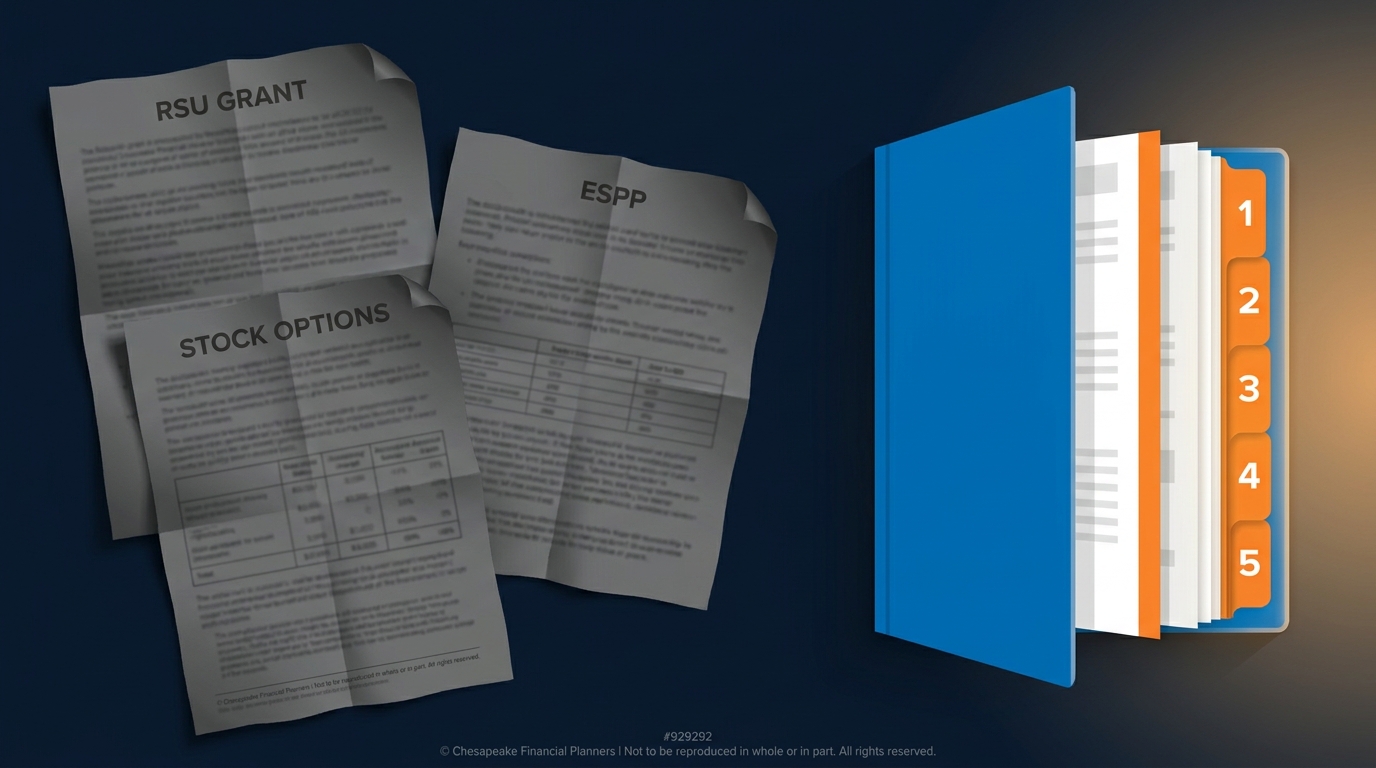
You're earning $200,000 or more in total comp. RSUs vest quarterly. Stock options sit in your Schwab account. You've got $150,000 in cash that you should do something with. Your 401(k) is on autopilot. And you have no idea if you're on track for any of your actual financial goals.
Sound familiar?
Tech professionals are exceptional at building products, scaling infrastructure, and solving complex problems. But when it comes to personal finance, most are winging it and leaving hundreds of thousands on the table through poor planning.
Let's fix that.
Why Tech Comp Makes Financial Planning Different
Traditional financial advice assumes W2 salary, maybe a 401(k) match, and straightforward tax returns. That doesn't work for tech professionals.
What makes tech comp unique:
- Equity is 30 to 50% of total comp. RSUs, stock options, and ESPP shares. Each has different tax treatment, vesting schedules, and risks.
- Income is lumpy. $80,000 salary plus $120,000 in RSU vesting isn't the same as a $200,000 salary. Cash flow planning requires different strategies.
- Tax complexity includes these. AMT, disqualifying dispositions, wash sales, and multi state taxation if you've moved. Your tax return isn't TurboTax friendly.
- Concentration risk. Your salary, equity, benefits, and often your investment portfolio are tied to one company. Diversification is critical but emotionally hard.
- Career volatility includes these. Layoffs, job changes, and acquisition uncertainty. Planning must accommodate short-term income disruptions.
You need a financial plan built for tech compensation, not a generic retirement calculator.

The 5 Pillars of Financial Planning for Tech Professionals
1. Cash Flow & Liquidity Management
The challenge is this. Your W2 salary might be $150,000, but $100,000 in RSUs vest quarterly. Quarterly vesting creates uneven cash flow. How much should you keep liquid vs. invest?
The framework includes these.
- Emergency fund. Keep 6 to 12 months of essential expenses in high yield savings. Tech jobs are volatile. Layoffs happen even at stable companies.
- Tax reserves. Set aside 35 to 40% of RSU vesting immediately for taxes. Don't spend it. It's not your money. It's the IRS's money.
- Short term goals from 0 to 3 years. House down payment, wedding, or sabbatical. Keep this in cash or short term bonds. Don't invest money you need within 3 years in stocks.
- Long term investments of 3 or more years. Everything else goes into diversified investments. Don't let cash pile up uninvested because you "don't know what to do with it."
2. Equity Compensation Strategy
The challenge includes these. RSUs, ISOs, NSOs, and ESPP. Each requires different strategies.
RSU strategy:
- Sell at vest to avoid concentration risk, unless you're confident maintaining 10 to 15% employer stock allocation
- Set aside 35 to 40% immediately for taxes
- Reinvest proceeds into diversified portfolio
Stock options strategy includes these.
- ISOs. Consider early exercise if strike price is near FMV. File 83(b) election within 30 days. Run AMT projections before exercising.
- NSOs. Exercise only when you have liquidity from acquisition, IPO, or secondary market, or you're leaving the company. Don't exercise and hold illiquid shares.
ESPP strategy includes these.
- Max out contributions at 15% of salary up to $25,000 annual limit
- Sell immediately at purchase as disqualifying disposition
- Capture the 15% discount, pay taxes, diversify proceeds
Concentration limit:
Never let employer stock exceed 15 to 20% of your net worth. Diversify systematically.
3. Tax Optimization
The challenge is this. Your effective tax rate is probably 10 to 15 percentage points higher than it needs to be.
High impact strategies include these.
Max out tax advantaged accounts.
- 401(k) at $24,500 for 2026 ($32,500 if age 50+; $35,750 if ages 60–63 under SECURE 2.0 super catch-up)
- Backdoor Roth IRA: $7,500 if income exceeds direct Roth limits ($8,600 if age 50+)
- Mega Backdoor Roth if your plan allows up to $47,500 additional after tax contributions converted to Roth
- HSA at $4,400 for individual or $8,750 for family with triple tax advantage
Tax loss harvesting.
Systematically harvest investment losses to offset RSU income and capital gains. This alone can save $5,000 to $15,000 annually.
Charitable giving if you give $10,000 or more annually.
Donate appreciated stock instead of cash. Avoid capital gains tax while claiming full fair market value deduction. Use donor advised funds to bunch multiple years of giving.
State tax planning if relocating.
Timing a move to a no income tax state like Texas, Florida, Tennessee, or Washington around large liquidity events can save six figures. Consult a tax attorney. States aggressively audit high-income relocations.
4. Investment Strategy & Diversification
The challenge is this. Most tech professionals are either 100% in employer stock plus cash, or they've panic bought crypto, meme stocks, or whatever Reddit recommended.
The solution is this.
Core portfolio at 80 to 90% of investable assets:
- Diversified index funds covering US stocks, international stocks, and bonds
- Low cost ETFs like VTI, VXUS, BND or equivalent
- Rebalance annually
- Ignore daily market noise
Satellite positions at 10 to 20% if you want:
- Individual stocks, sector bets, or alternatives
- Limit to amount you can afford to lose entirely
- Don't let "play money" become 40% of your portfolio
Avoid these.
- Market timing because you can't predict the market
- Concentrated stock bets because you're already concentrated in employer stock
- Complex products you don't understand like structured notes, leveraged ETFs, or crypto derivatives
5. Long-Term Goal Planning
The challenge is this. You're making great money, but have you actually calculated what financial independence looks like? When can you retire? Take a sabbatical? Start a company?
The framework includes these.
Define enough.
- What annual spending do you need to feel secure?
- What does financial independence look like? $2 million? $5 million?
- Do you want to retire at 45? 55? 65? Never?
Calculate your number:
- Annual spending × 25 = rough financial independence number (4% rule)
- Example is $120,000 annual spending times 25 equals $3 million target
Track progress by doing these.
- Net worth tracking quarterly
- Are you on pace to hit your target by your goal age?
- Do you need to increase savings rate or adjust timeline?
Adjust as life changes.
- Marriage, kids, home purchase, and career change all impact goals
- Review annually and adjust plan
Common Financial Planning Mistakes Tech Professionals Make
Mistake 1: Letting cash pile up uninvested
Earning $250,000 or more and keeping $200,000 in a checking account earning 0% is costing you $10,000 to $20,000 annually in lost investment returns.
Mistake 2: Over-concentrating in employer stock
Saying my company is doing great is not a diversification strategy. Enron employees thought the same thing.
Mistake 3: Ignoring taxes until April
Tax planning should happen year round from January through December, not just at filing time.
Mistake 4: DIY complex equity decisions
Stock options, AMT, 83(b) elections, and disqualifying dispositions require professional guidance. Mistakes cost tens of thousands.
Mistake 5: No estate plan
You have $500,000 or more in assets, maybe a spouse and kids, and no will or trust? Fix this immediately.
Mistake 6: Lifestyle inflation eating all raises
RSUs vest and salary increases, but spending increases equally. You're earning more but not building wealth.

When to Hire a Financial Advisor (And What to Look For)
You should work with a financial advisor if these apply.
- Your total comp exceeds $200,000 and includes significant equity
- You have complex tax situations with AMT, multi state, or equity comp
- You're approaching a liquidity event like IPO, acquisition, or job change
- Your net worth exceeds $500,000 and you want comprehensive planning
- You don't have time or interest to manage this yourself
What to look for includes these.
- Fee only fiduciary advisor. They're legally required to act in your interest, not push products.
- Equity compensation expertise. Most advisors don't understand ISOs, NSOs, RSUs, AMT, or 83(b) elections. Find one who does.
- Tax coordination. Your advisor should work with your CPA or provide tax guidance.
- Investment management. Should offer low cost diversified investment strategies, not active trading or complex products.
- Comprehensive planning. Cash flow, tax, equity strategy, insurance, and estate planning all coordinated.
Your Financial Planning Action Plan
This month:
This quarter:
This year:
Financial Planning Is Your Highest-Leverage Work
You spend 40 to 60 hours per week building products, shipping code, or managing teams. But the decisions you make about your compensation, taxes, and investments will compound over decades.
An hour spent optimizing your equity strategy, tax plan, or investment allocation can be worth $10,000 to $50,000. That's a better hourly rate than any tech job pays.
Don't let financial planning be the thing you get to eventually. Eventually turns into ten years, missed opportunities, and six figures left on the table.
You're exceptional at solving complex problems in your career. Apply that same rigor to your finances.
This information is not intended to be a substitute for specific individualized tax, legal, or investment advice. We suggest that you discuss your specific situation with a qualified tax, legal, or financial advisor.
Please consult your financial professional regarding your specific situation.
Content in this material is for general information only and not intended to provide specific advice or recommendations for any individual.
Diversification does not guarantee profit or protect against loss in declining markets.
Advisors associated with Chesapeake Financial Planners may be either (1) LPL Financial Registered Representatives offering securities through LPL Financial, Member FINRA and SIPC, and investment advisor representatives offering investment advice through Great Valley Advisor Group; or (2) solely investment advisor representatives offering investment advice through Great Valley Advisor Group and not affiliated with LPL Financial. Great Valley Advisor Group, and Chesapeake Financial Planners are separate entities from LPL Financial.
Chesapeake Financial Planners | 2402 Scotlon Ct, Forest Hill, MD 21050 | (410) 652-7868 | www.chesapeakefp.com
© 2026 Chesapeake Financial Planners | Not to be reproduced in whole or in part. All rights reserved.


