

Why Do Business Owners Delay Naming a Successor?
Last reviewed: August 2026
Business succession planning usually stalls for a reason that has nothing to do with legal documents. Owners delay naming a successor because the decision forces a harder question than any buy-sell agreement ever will: who are you once the business is no longer yours to run? The paperwork is the easy part. The identity underneath it is what keeps the folder closed.
Key Takeaways
- Roughly a third of U.S. business owners have no plan for the future or are unsure of one, according to Gallup's Pathways to Wealth survey.
- The real obstacle is rarely the buy-sell agreement, which can be redrafted in a month; it is the owner's identity after the business.
- Maryland taxes estates above $5 million and adds a 10% inheritance tax on non-lineal heirs, unlike national succession advice.
- Owners who start early exit on their own terms; those who wait for a health scare or dispute only get to react.
About the Author: Jeff Judge, CFP®, AEP®, ChFC®, CLU® is Managing Partner of Chesapeake Financial Planners in Forest Hill, Maryland. He has been helping families and business owners in Harford County and the Baltimore metro area navigate business succession and exit planning since earning his CFP® certification in 2013, by using Chesapeake's signature process, the R.U.D.D.E.R. Method™. "The owners who put this off are not lazy or disorganized. They just have not decided what they want their life to look like on the other side, and no document can decide that for them."
Why does business succession planning stall when the paperwork is the easy part?
Ask an owner why they have not named a successor and you will hear a calendar full of good reasons. The market is not right. The kids are not ready. A key employee might walk if the wrong person gets tapped. One more year, one more good quarter, then they will sort it out. A year later, I hear the same answer, almost word for word.
Here is what I have learned after years of these conversations. The delay is almost never about the legal machinery. A buy-sell agreement can be redrafted in about a month. A valuation can be ordered. The transfer mechanics are routine work for an attorney and an accountant. What stalls the whole thing is quieter and harder to put on a to-do list.
Is naming a successor really a legal problem?
No. Naming a successor is mostly an identity problem wearing a legal costume. For most owners, the business quietly became three things at once: the retirement plan, the daily identity, and the structure that shapes every morning. Handing it off means facing what replaces all three. That is the heart of business succession planning: it is a personal decision first and a legal one second. It is also why Gallup's survey of business owners found that roughly a third have no plan for the future or are unsure of one. The document is not the bottleneck. The decision beneath it is.

What are owners really deciding when they name a successor?
Naming a successor is an admission that someone else can run the thing you built. For an owner who has spent thirty years as the person who figures it out when everything breaks, that admission can land like a demotion. If you are no longer the one who solves the hard problems, then what are you for?
I sat with a masonry contractor in his early sixties last year who said it plainly. He had the buyer, the numbers worked, and his health was fine. And he still could not sign. "I don't know how to be somebody who isn't building something," he told me. That sentence was the whole obstacle. Not the price, not the terms, the sentence.
"Jeff Judge, founder of Chesapeake Financial Planners, has watched this pattern long enough to name it plainly. The owners who wait longest to name a successor are almost never the ones with the most complicated balance sheets. They're the ones who haven't decided who they want to be once the business isn't theirs to run anymore."
That is the core of it. The complexity that freezes people is rarely financial. It is personal, and no spreadsheet will resolve it for them.
What sits unresolved while business succession planning waits?
While the decision waits, real items sit half-finished. This is where the delay stops being philosophical and starts costing money. The loose ends I see most often look like this:
| What waits | Why it matters |
|---|---|
| An outdated buy-sell agreement | Old formulas and departed partners can misfire exactly when a death or disability triggers them |
| A missing or stale will and estate plan | The business can land in probate or pass in a way the owner never intended |
| Underfunded retirement savings | Money that could have funded a SEP or a solo 401(k) went back into inventory, payroll, and equipment |
| An unknown after-tax number | The owner has never run the math on what a sale actually leaves once every tax is paid |
A stale buy-sell is worth its own conversation. Owners often find the funding and the formula no longer match reality only when they finally sit down to review the buy-sell agreement. But that last row in the table is the one that quietly does the most damage.
How do you know if you have run the real numbers?
You have run them when you can state a single after-tax number and stand behind it. Most owners cannot, because their wealth is concentrated in one place. It is common for 70 to 80 percent of an owner's net worth to sit inside one company in one industry, which means one buyer, one market, and one bad year can move the whole retirement picture. Understanding business owner concentration risk is the first honest step, and knowing what your exit actually pays after taxes is the second.
In my experience, the event that finally breaks the logjam is rarely inspiration. It is a phone call. An owner's CPA calls in the spring with a tax bill bigger than expected, and suddenly planning feels urgent. The problem is that the urgency fades the moment the bill is paid, and the folder closes again until next spring.
How do you reframe business succession as your next chapter, not an ending?
The shift that unlocks everything is small but real: stop treating succession as a goodbye and start treating it as a design problem. You are not ending the business. You are designing what comes after it, on purpose, while you still hold the pen.
That reframing is exactly why we built a repeatable process for it. The R.U.D.D.E.R. Method™ is Chesapeake Financial Planners' six-step planning process: Review and Recognize, Uncover and Understand, Design and Develop, Discuss and Decide, Execute and Empower, and Reassess and Refine. For a business owner, the next chapter is not one option. It is a menu. Some owners consult part-time and keep a hand in the work. Some mentor the next generation and get the satisfaction without the liability. Some are genuinely done and want the fishing boat. All three are legitimate, and naming which one you want makes every other decision easier.
There is a Maryland wrinkle that national succession content ignores, and it matters here in Harford County. Maryland is one of the few states that levies both an estate tax and an inheritance tax. The Maryland estate tax applies to estates above $5 million per person, far below the federal exemption, which the IRS set at $15 million per person for 2026. On top of that, Maryland's inheritance tax charges 10 percent on property passing to non-lineal heirs, such as a niece, nephew, or business partner, while children and grandchildren are exempt. For a Bel Air or Forest Hill owner whose company is counted in the estate, a closely held business can push a family over the Maryland threshold in a way a national rule of thumb never flags.
Timing is the whole game. Owners who start early get to exit on their own terms, at a price that reflects what they built, with runway to plan around it. Owners who wait for a health scare, a partner dispute, or a surprise offer only get to react. Same business, very different outcome, decided mostly by when the planning started.
What changes once your succession plan actually exists?
Owners expect the plan to feel like a loss. What they report instead is relief. The day-to-day gets lighter, because the weight of an unmade decision is gone. They finally know their real after-tax number, so choices about spending, gifting, and reinvesting get easier. Hiring a strong number two stops feeling like a threat and starts looking like an advantage, because a business that runs without you is worth more, not less. And there is a quiet sense of completion, the feeling of having finished the thing well rather than abandoned it.
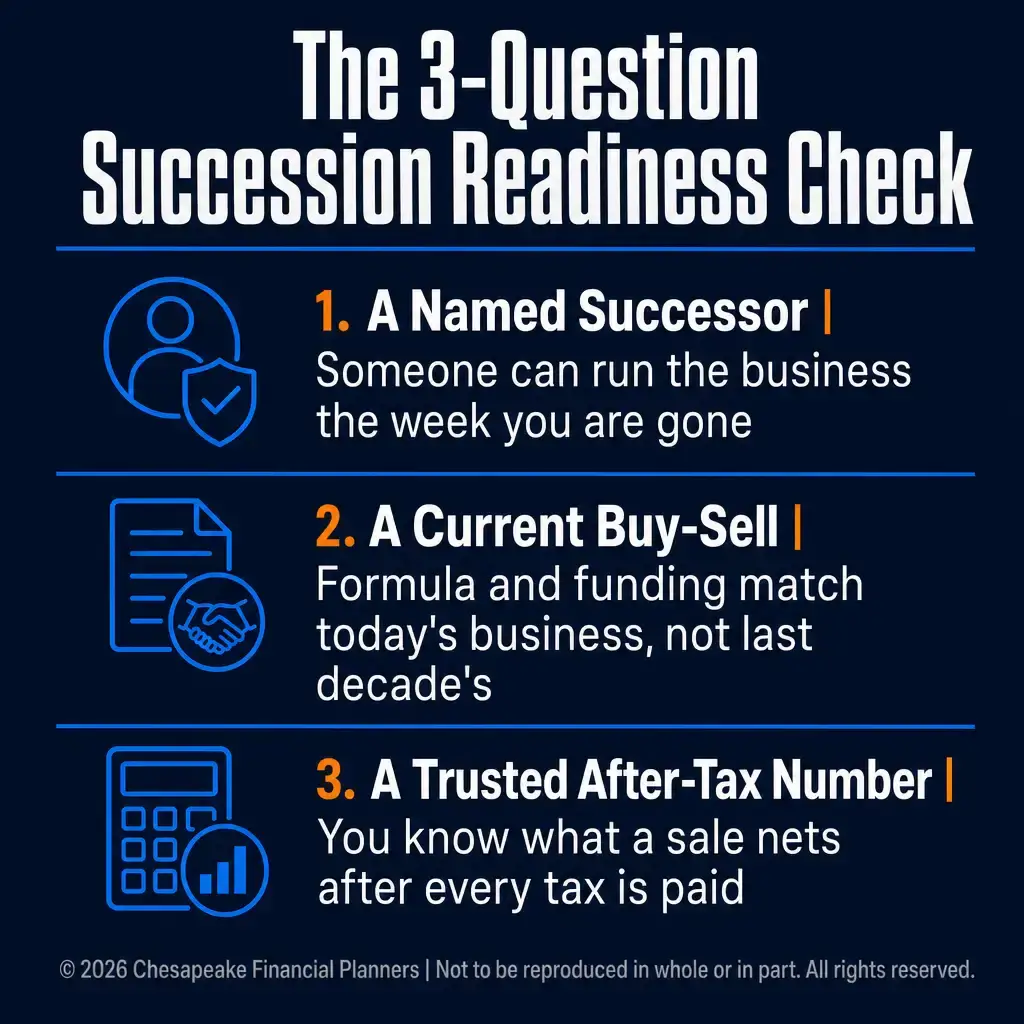
If you want a simple gut check you can do this week, ask yourself three questions. Do you have a named successor? Do you have a current buy-sell agreement that matches today's reality? And can you state an after-tax number you actually believe if you sold this year? If any answer is no, that is not a failure. It is just the next piece of work, and it is very doable once you decide to start.
Frequently Asked Questions
Why do business owners delay naming a successor?
Most owners delay because naming a successor forces an identity decision, not a legal one. The buy-sell agreement and valuation are routine work an attorney can handle in weeks. What stalls the process is the harder question of who the owner becomes once the business is no longer theirs to run each day.
Is a buy-sell agreement the same as a succession plan?
No. A buy-sell agreement is one document inside a succession plan, not the plan itself. It sets what happens to ownership if a partner dies, leaves, or becomes disabled. A full succession plan also covers who runs the company next, how the owner funds retirement, and how the transfer is taxed and timed.
How much of a business owner's wealth is usually tied to the company?
It is common for 70 to 80 percent of an owner's net worth to sit inside a single company in a single industry. That concentration means one buyer, one market, or one difficult year can move the entire retirement picture, which is why running an honest after-tax number before any sale matters so much.
Does Maryland tax the value of a business at death?
Yes, potentially. Maryland applies its estate tax to estates above $5 million per person, well under the federal exemption, and a closely held business is counted toward that total. Maryland also charges a 10 percent inheritance tax on assets passing to non-lineal heirs such as nieces, nephews, or partners, though children and grandchildren are exempt.
When should business succession planning start?
Ideally years before you intend to exit, while your health, your team, and the market still give you options. Starting early lets you exit on your own terms at a price that reflects what you built. Waiting until a health scare, dispute, or surprise offer forces the issue usually means reacting instead of choosing.
What is the first step if I have been putting this off?
Start by answering one question: if you sold this year and paid every tax, would you be financially okay? That single after-tax number tells you whether a sale funds your life or leaves a gap. From there, updating the buy-sell agreement and naming a successor become concrete tasks rather than a vague someday.
If naming a successor has been sitting on your someday list, the hardest part is not the paperwork, it is deciding to start. Business succession planning gets easier the moment you turn it into a design project with a clear next chapter. If you own a business in Harford County or the Baltimore area and want a straightforward conversation about what your exit could look like, schedule a time to talk with Chesapeake Financial Planners.
A version of this article was originally published on Chesapeake Financial Planners' LinkedIn.
Disclosures
The information provided is for educational purposes only and should not be construed as investment advice. Investment strategies should be tailored to individual circumstances, risk tolerance, and goals. Past performance doesn't guarantee future results. Consult with qualified financial professionals regarding your specific situation.
Advisors associated with Chesapeake Financial Planners may be either (1) LPL Financial Registered Representatives offering securities through LPL Financial, Member FINRA and SIPC, and investment advisor representatives offering investment advice through Great Valley Advisor Group; or (2) solely investment advisor representatives offering investment advice through Great Valley Advisor Group and not affiliated with LPL Financial. Great Valley Advisor Group, and Chesapeake Financial Planners are separate entities from LPL Financial.
Chesapeake Financial Planners | 2402 Scotlon Ct, Forest Hill, MD 21050 | (410) 652-7868 | www.chesapeakefp.com
© 2026 Chesapeake Financial Planners | Not to be reproduced in whole or in part. All rights reserved.


