

You exercised incentive stock options last year. Your CPA just called. "You owe $85,000 in Alternative Minimum Tax."
You're stunned. Your regular tax return showed you owed $30,000. Where did this extra $85,000 come from?
Welcome to the Alternative Minimum Tax, the parallel tax system that catches high earners, especially those with stock options, off guard.
What Is the Alternative Minimum Tax (AMT)?
AMT is a parallel tax system designed to ensure wealthy taxpayers pay a minimum amount of tax, even after deductions and exemptions.
How it works is this.
- Calculate regular income tax
- Calculate AMT (adds back certain deductions, includes extra income items)
- Pay whichever is higher
Most people pay regular tax. But certain income types and deductions trigger AMT.
Who Gets Hit by AMT?
AMT typically affects these groups.
- Married couples earning $150,000 to $1,000,000
- Single filers earning $75,000 to $500,000
- Anyone exercising incentive stock options (ISOs)
- Taxpayers with large state tax deductions
- Those with significant passive income
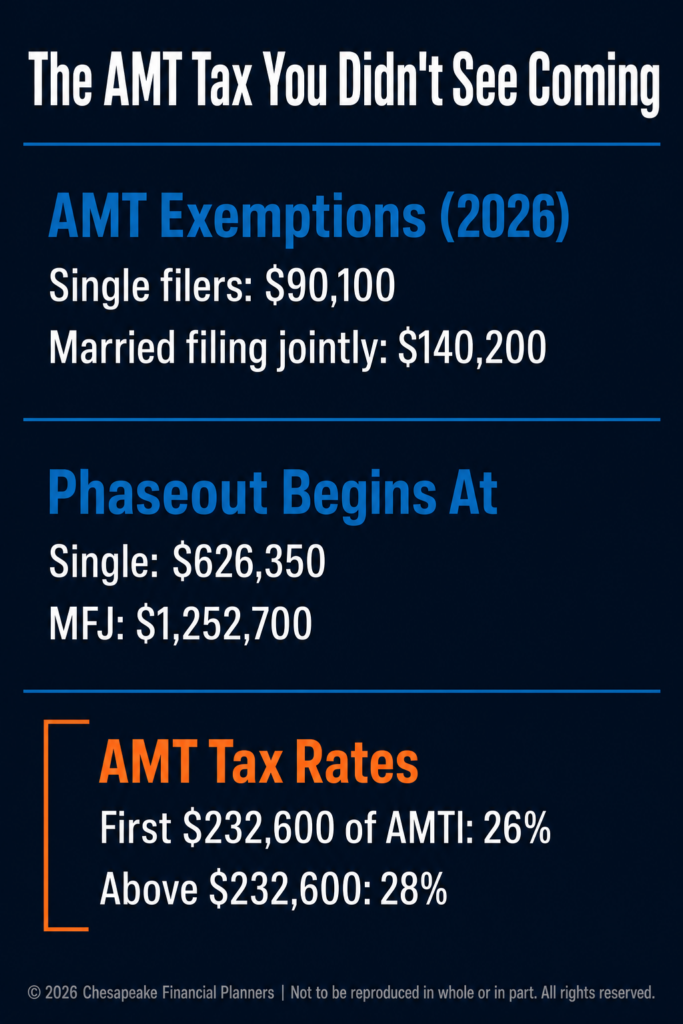
2026 AMT exemption amounts:
- Single: $90,100
- Married filing jointly: $140,200
Phaseout works like this. Exemption reduces by 25 cents per dollar of income over $626,350 for single or $1,252,700 for married.
Common AMT Triggers
Trigger 1: Exercising Incentive Stock Options (ISOs)
The number one AMT trap for tech employees and executives.
How it works is this. When you exercise ISOs, the "bargain element" (FMV minus strike price) is added to AMT income but not regular income.
Example:
- Exercise 10,000 ISOs
- Strike price: $5
- Current FMV: $35
- Bargain element: $30 × 10,000 = $300,000
- AMT rate: 28%
- AMT bill equals $84,000 even though you haven't sold anything
Worst case is this. Stock drops after exercise, you pay AMT on phantom gains that evaporated.
Trigger 2: State and Local Tax (SALT) Deduction
Regular tax allows SALT deductions up to $10,000. AMT disallows them entirely.
Impact is this. High tax state residents in CA, NY, and NJ lose deductions, triggering AMT.
Trigger 3: Large Capital Gains
While long term capital gains aren't directly added back for AMT, they increase income, reducing your AMT exemption through phaseouts.
Trigger 4: Private Activity Bonds
Interest from certain municipal bonds is tax free for regular tax but taxable for AMT.
Trigger 5: Accelerated Depreciation
Businesses using accelerated depreciation for regular tax must use slower straight line for AMT, creating differences.
How to Calculate Your AMT Exposure
Step 1: Calculate regular taxable income
Step 2: Add back AMT adjustments:
- ISO bargain element at exercise
- State and local tax deductions
- Miscellaneous itemized deductions
- Private activity bond interest
Step 3 is to subtract AMT exemption of $90,100 single or $140,200 married for 2026
Step 4 is to multiply by AMT rate as follows.
- 26% on first $232,600 (2026)
- 28% above $232,600
Step 5 is to compare to regular tax. Pay the higher amount.
Strategies to Minimize AMT
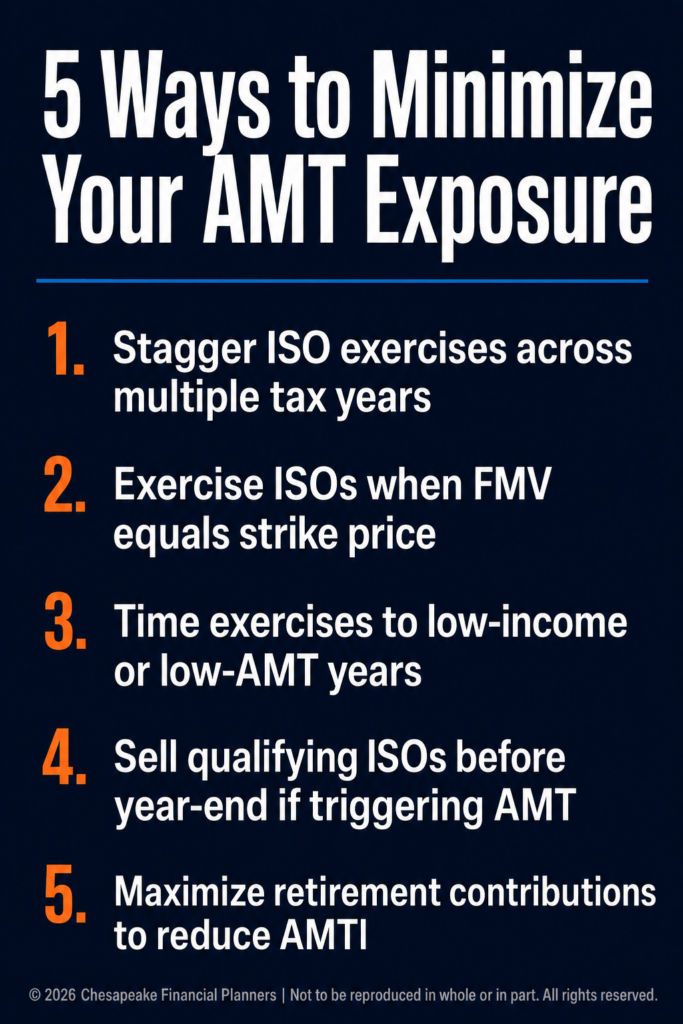
Strategy 1: Stagger ISO Exercises Over Multiple Years
Instead of exercising 40,000 ISOs in one year, spread over 4 years at 10,000 per year.
Why is this. Keeps bargain element under AMT exemption threshold each year.
Example:
- Single filer, $120,000 salary
- AMT exemption: $85,700
- Can exercise ISOs with approximately $50,000 to $60,000 bargain element without triggering AMT
- Exercise ISOs with strike equals FMV immediately, larger grants over time
Strategy 2: Exercise ISOs When Strike Price = FMV
If you exercise ISOs when FMV equals strike price, typically right after grant, there's zero bargain element, so zero AMT.
Best time is immediately after joining startup, before company valuation increases.
Strategy 3: Time ISO Exercises in Low-Income Years
AMT exemption phases out at high incomes. Exercise ISOs in years with lower W2 income.
Good years for ISO exercise include these.
- Between jobs with only partial year income
- Sabbatical or unpaid leave
- Year after retiring before Social Security or RMDs start
Strategy 4: Sell Shares Before Year-End to Create "Disqualifying Disposition"
If you exercised ISOs and triggered AMT, selling shares in the same year converts the transaction to NSO treatment.
Result is this. Removes AMT income, adds ordinary income. Can reduce net tax if regular tax with ordinary income is lower than AMT.
Downside is this. Lose preferential ISO long term capital gains treatment.
Strategy 5: Harvest Capital Losses
Capital losses offset capital gains dollar for dollar, reducing income and potentially keeping you below AMT exemption phaseout thresholds.
Strategy 6: Maximize Pre-Tax Retirement Contributions
401(k), traditional IRA, and HSA contributions reduce income, lowering both regular tax and AMT exposure.
2026 limits:
- 401(k): $24,500 ($32,500 if 50+)
- IRA: $7,500 ($8,500 if 50+)
- HSA: $4,400 individual, $8,750 family
Strategy 7: Delay State Tax Payments
Since SALT is disallowed for AMT, don't prepay state taxes in December if you'll be in AMT.
Regular strategy is to prepay January state estimated tax in December for current year deduction
AMT strategy is to wait until January. Deduction doesn't help anyway
AMT Credits for Getting Money Back
If you pay AMT due to timing differences like ISO exercises, you may get it back later via AMT credits.
How AMT credits work is this.
- AMT paid due to deferral items like ISOs and depreciation creates credits
- Credits offset regular tax in future years when regular tax exceeds AMT
- Can carry forward indefinitely
Example:
- Year 1 shows you pay $50,000 AMT on ISO exercise, earn $50,000 AMT credit
- Year 2 shows you sell ISO shares, pay regular tax of $150,000, AMT of $100,000
- Credit reduces tax to $100,000 by using $50,000 credit against regular tax
Note is this. Only timing differences create credits. Exclusion items like SALT don't generate credits.
When to Get Professional Help
DIY is fine for these situations.
- Simple W-2 income with standard deductions
- No ISOs or complex investments
Get professional help if any of these apply.
- Exercising large ISO grants
- Income over $200K with significant deductions
- Multiple states where income apportionment gets complex
- Business income with depreciation
- Previously paid AMT and need to track credits
Common AMT Mistakes
Mistake 1: Not running AMT projections before exercising ISOs
Mistake 2. Prepaying state taxes in December when in AMT since it doesn't help
Mistake 3. Not tracking AMT credits and leaving money on table
Mistake 4. Exercising all ISOs in one year instead of spreading
Mistake 5: Not consulting CPA before major stock transactions
Your AMT Prevention Checklist
Before exercising ISOs:
During tax planning:
Annually:
The Bottom Line
AMT catches people by surprise because it's a parallel system with different rules. The ISO bargain element trap alone has cost tech employees hundreds of thousands in unexpected taxes.
Plan ahead. Run projections before exercising ISOs. Spread exercises over multiple years. Work with a CPA who understands AMT.
Paying AMT isn't always avoidable, but getting blindsided by it is.
This content is for educational purposes only and should not be considered as tax advice. AMT rules are complex and subject to change. Consult with a qualified CPA or tax professional before making decisions involving ISOs or other AMT triggers.
Tax rates, exemptions, and phaseout thresholds are subject to annual adjustment. Examples provided are simplified for illustrative purposes.
ISO exercises involve financial risk, including potential loss of principal. Stock value can decline after exercise, leaving you with AMT liability and worthless shares.
Advisors associated with Chesapeake Financial Planners may be either (1) LPL Financial Registered Representatives offering securities through LPL Financial, Member FINRA and SIPC, and investment advisor representatives offering investment advice through Great Valley Advisor Group; or (2) solely investment advisor representatives offering investment advice through Great Valley Advisor Group and not affiliated with LPL Financial. Great Valley Advisor Group, and Chesapeake Financial Planners are separate entities from LPL Financial.
Chesapeake Financial Planners | 2402 Scotlon Ct, Forest Hill, MD 21050 | (410) 652-7868 | www.chesapeakefp.com
© 2026 Chesapeake Financial Planners | Not to be reproduced in whole or in part. All rights reserved.


