

Inflation erodes purchasing power. A dollar today buys less tomorrow, and over decades, the cumulative effect can be devastating if your financial plan doesn't account for it. After years of low inflation, recent spikes have reminded investors and retirees that inflation risk is real and must be addressed proactively.
Inflation erodes purchasing power. A dollar today buys less tomorrow, and over decades, the cumulative effect can be devastating if your financial plan doesn't account for it. After years of low inflation, recent spikes have reminded investors and retirees that inflation risk is real and must be addressed proactively.
The question isn't whether inflation will affect your financial plan it will. The question is whether your plan is structured to withstand it. Here's how to adjust your strategy to protect your wealth and ensure your goals remain achievable even in higher-inflation environments.
Why Inflation Matters to Your Financial Plan
It Reduces Purchasing Power
If inflation averages 3% annually, a $100,000 annual lifestyle today will require $180,000 in 20 years to maintain the same standard of living. If your savings or income don't grow at least as fast as inflation, your quality of life declines over time.
It Affects Retirement Sustainability
Retirees face unique inflation risk because they're drawing from portfolios rather than earning income. If your portfolio grows at 5% but inflation is 3%, your real return is only 2%. Higher inflation means you need either higher returns or lower spending to make savings last.
It Impacts Different Expenses Differently
Healthcare and housing costs often rise faster than overall inflation. If these are large parts of your budget, you're more exposed to inflation than someone with lower fixed costs.
It Diminishes Cash and Bonds
Cash loses purchasing power directly. Bonds deliver fixed income that may not keep pace with rising prices. Inflation disproportionately hurts conservative portfolios.

How to Adjust Your Investment Strategy
Maintain Stock Exposure
Stocks are the most reliable long-term hedge against inflation. Companies can raise prices to offset higher costs, allowing earnings, and stock values, to grow over time. Historical data shows that stocks significantly outpace inflation over long periods.
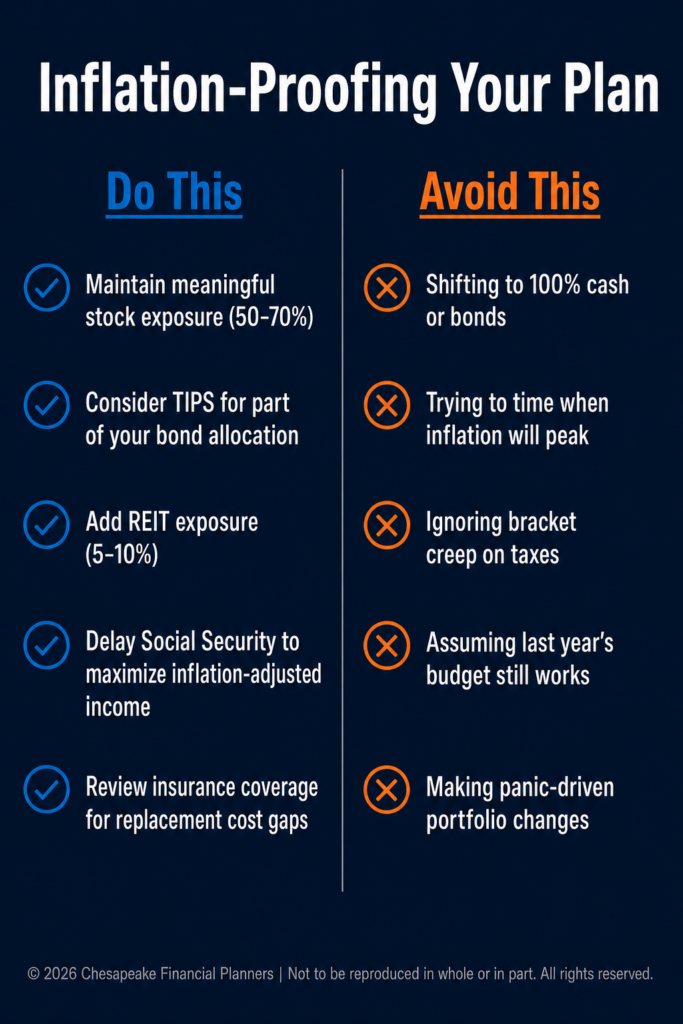
Even retirees should maintain significant stock exposure (50-70% for many) to ensure portfolios grow enough to support decades of rising expenses.
Avoid Being Too Conservative
Shifting to 100% bonds or cash may feel safe, but it guarantees you'll lose purchasing power during inflation. A balanced portfolio with meaningful stock exposure is essential for inflation protection.
Consider Treasury Inflation-Protected Securities (TIPS)
TIPS are government bonds that adjust principal based on inflation, ensuring your purchasing power is preserved. They provide true inflation protection but come with lower expected returns than stocks.
TIPS are appropriate for a portion of bond holdings, particularly for retirees or those nearing retirement.
Include Real Estate Exposure
Real estate often performs well during inflation because property values and rents tend to rise with prices. Real Estate Investment Trusts (REITs) provide exposure to real estate without the complexity of direct ownership.
A 5-10% allocation to REITs can enhance inflation protection.
Be Selective with Bonds
Traditional bonds struggle during inflation because fixed payments lose purchasing power. Short-term bonds or floating-rate bonds are less sensitive to inflation than long-term bonds.
Consider reducing duration (average maturity) of bond holdings during inflationary periods.
Avoid Overconcentration in Cash
While emergency funds should remain in cash, keeping excess cash is costly during inflation. Only hold what you need for short-term expenses and emergencies.
How to Adjust Your Spending and Savings
Increase Savings Rate
If inflation is reducing the real value of your savings, increasing your savings rate compensates. Even a 2-3% increase in savings rate can offset inflation's drag on long-term accumulation.
Adjust Retirement Projections
Run updated retirement projections using higher inflation assumptions (3-4% instead of 2%). This reveals whether your current savings rate is still sufficient or whether you need to save more or adjust retirement timing.
Budget for Rising Costs
Review your spending and identify which categories are most inflation-sensitive: groceries, gas, healthcare, utilities. Adjust your budget to reflect higher costs and find areas to cut discretionary spending if needed.
Lock in Fixed Costs Where Possible
Fixed-rate mortgages, long-term service contracts, and prepaid expenses can protect you from future price increases. If rates are rising, locking in current rates can save money over time.
How to Adjust Retirement Withdrawal Strategies
Dynamic Withdrawal Rates
Instead of withdrawing a fixed percentage annually, adjust withdrawals based on portfolio performance and inflation. In years with high inflation and poor returns, reduce discretionary spending to preserve capital.
Use a "Floor and Upside" Strategy
Cover essential expenses with inflation-protected income sources (Social Security, TIPS, annuities). Discretionary spending comes from portfolio withdrawals, which can flex based on conditions.
Delay Social Security
Social Security benefits are inflation-adjusted annually. Delaying benefits until age 70 increases your inflation-protected income for life—one of the most valuable inflation hedges available.
Hold More Cash for Near-Term Expenses
Keep 1-2 years of expenses in cash and bonds to avoid selling stocks during downturns. This allows your equity holdings to recover without forcing sales at depressed prices.
Inflation-Proofing Other Areas of Your Plan
Review Insurance Coverage
Homeowners and auto insurance should be reviewed regularly to ensure coverage keeps pace with replacement costs. Inflation increases the cost to rebuild or replace, potentially leaving you underinsured.
Healthcare Planning
Healthcare costs consistently outpace general inflation. Maximize Health Savings Account (HSA) contributions for tax-free growth, and budget for higher premiums, deductibles, and out-of-pocket costs in retirement.
Estate Planning Adjustments
Federal estate tax exemptions adjust for inflation, but fixed bequests in wills don't. Review estate documents to ensure distributions reflect current values and purchasing power.
Education Funding
College costs rise faster than general inflation. If you're funding 529 plans, increase contributions or adjust expectations about how much education costs will be covered.
What Not to Do During Inflation
Don't Panic and Abandon Your Plan
Inflation causes volatility and uncertainty, but reacting emotionally—selling stocks, moving to cash, or making drastic changes—often causes more harm than inflation itself.
Don't Try to Time Inflation
Predicting when inflation will spike or subside is nearly impossible. Base your strategy on long-term resilience, not short-term predictions.
Don't Ignore Taxes
Inflation pushes income into higher tax brackets (bracket creep) and increases capital gains taxes on appreciated assets. Coordinate inflation adjustments with tax strategies to minimize liability.
Don't Assume Low Inflation Will Return Quickly
Even if inflation moderates, prices rarely decline to previous levels. Adjust your planning for a permanently higher cost structure.
The Role of a Financial Advisor During Inflation
Navigating inflation requires adjustments across investments, spending, taxes, and retirement strategies. A financial advisor can:
- Update retirement projections with realistic inflation assumptions
- Rebalance portfolios to maintain appropriate inflation-hedging exposure
- Model different scenarios (higher inflation, lower returns, delayed retirement)
- Implement tax strategies that offset higher costs
- Provide behavioral coaching to prevent panic-driven decisions
Historical Perspective
While recent inflation has been unsettling, it's not unprecedented. The 1970s and early 1980s saw sustained high inflation, yet investors who stayed disciplined, maintained stock exposure, and adjusted spending weathered the storm successfully.
Markets adjust to inflation over time. Companies raise prices, wages eventually catch up, and asset values reflect the new environment. Patience and discipline win over reactivity.
Your Next Step
Inflation is a permanent feature of the economic landscape. Whether it's 2%, 4%, or higher, your financial plan must account for it. Ignoring inflation or hoping it will go away guarantees that your purchasing power—and your goals—will erode over time.
If you're concerned about how inflation affects your retirement plan, savings strategy, or investment portfolio, Chesapeake Financial Planners can help. We build inflation-resilient strategies designed to preserve purchasing power and help you pursue your goals regardless of economic conditions.
Advisors associated with Chesapeake Financial Planners may be either (1) LPL Financial Registered Representatives offering securities through LPL Financial, Member FINRA and SIPC, and investment advisor representatives offering investment advice through Great Valley Advisor Group; or (2) solely investment advisor representatives offering investment advice through Great Valley Advisor Group and not affiliated with LPL Financial. Great Valley Advisor Group, and Chesapeake Financial Planners are separate entities from LPL Financial.
Chesapeake Financial Planners | 2402 Scotlon Ct, Forest Hill, MD 21050 | (410) 652-7868 | www.chesapeakefp.com
© 2026 Chesapeake Financial Planners | Not to be reproduced in whole or in part. All rights reserved.


