
What Is a Buy-Sell Agreement and Does My Business Need One?
Last reviewed: July 2026
A buy-sell agreement is a legally binding contract that controls what happens to an owner's share of a business when a triggering event occurs, such as death, disability, retirement, or a partner wanting out. If you own a business with one or more partners, you need one. Without it, you can end up in business with your partner's spouse, in court over what the shares are worth, or unable to come up with the cash to buy anyone out. This kind of buy-sell agreement business planning is the difference between a smooth transition and a slow-motion disaster.
Key Takeaways
- A buy-sell agreement controls who can buy an owner's share, when, and at what price when a triggering event happens.
- Any business with two or more owners needs one; single-owner businesses use other succession tools instead.
- Roughly 33% of small business owners have no documented succession or continuity plan, leaving families and partners exposed.
- Life insurance is the most common way to fund a buyout so cash is available the moment it is needed.
- Review the agreement and its valuation method at least every two to three years, not just when something goes wrong.
About the Author: Jeff Judge, CFP®, AEP®, ChFC®, CLU® is Managing Partner of Chesapeake Financial Planners in Forest Hill, Maryland. He has been helping families and business owners in Harford County and the Baltimore metro area navigate business succession planning since earning his CFP® certification in 2013, by using Chesapeake Financial Planners’ signature process, the R.U.D.D.E.R. method™. Jeff has seen more partnerships unravel over a missing or stale buy-sell agreement than over any disagreement about strategy.
Most partnerships start with optimism. Nobody wants to talk about death, disability, or a partner's divorce when you're excited about building something. That avoidance is exactly the problem. The agreement is far easier to negotiate when everyone is getting along than in the middle of a funeral or a lawsuit.
What Is a Buy-Sell Agreement and How Does It Work?
A buy-sell agreement is a contract among business owners (or between owners and the company) that spells out what happens to an ownership interest when a specified event occurs. Think of it as a prenuptial agreement for your business. It is much easier to agree on terms before anyone is in crisis.
The agreement answers three questions that otherwise get fought over later:
- When must or can an owner's interest be sold? Death, disability, retirement, voluntary departure, divorce, or bankruptcy are the usual triggers.
- Who can buy that interest? The remaining owners, the company itself, or in some cases an approved outside party.
- How much will be paid, and on what terms? This is where the valuation method and payment schedule live.
Get those three answers in writing and you have removed most of the uncertainty that destroys partnerships. According to the IRS, a properly structured buy-sell agreement can also help establish the value of a business interest for federal estate tax purposes, which matters a great deal for owners with taxable estates. As a reference point, the IRS set the 2026 federal estate tax exemption at $15 million per individual, so larger ownership stakes can carry real estate tax exposure if they pass uncontrolled.
This is also where Jeff applies the R.U.D.D.E.R. Method™, Chesapeake Financial Planners' six-step planning process: Review and Recognize, Uncover and Understand, Design and Develop, Discuss and Decide, Execute and Empower, and Reassess and Refine. A buy-sell agreement that never gets reassessed is the one that fails.
Why Does a Multi-Owner Business Need a Buy-Sell Agreement?
If your business has two or more owners, a buy-sell agreement protects every one of you from outcomes nobody wants. It does four things that matter.
It keeps out unwanted partners. Without an agreement, a deceased partner's spouse or children inherit the ownership stake. You can end up running a company alongside someone with no experience in your industry and strong opinions about how it should be run. A buy-sell agreement gives the surviving owners the right (or obligation) to buy that interest instead.
It sets a fair value in advance. When someone exits, emotions run high and disputes about worth are common. A pre-agreed valuation method removes the guesswork and keeps everyone out of court. This connects directly to How much is my business actually worth if I want to sell?.
It provides liquidity for families. Your family cannot pay the mortgage with illiquid business equity. A funded agreement, usually backed by life insurance, makes sure cash arrives when your family needs it most.
It protects continuity. Customers, employees, and vendors are all counting on stability. A buy-sell agreement lets the business keep running smoothly even as ownership changes hands. That continuity is a core part of any business continuity and exit planning timeline.
Jeff has watched this play out badly more than once. In his experience, the partnerships that survive a sudden death or disability are almost always the ones that signed a funded agreement years earlier and then actually kept the numbers current.
What Are the Essential Provisions Every Buy-Sell Agreement Should Include?
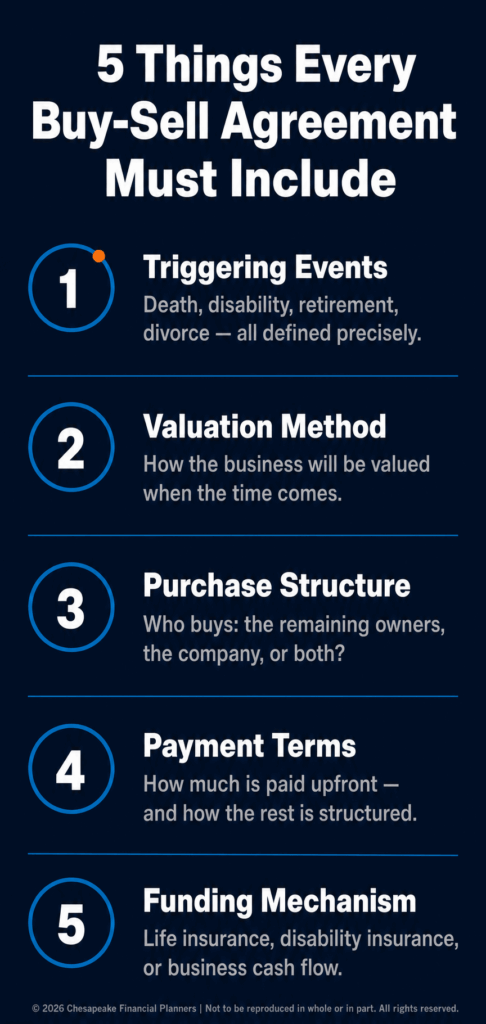
A buy-sell agreement only works if it is specific. Vague language is what gets argued over later. Five provisions do the heavy lifting.
1. Triggering events. Define exactly what starts a buyout: death, permanent disability, retirement at a stated age, voluntary departure, termination for cause, divorce, bankruptcy, or loss of a professional license. Be precise. What counts as "disability," and after how many days of absence? What happens if a partner wants to retire at 55 instead of 65?
2. Valuation method. Decide how the business will be valued before you ever need the number.
| Method | How it works | Trade-off |
|---|---|---|
| Fixed price | Owners set and update a price annually | Simple, but requires discipline to keep current |
| Formula | A multiple of revenue or earnings | Objective, but may not reflect true value |
| Independent appraisal | A professional values the business when triggered | Accurate, but slower and more expensive |
| Hybrid | Combines two or more methods | Flexible, but more complex to administer |
The method matters less than having one everyone agreed to in advance.
3. Purchase structure. Decide who buys. In a cross-purchase, the remaining owners buy the departing owner's share directly. In an entity (redemption), the company itself buys back the shares. A hybrid gives the company the first option, then the remaining owners. Each has different tax and insurance consequences worth working through with your advisor.
4. Funding mechanism. This is where most agreements fall apart. An unfunded buy-sell is just a promise. Life insurance is the most common funding tool because it delivers a lump sum exactly when a death triggers a buyout. Disability buyout insurance covers the disability trigger. Some owners use a sinking fund or installment payments, but those put cash flow pressure on the business at the worst time. Jeff Judge notes: "When I show clients the actual numbers — buying at $85 for stock worth $100 the same day, even in a flat market — most of them immediately ask why they weren't contributing the maximum all along."
5. Payment terms. Even with insurance, spell out timing. Is the purchase paid as a lump sum, or over a period of years with interest? Clear terms prevent a solvent buyout from becoming a cash crunch.

For owners thinking past the agreement itself, this work fits inside a broader plan. See What Do Business Owners Most Often Forget to Plan Before Exiting? and What are the best exit strategies for business owners? for the next layer of decisions.
Frequently Asked Questions
Does a single-owner business need a buy-sell agreement?
A single-owner business does not need a traditional buy-sell agreement because there is no co-owner to buy or sell to. Instead, a sole owner relies on a succession plan, a key-person insurance policy, or instructions in estate documents to direct what happens to the business at death or disability. The need for a buy-sell agreement starts the moment a second owner joins.
How is a buy-sell agreement usually funded?
A buy-sell agreement is most often funded with life insurance, which provides a tax-advantaged lump sum precisely when a death triggers a buyout. Disability buyout insurance covers the disability trigger. Owners can also use a company sinking fund or installment payments over time, but those approaches strain cash flow at the exact moment the business can least afford it.
How often should a buy-sell agreement be reviewed?
A buy-sell agreement should be reviewed at least every two to three years, and any time the business value changes meaningfully, an owner is added or leaves, or tax law shifts. The most common failure Jeff sees is a fixed price that nobody updated, leaving a stale number that no longer reflects what the business is actually worth.
What happens if my business has no buy-sell agreement?
Without a buy-sell agreement, ownership passes according to default law and estate documents, which often means a deceased owner's heirs inherit the stake directly. The surviving owners can be forced into business with inexperienced family members, locked in disputes over value, or unable to fund a buyout at all. Roughly a third of small business owners have no documented continuity plan, per the SBA.
Can a buy-sell agreement help with estate taxes?
Yes, a properly drafted buy-sell agreement can help fix the value of a business interest for federal estate tax purposes when it meets IRS requirements. With the 2026 federal estate tax exemption set at $15 million per individual by the IRS, owners with larger stakes benefit from both a defensible valuation and a funded source of liquidity to cover any tax due.
Is a buy-sell agreement the same as a partnership agreement?
No, a buy-sell agreement is not the same as a partnership agreement, though they often work together. A partnership agreement governs day-to-day operations, profit splits, and decision rights. A buy-sell agreement specifically governs ownership transfers when a triggering event occurs. Many businesses build buy-sell provisions directly into a broader partnership or operating agreement.
Where to Go From Here
A buy-sell agreement is not a document you sign once and forget. It is a living part of your succession plan that needs a current valuation, real funding, and a periodic review to keep pace with your business. If you found this helpful, our business owner planning guide walks through funding strategies and valuation methods in depth. Download it at chesapeakefp.com, and explore When Should I Start Planning My Business Exit Strategy? when you're ready to map the bigger picture.
Disclosures
The information provided is for educational purposes only and should not be construed as investment advice. Investment strategies should be tailored to individual circumstances, risk tolerance, and goals. Past performance doesn't guarantee future results. Consult with qualified financial professionals regarding your specific situation.
Advisors associated with Chesapeake Financial Planners may be either (1) LPL Financial Registered Representatives offering securities through LPL Financial, Member FINRA and SIPC, and investment advisor representatives offering investment advice through Great Valley Advisor Group; or (2) solely investment advisor representatives offering investment advice through Great Valley Advisor Group and not affiliated with LPL Financial. Great Valley Advisor Group, and Chesapeake Financial Planners are separate entities from LPL Financial.


