

Should You Consolidate Old 401(k) Accounts From Past Jobs?
Consolidating old 401(k) accounts from past jobs is usually a smart move because it gives you one clear view of your total retirement money, so you can see your real allocation, spot duplicate holdings, and stop paying for drift and higher fees you never agreed to. It does not promise a better return. What it buys you is clarity, and clarity is what lets you finally manage money that has been sitting untouched for years.
Last reviewed: July 2026
Key Takeaways
- Every job change tends to leave a 401(k) behind, and after three or four moves you have a pile of scattered accounts, not a plan. Scattered is not managed.
- The 2026 401(k) elective deferral limit is $24,500, with an $8,000 catch-up at 50, so a well organized set of accounts is worth getting right.
- The 2026 IRA contribution limit is $7,500, a useful destination for consolidated dollars, though rollover mechanics affect taxes and protections and deserve care.
- Consolidation gives you a picture, not a magic return bump. The first and most valuable step is simply gathering every account into one clear view.
About the Author: Jeff Judge, CFP®, AEP®, ChFC®, CLU®, is a financial planner at Chesapeake Financial Planners in Forest Hill, Maryland, where he helps Harford County professionals and job changers bring scattered retirement accounts into one coherent plan. He has spent years watching capable people leave old 401(k)s untended, not from carelessness but from a lack of any forcing function. As Jeff puts it, "In my experience, the hardest part of fixing forgotten 401(k)s is never the doing, it is simply getting yourself to look at them together."
Why Does Every Job Change Leave a 401(k) Behind?
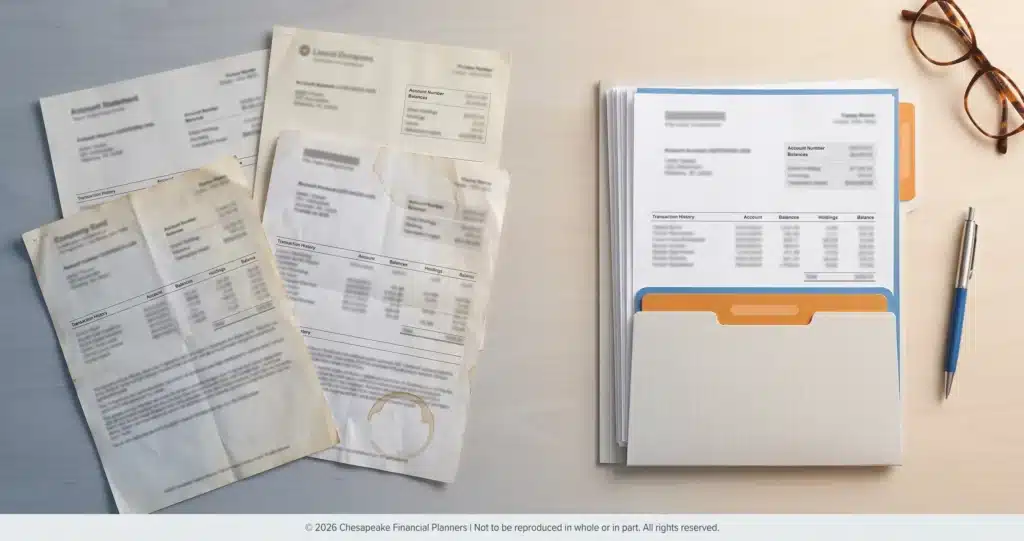
Here is the pattern I see constantly. You start a job, you sign up for the 401(k), and you pick an allocation in about four minutes during onboarding. Then you move on with your life. A few years later you leave for a better role, and the 401(k) stays behind. You mean to deal with it. You never do. Repeat that three or four times across a career and you end up with a scattered set of accounts at different custodians, each with a login you cannot remember, each invested according to a four minute decision you never revisited.
None of those accounts are talking to each other, and none of them are part of a plan, because there is no plan. There is just a pile. The money is still yours, which is exactly why this gets ignored. Nothing is missing, so nothing feels urgent. But scattered is not the same as managed, and a balance sitting in an account you have not opened in six years is not working for you the way you assume it is.
Does leaving an old 401(k) behind actually cost me anything? Yes, though quietly. An orphaned account keeps drifting from its target mix and can sit in higher cost default options, so year after year it can carry risk you did not choose and fees you never noticed. The balance stays visible, so the slow drag stays invisible.
Why Is the Cost of Forgotten 401(k)s Invisible?
This is the part that makes the problem so easy to put off. There is no alarm. No statement arrives in red ink. The accounts just sit there, and because nothing looks wrong, nothing feels urgent. But think about what is actually happening inside them. That allocation you picked in four minutes during onboarding may have been wrong for you then, and it has almost certainly drifted since. Markets move. The mix you chose years ago is not the mix you have today, because the pieces grew at different rates and nobody rebalanced them. You might be carrying far more risk than you think, or far less, with no way of knowing because you have not looked.
Then there is what each account is actually holding. Old plans sometimes default people into options that carry higher internal costs than necessary, and a difference of even a fraction of a percent, charged every year for decades, adds up to a meaningful bite out of the final number. You pay it whether or not you know it exists. The fee does not send you a notice. It just quietly reduces what compounds. This is where I lean on the R.U.D.D.E.R. Method™, our planning framework, to review each holding deliberately rather than by accident.
And here is the most overlooked part. When your accounts are scattered, nobody is looking at the whole picture, including you. You cannot tell if you are accidentally overweight in one sector across three accounts. You cannot tell if two old plans hold nearly identical funds, so you think you are diversified when you are actually doubled up. That is false diversification, and the fragmentation itself hides it. The danger is not any single account, but the fact that no one is seeing them together.
The fragmentation itself is what hides the problem. In my experience, no single forgotten account is a disaster; the real damage is that nobody, including you, is ever seeing them side by side. Jeff Judge, CFP®

Is Set It and Forget It Really a Strategy?
There is a comforting phrase that gets thrown around about retirement investing, the idea that you can set it and forget it. I understand the appeal. People are busy, investing is intimidating, and the promise that you can put it on autopilot and walk away is exactly what a stressed professional wants to hear. The trouble is that the phrase quietly drops the second half of the job. Setting it is real. Automating contributions, picking a sensible starting allocation, getting money in consistently, all of that is genuinely good. But forgetting it is where people get hurt, because automated strategies still drift and still need a look every so often.
Your situation at 28, fresh into your first real job, is not your situation at 44 with a mortgage, a couple of kids, equity comp from a current employer, and three old accounts in the wind. The allocation that made sense at 28 does not automatically make sense now, and an account you forgot exists is definitionally not being adjusted to keep up. Set it and forget it is half a strategy. Forgetting it was never the plan. It just felt like one.
It is also worth being honest about what consolidation buys you, which is a clearer picture, not a magic return bump. Anyone who pitches a rollover as a guaranteed performance upgrade is overselling it. The real details matter too: how a rollover is handled can affect your tax situation, your access to certain strategies later, and the protections that apply to the money, so it is worth understanding the options before you move anything rather than after.
What Does Consolidation Look Like for a Real Job Changer?
Let me describe someone I talk to all the time, stitched together from many real conversations. She is 45, a senior manager who has worked at four companies since her mid twenties. Each move was a step up, and each time she rolled into the new employer plan for fresh contributions and left the old one behind. When we finally add it up, she has four old accounts she had nearly forgotten, holding a combined balance larger than the active plan she actually pays attention to. One is still in the most conservative default option from a job she left at 29, money that has spent roughly fifteen years barely participating in her own growth. Two others hold nearly identical funds, so a chunk of what she thought was diversification is really the same bet made twice.
Nothing here was a disaster. No single account blew up. But the cumulative effect of a too conservative orphan, accidental duplication, and a couple of higher cost holdings had been quietly working against her for years. The fix was not exotic. It was getting everything into one view so the problems became visible, and then making deliberate choices instead of inherited ones. The hard part was never the doing. It was the looking.
This pattern is especially common right here in Harford County. I sit down with plenty of job changers connected to Aberdeen Proving Ground who hold a federal Thrift Savings Plan alongside two or three old private sector 401(k)s from earlier roles. Bringing those together takes real care, because Maryland taxes traditional retirement withdrawals as income while qualified Roth withdrawals come out tax free, so the traditional versus Roth mix inside those scattered accounts actually shapes your future Maryland tax bill. Consolidation is where that picture finally becomes clear enough to plan around.
Can I combine a TSP with old private 401(k) accounts? Often yes, and the direction you move the money matters. TSP rules, employer plan rules, and IRA options each carry different costs, investment menus, and protections, so the right path depends on your specific accounts. The point is to see all of them together first, then decide deliberately.
Why Do Capable People Leave This Undone for Years?
I want to be fair about why this happens, because it is not laziness and it is not stupidity. The people sitting on four orphaned accounts are usually the most capable people I meet. They run teams and manage budgets bigger than their own net worth. So why does this one thing slip? Part of it is that the task has no deadline. A tax return has a date. A mortgage payment has a date. Old 401(k) accounts have no date and no consequence for waiting, and anything without a deadline loses to everything with one, every single time.
Part of it is that the task feels bigger than it is. In your head, dealing with the old accounts means making complicated investment decisions you are not sure you are qualified to make, so you defer to a someday that never arrives. The irony is that the first and most valuable step is not a complicated investment decision at all. It is just gathering the information. And part of it is that the accounts are genuinely easy to forget, tied to employers you no longer work for and passwords you set years ago. Out of sight really does become out of mind.
So what is the actual next step? It is small, and it is not an investment decision. Start by simply building the picture:
- List every retirement account from every employer you have ever had, including the ones you half forgot.
- Find the logins, or start the recovery process, for each old plan and custodian.
- Write down what each account is invested in and what it is costing you in internal fees.
Frequently Asked Questions
Should I consolidate old 401(k) accounts from past jobs?
For most people with several old accounts, yes, because consolidation gives you one clear view of your total retirement money. That single picture lets you see your real allocation, catch duplicate holdings, and stop paying for drift and higher fees you never chose. It does not promise a better return, but it does let you finally manage money that has been sitting untended.
Does consolidating old 401(k) accounts improve my investment returns?
Not directly, and you should be skeptical of anyone who claims it will. What consolidation buys you is clarity, not a magic return bump. By seeing every holding in one place you can remove accidental duplication, correct a too conservative orphan account, and trim unnecessary fees. Those improvements can help over time, but the honest benefit is a clearer, more manageable picture.
Will rolling over an old 401(k) trigger taxes?
A properly executed direct rollover from one qualified plan to another plan or IRA generally is not a taxable event. Problems arise with indirect rollovers, missed deadlines, or moving pre tax money into a Roth account, which can create a tax bill. Because the mechanics affect your taxes and protections, and because the 2026 IRA limit is ,500 for new contributions, it is worth confirming the path before you move anything.
How many old 401(k) accounts is too many to track?
There is no magic number, but in practice most people start losing the thread at three or more. Once you are past a couple of custodians with separate logins and separate statements, it becomes very hard to see your true allocation or notice duplicate funds. If you cannot describe what each account holds from memory, that is a strong signal it is time to bring them together.
What is the very first step to dealing with forgotten retirement accounts?
The first step is simply making a complete list of every retirement account from every employer you have ever had, then finding the logins and noting what each one holds and costs. That is information gathering, not an investment decision, and it is the highest value move most people can make. Once everything is in view, the right next step usually becomes obvious, and you do not have to do the analysis alone.
If you have old 401(k) accounts scattered across past jobs and you are ready to finally see them together, that is exactly the kind of work we do at Chesapeake Financial Planners. We will help you build the full picture, understand your real allocation and costs, and decide on the right next move for your situation. Schedule a conversation with our team and stop leaving your retirement money on the bench.
A version of this article was originally published on Jeff Judge's LinkedIn.
Want to go deeper? Our 401(k) vs. IRA Rollover Guide walks through this step by step.
Disclosures
The information provided is for educational purposes only and should not be construed as investment advice. Investment strategies should be tailored to individual circumstances, risk tolerance, and goals. Past performance doesn't guarantee future results. Consult with qualified financial professionals regarding your specific situation.
All investing involves risk including loss of principal. No strategy assures success or protects against loss.
There is no guarantee that a diversified portfolio will enhance overall returns or outperform a non-diversified portfolio. Diversification does not protect against market risk.
Asset allocation does not ensure a profit or protect against loss.
Because of their narrow focus, investments concentrated in certain sectors or industries will be subject to greater volatility and specific risks compared with investing more broadly across many sectors, industries, and companies.
Rebalancing a portfolio may cause investors to incur tax liabilities and/or transaction costs and does not assure a profit or protect against a loss.
To qualify for tax-free withdrawals, you must generally be age 59 1/2 and hold the converted funds in the Roth IRA for at least five years. Each conversion has its own five-year period, and early withdrawals may be subject to a 10% penalty unless an exception applies. Income limits still apply for future direct Roth IRA contributions.
Advisors associated with Chesapeake Financial Planners may be either (1) LPL Financial Registered Representatives offering securities through LPL Financial, Member FINRA and SIPC, and investment advisor representatives offering investment advice through Great Valley Advisor Group; or (2) solely investment advisor representatives offering investment advice through Great Valley Advisor Group and not affiliated with LPL Financial. Great Valley Advisor Group, and Chesapeake Financial Planners are separate entities from LPL Financial.
Chesapeake Financial Planners | 2402 Scotlon Ct, Forest Hill, MD 21050 | (410) 652-7868 | www.chesapeakefp.com
© 2026 Chesapeake Financial Planners | Not to be reproduced in whole or in part. All rights reserved.


