

You're doing fine financially—but you're wondering: When should I start working with a financial planner?
The short answer: Sooner than you think.
Most people wait until they have a crisis (job loss, inheritance, divorce) or until they're close to retirement. But the truth is, the earlier you start, the more value a financial planner can add.
Let's break down when financial planning makes sense, what signs indicate you're ready, and why waiting might cost you.
The Common Mistake: Waiting Too Long
Most people think, "I'll hire a financial planner when I'm wealthy" or "I'll get help when I'm close to retirement."
The problem with waiting:
- You miss years of compounding returns from smarter decisions
- You make costly mistakes that could have been avoided
- You build bad financial habits that are hard to break
- You lose time—the most valuable asset in wealth-building
The reality: If you have income, expenses, and financial goals, you can benefit from financial planning.
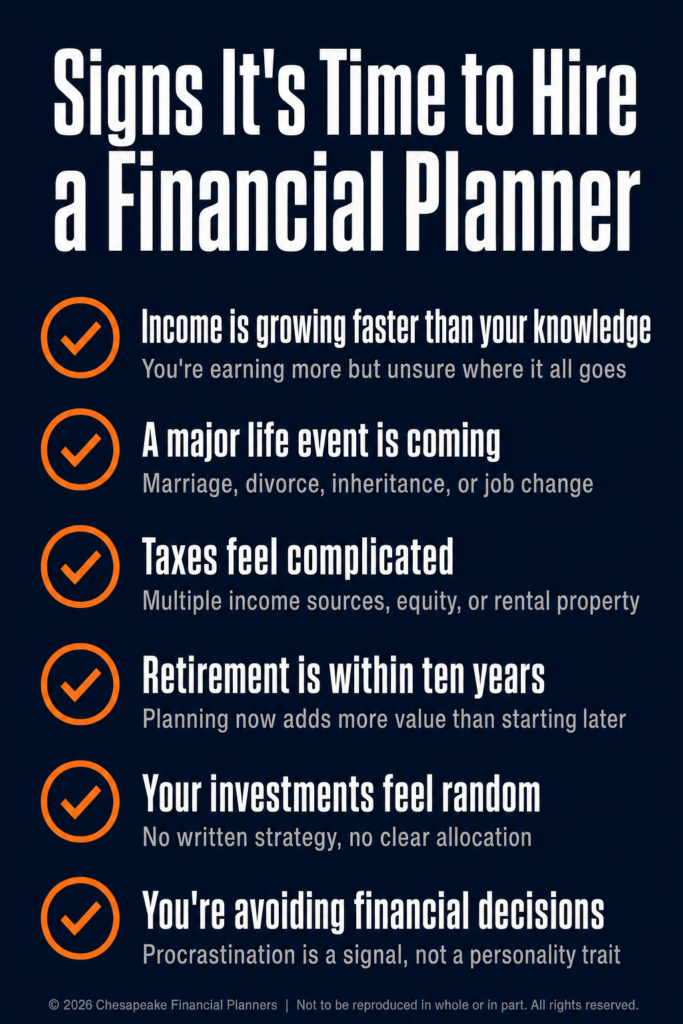
Signs You're Ready for a Financial Planner

You don't need to be wealthy to benefit from a planner. Here are clear signs it's time:
1. Your financial life is getting complex
You started your career with a simple paycheck and a checking account. But now you have:
- Multiple income sources (salary, bonuses, side hustles)
- Investment accounts (401(k), IRA, taxable brokerage)
- Equity compensation (RSUs, stock options)
- Real estate or rental properties
- Student loans, mortgage, or other debt
When things get complex, mistakes get expensive. A planner helps you coordinate everything.
2. You're earning more but not sure where it's going
Your income jumped—but somehow, your savings didn't. You're living paycheck to paycheck despite making six figures.
This is lifestyle inflation. A planner helps you turn income into wealth, not just higher expenses.
3. You're facing a major life transition
Big life events create financial complexity:
- Getting married or divorced
- Having kids
- Buying a home
- Changing careers
- Starting a business
- Receiving an inheritance
- Approaching retirement
Transitions are high-stakes moments. A planner helps you navigate without costly mistakes.
4. You don't have time to manage your finances
You're busy building your career, raising kids, running a business. You know you should be optimizing your finances, but you don't have the time or energy.
A planner saves you time. They handle the research, monitoring, and execution—so you can focus on what matters.
5. You're making conflicting financial decisions
You're saving aggressively for retirement but also carrying high-interest credit card debt. Or you're investing in equities but also paying extra on a 3% mortgage.
Conflicting priorities destroy wealth. A planner helps you prioritize and sequence decisions.
6. You're not confident in your financial strategy
You're not sure if you're saving enough, investing correctly, or on track for your goals. You're anxious about money but don't know how to fix it.
Confidence comes from having a plan. A planner gives you clarity and freedom
7. You want to optimize taxes
You're in a high tax bracket and suspect you're overpaying. You're not sure if you should contribute to Traditional or Roth accounts, or how to minimize taxes in retirement.
Tax optimization can save tens of thousands. A planner (working with your CPA) helps you keep more of what you earn.
8. You've made financial mistakes and want to avoid repeating them
You panic-sold during a market downturn. You cashed out a 401(k). You took on bad debt.
Everyone makes mistakes. A planner provides structure, accountability, and behavioral coaching to help you avoid repeating them.
When Financial Planning Adds the Most Value
Financial planning is valuable at every stage—but certain life stages benefit the most:
Your 30s-40s: The Wealth-Building Accelerator
This is when financial planning has the highest ROI. You're earning well, but juggling competing priorities:
- Maxing retirement accounts
- Paying down debt
- Saving for a home
- Planning for kids' education
Why it matters:
Decisions you make now compound for 20-30+ years. Getting them right accelerates wealth exponentially.
Your 50s: The Peak Earning Years
You're at your peak earning potential—but also facing:
- College tuition bills
- Aging parents
- Retirement planning (10-15 years out)
Why it matters:
This is your last chance to accelerate wealth before retirement. A planner helps you potentially maximize these high-income years.
Your 20s: Building the Foundation
Even if you're just starting out, a planner can help you:
- Avoid student loan mistakes
- Start investing early (compounding is powerful)
- Build good habits
- Set up a financial foundation
Why it matters:
The habits you build in your 20s set the trajectory for your entire financial life.
What About Robo-Advisors?
Robo-advisors (Betterment, Wealthfront) are cheap, algorithm-driven platforms that manage portfolios automatically.
They're great for:
- Simple situations (one job, straightforward goals)
- Hands-off portfolio management
- Low-cost investing
They're not enough if:
- Your financial life is complex
- You need tax planning, estate planning, or insurance advice
- You want behavioral coaching and accountability
- You have equity compensation, business ownership, or rental properties
Robo-advisors are a starting point—not a substitute for comprehensive financial planning.
How Much Does a Financial Planner Cost?
Fees vary widely:
Assets Under Management (AUM):
0.5-1.5% of assets annually. Common for ongoing, comprehensive planning.
Flat annual fee:
$2,000-10,000+/year for holistic planning, regardless of assets.
Hourly fee:
$200-500/hour for project-based advice.
At Chesapeake Financial Planners, we use a fee-based model where compensation is transparent and aligned with your interests.
What to Look for in a Financial Planner
Not all planners are created equal. Here's what to prioritize:
1. Fiduciary duty:
Choose a fiduciary who is legally required to act in your best interest.
2. Fee-only or fee-based:
Avoid commission-based advisors who profit from selling products.
3. Relevant credentials:
Look for CFP® (Certified Financial Planner), CPA, or other recognized credentials.
4. Experience with your situation:
Do they work with people in your income range, life stage, and complexity?
5. Comprehensive planning:
They should address investments, taxes, insurance, estate, and retirement—not just pick funds.
6. Chemistry:
You'll be sharing personal financial information. Make sure you trust them.
The Bottom Line
When should you start working with a financial planner?
The best time was 10 years ago. The second-best time is now.
You don't need to be wealthy to benefit. If your financial life has complexity, if you're earning well, or if you want to accelerate wealth-building, a planner adds value.
The earlier you start, the more you benefit from compounding good decisions.
At Chesapeake Financial Planners, we help clients build comprehensive financial strategies—at every life stage, from early career to retirement.
Ready to start? Let's talk.
This material is for general information only and is not intended to provide specific advice or recommendations for any individual.
Chesapeake Financial Planners | 2402 Scotlon Ct, Forest Hill, MD 21050 | (410) 652-7868 | www.chesapeakefp.com
© 2026 Chesapeake Financial Planners | Not to be reproduced in whole or in part. All rights reserved.

