
Your employer offers a 401(k) with a match. You've been told this is "free money" and you'd be foolish not to take it. But between student loans, rent, and trying to build an emergency fund, contributing to retirement feels like a luxury you can't afford right now.
Here's the reality: skipping your employer match is one of the most expensive financial mistakes you can make. It is not just "free money." It is an instant, guaranteed return on your investment that compounds for decades.
If you're not capturing your full employer match, you're leaving thousands, potentially tens of thousands, of dollars on the table every year.
Here's how to make sure you're maximizing this benefit.
What Is a 401(k) Employer Match?
An employer match is when your company contributes to your 401(k) based on how much you contribute. It's an incentive to encourage retirement savings.
Common matching formulas:
- Dollar-for-dollar up to 3%: Your employer matches every dollar you contribute, up to 3% of your salary.
- 50 cents per dollar up to 6%: Your employer contributes 50 cents for every dollar you put in, up to 6% of your salary.
- 100% of the first 3%, then 50% of the next 2%: Various
Example 1: Dollar for dollar match up to 3%
- Your salary: $80,000
- You contribute 3%: $2,400
- Employer matches 3%: $2,400
- Total contribution: $4,800
You're doubling your money instantly, a 100% return before your investments even grow.
Example 2: 50 cents per dollar up to 6%
- Your salary: $100,000
- You contribute 6%: $6,000
- Employer contributes 3%: $3,000
- Total contribution: $9,000
That's a 50% instant return, which is extraordinary.
Why the Match Is Non-Negotiable
Think of the employer match as part of your total compensation package. If you're not capturing it, you're effectively taking a pay cut.
The Math:
Let's say you earn $75,000 and your employer offers a dollar-for-dollar match up to 4%.
If you contribute 4% ($3,000):
- Your contribution: $3,000
- Employer match: $3,000
- Total invested: $6,000
If you contribute 0%:
- Your contribution: $0
- Employer match: $0
- Total invested: $0
Over 30 years, assuming 7% annual returns, that $6,000 annual contribution grows to approximately $566,000.
Miss the match every year, and you've forfeited more than half a million dollars. That's not hyperbole. It's compounding.
Understanding Vesting Schedules
Just because your employer contributes doesn't mean that money is immediately yours. Many companies have vesting schedules, timelines that determine when you own the employer contributions.
Immediate vesting: You own the match as soon as it hits your account. If you leave the company tomorrow, you take it with you.
Cliff vesting: You must for the company for a set period (often 1-3 years) before you own any of the match. Leave before the cliff, and you forfeit the match entirely.
Graded vesting: You gain ownership gradually. For example:
- After 2 years: 20% vested
- After 3 years: 40% vested
- After 4 years: 60% vested
- After 5 years: 80% vested
- After 6 years: 100% vested
Your contributions are always 100% vested. Vesting only applies to employer contributions.
Why this matters: If you're planning to leave your job soon, understand your vesting schedule. Staying a few extra months could mean keeping thousands of dollars in matching contributions.
How to Maximize Your Match
1. Contribute Enough to Get the Full Match
This should be your first retirement savings priority, even before paying down low-interest debt or building a large emergency fund.
If your employer matches up to 5%, contribute at least 5%. If the match is 3%, contribute at least 3%. Don't leave money on the table.
2. Understand Match Timing
Some employers match per paycheck. Others do it quarterly, annually, or based on your year-end contribution.
If your employer matches per paycheck and you front-load contributions (hitting the $23,500 annual limit early in the year), you might miss out on later matches. Check your plan's rules.
Example:
- Your salary: $120,000
- Employer matches 50% up to 6% ($3,600 total for the year)
- You contribute $23,500 by June
If matching is per-paycheck, you only receive matches for January-June. You've lost half the match.
Solution: Spread your contributions evenly throughout the year, or check if your plan offers a "true-up" feature that ensures you get the full match regardless of contribution timing.
3. Increase Contributions With Raises
Every time you get a raise, increase your 401(k) contribution by at least half of the increase. You'll maintain your take-home pay while dramatically boosting retirement savings.
Example:
- You earn $70,000 and contribute 5% ($3,500/year)
- You get a 4% raise ($2,800 more per year)
- Increase your contribution by 2%, capturing half the raise
Your take-home pay still goes up, but your retirement savings accelerate.
4. Take Advantage of Catch-Up Contributions
If you're 50 or older, you can contribute an additional $7,500 in 2026 (total limit: $31,000). This is especially valuable if you started saving late or had career interruptions.
Beyond the Match: Should You Contribute More?
Capturing the match is non-negotiable. But should you contribute beyond the match?
Yes, if:
- You've built a 3-6 month emergency fund
- You've paid off high-interest debt (credit cards, high-rate personal loans)
- You have no better use for the money (e.g., employer stock purchase plans with guaranteed discounts)
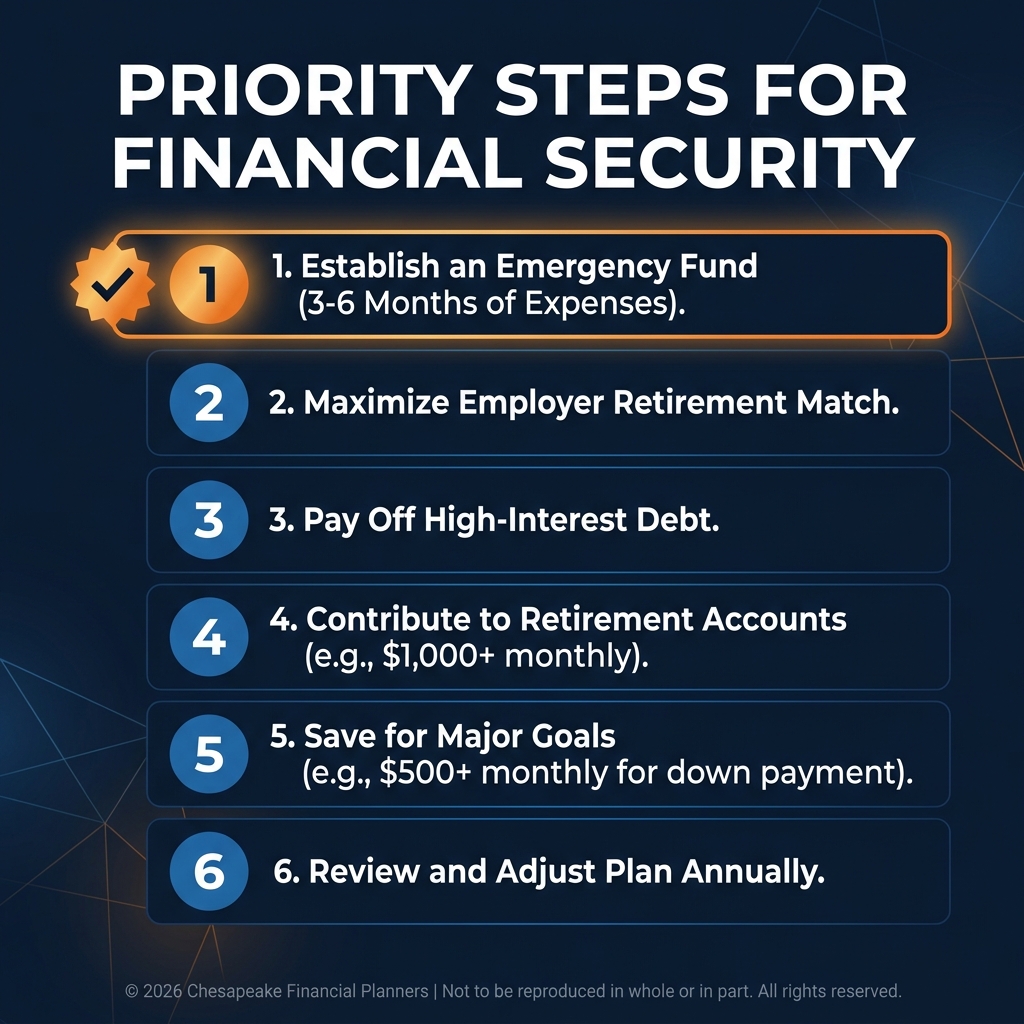
Prioritize in this order:
- Contribute enough to get the full employer match
- Pay off high-interest debt (>6-7% interest)
- Build an emergency fund (3-6 months of expenses)
- Max out an IRA ($7,000 in 2026, or $8,000 if 50+)
- Increase 401(k) contributions toward the $23,500 limit
- Consider taxable brokerage accounts or other goals
Roth 401(k) vs. Traditional 401(k)
Many employers now offer a Roth 401(k) option, where you contribute after-tax dollars and withdrawals in retirement are tax-free.
Traditional 401(k):
- Contributions are pre-tax (reduce your taxable income now)
- Withdrawals in retirement are taxed as ordinary income
Roth 401(k):
- Contributions are after-tax (no immediate tax benefit)
- Withdrawals in retirement are tax-free
Important: Employer matching contributions always go into a Traditional 401(k), even if you're contributing to a Roth 401(k). You'll owe taxes on the match when you withdraw it in retirement.
Which to choose?
- If you're early in your career or in a lower tax bracket (22-24%), Roth 401(k) is often better
- If you're in a high tax bracket (32%+) now and expect to be in a lower bracket in retirement, Traditional 401(k) makes sense
- Many people split contributions between both for tax diversification
What If You Can't Afford to Capture the Full Match?
If money is tight, do whatever you can to at least capture part of the match. Even 2-3% is better than nothing.
Strategies to free up cash flow:
- Cut one discretionary expense (subscription services, dining out, etc.)
- Redirect your next raise or bonus into your 401(k)
- Temporarily pause other savings goals (beyond your emergency fund minimum)
- Reduce 401(k) contributions once you've captured the match, then direct cash toward high-interest debt
The match is a guaranteed return. Almost nothing else in your financial life offers that certainty.
Common 401(k) Match Mistakes
1. Not Enrolling
Some plans require you to opt in. If you haven't enrolled, you're missing the match entirely. Check with HR.
2. Contributing Too Little
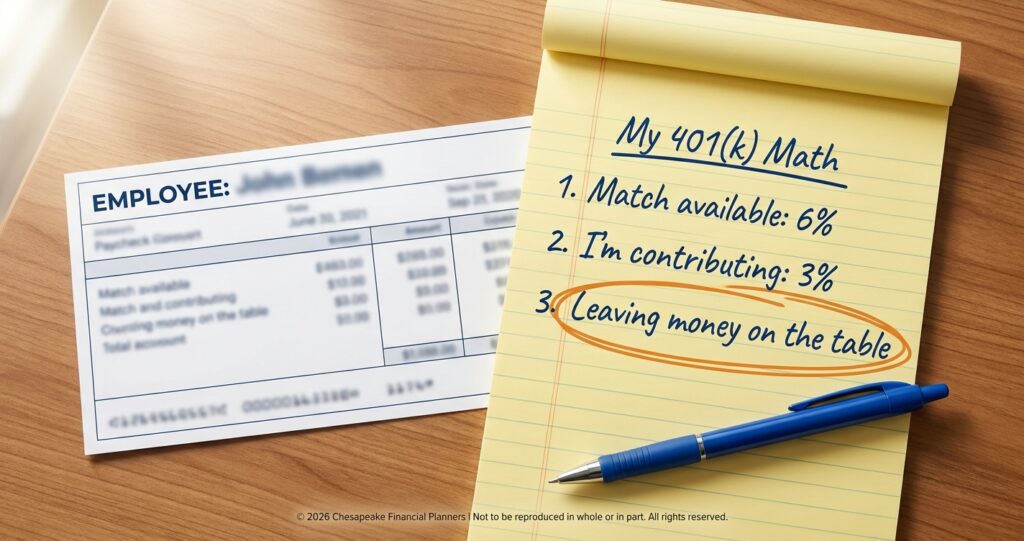
Contributing 3% when the match goes up to 6% means you're leaving money on the table.
3. Cashing Out When You Leave
If you change jobs, roll your 401(k) into an IRA or your new employer's plan. Cashing out triggers taxes and a 10% early withdrawal penalty if you're under 59½.
4. Ignoring Investment Options
The match is step one. Make sure your money is actually invested. Many people accidentally leave contributions sitting in a money market fund earning almost nothing.
The Bottom Line
Your employer match is the single best investment return you'll ever get, an instant 50-100% gain. Capturing it should be your first retirement savings priority, ahead of almost everything except high-interest debt.
Even if you can't max out your 401(k), contribute at least enough to get the full match. Your future self will thank you.
This information is for educational purposes only and should not be considered financial, tax, or investment advice. 401(k) plans vary by employer, and individual circumstances differ. Consult with a qualified financial advisor and review your plan documents before making contribution decisions.
Contributions to a traditional 401(k) are tax-deferred, meaning that taxable income is reduced by the amount of the contribution, but distributions are taxed as ordinary income in retirement.
Advisors associated with Chesapeake Financial Planners may be either (1) LPL Financial Registered Representatives offering securities through LPL Financial, Member FINRA and SIPC, and investment advisor representatives offering investment advice through Great Valley Advisor Group; or (2) solely investment advisor representatives offering investment advice through Great Valley Advisor Group and not affiliated with LPL Financial. Great Valley Advisor Group, and Chesapeake Financial Planners are separate entities from LPL Financial.
Chesapeake Financial Planners | 2402 Scotlon Ct, Forest Hill, MD 21050 | (410) 652-7868 | www.chesapeakefp.com
© 2026 Chesapeake Financial Planners | Not to be reproduced in whole or in part. All rights reserved.


