

Tax season rolls around, and you hear people throw around two terms: "marginal tax rate" and "effective tax rate." Your tax software calculates both. Your financial advisor references them when discussing strategies. But if you're like most people, you're not entirely sure what the difference is, or why it matters.
Here's the reality: confusing these two rates can lead to bad financial decisions. You might avoid a Roth conversion because you think you're in the "35% tax bracket" when your actual tax burden is far lower. Or you might underestimate your tax bill and end up with a surprise penalty.
Understanding the difference between marginal and effective tax rates is essential for smart tax planning, retirement decisions, and long-term wealth-building.
Here's what you need to know.
Marginal Tax Rate: The Rate on Your Next Dollar
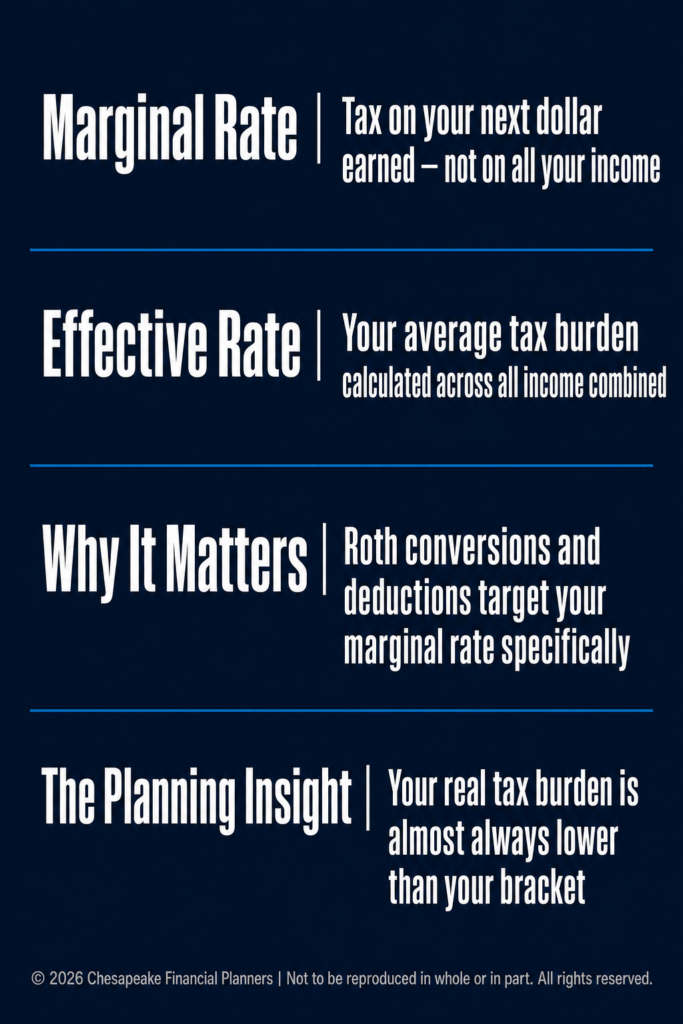
Your marginal tax rate is the tax rate you pay on your next dollar of income. It's the rate that applies to the top slice of your earnings.
The U.S. has a progressive tax system with multiple tax brackets. As your income rises, each additional dollar is taxed at a higher rate, but only the income within each bracket is taxed at that bracket's rate.
2026 Federal Tax Brackets (Married Filing Jointly):
- 10% on income up to $24,800
- 12% on income from $24,801 to $100,800
- 22% on income from $100,801 to $211,400
- 24% on income from $211,401 to $403,550
- 32% on income from $403,551 to $512,450
- 35% on income from $512,451 to $768,700
- 37% on income over $768,700
Example:
- You're married and earn $150,000
- Your marginal tax rate is 22%
That means the next $1,000 you earn (from a bonus, side gig, or investment gain) will be taxed at 22%. But that doesn't mean your entire $150,000 is taxed at 22%.
Effective Tax Rate: Your Average Tax Burden

Your effective tax rate is your total tax divided by your total income. It's the average rate you're paying across all your income.
Because of the progressive tax system, your effective tax rate is always lower than your marginal tax rate.
Example:
- You're married and earn $150,000
- Your federal tax bill (after deductions and brackets) is $18,500
- Your effective tax rate is 12.3% ($18,500 / $150,000)
Even though you're in the 22% marginal tax bracket, your effective rate is just 12.3%.
Why the Difference Matters
1. Roth Conversions
Many people avoid Roth conversions because they think, "I'm in the 32% bracket. I don't want to pay 32% tax on a conversion."
But if your effective tax rate is 18%, paying 32% on the converted amount may still make sense, especially if you expect to be in a higher bracket in retirement or if the conversion keeps you below key income thresholds.
You're not paying 32% on your entire income, just on the dollars you convert.
2. Taking Bonuses or Additional Income
If you're offered a $10,000 bonus and you're in the 24% marginal bracket, you'll pay $2,400 in federal tax (plus state and FICA taxes). Understanding this helps you decide whether to take the bonus in cash, defer it, or direct it to a 401(k).
3. Retirement Withdrawals
In retirement, your marginal rate determines how much tax you'll pay on each additional dollar you withdraw from Traditional IRAs or 401(k)s. If you're in the 12% bracket and withdraw $20,000, you'll pay 12% on that withdrawal (plus any Social Security taxation impact).
Knowing your marginal rate helps you optimize withdrawal strategies to stay in lower brackets.
4. Evaluating Tax Deductions
The value of a tax deduction depends on your marginal rate, not your effective rate.
If you're in the 32% bracket and make a $10,000 charitable donation, you save $3,200 in federal taxes (32% of $10,000). If you're in the 12% bracket, the same donation saves you $1,200.
5. Comparing Tax Strategies
When evaluating whether to fund a Traditional IRA (tax deduction now) vs. a Roth IRA (tax-free withdrawals later), your marginal rate today vs. your expected marginal rate in retirement is what matters, not your effective rate.
How to Calculate Your Marginal Tax Rate
Step 1: Find Your Taxable Income
This is your gross income minus deductions (standard or itemized).
Example:
- Gross income: $180,000
- Standard deduction (married): $32,200
- Taxable income: $147,800
Step 2: Identify Your Tax Bracket
Look at the tax brackets for your filing status. Find where your taxable income falls.
For $147,800 (married filing jointly in 2026), you're in the 22% bracket (income between $100,801 and $211,400).
Your marginal tax rate is 22%.
How to Calculate Your Effective Tax Rate
Step 1: Calculate Your Total Tax
Use the tax brackets to calculate your total federal tax.
Example (married filing jointly, $147,800 taxable income):
- 10% on first $24,800 = $2,480
- 12% on income from $24,801 to $100,800 ($75,999) = $9,120
- 22% on income from $100,801 to $147,800 ($47,000) = $10,340
- Total federal tax: $21,940
Step 2: Divide by Your Income
Effective tax rate = Total tax / Gross income
- $21,940 / $180,000 = 12.2%
Even though you're in the 22% marginal bracket, your effective federal tax rate is just 12.2%.
State and Local Taxes
Don't forget: federal taxes are only part of the picture.
State Income Tax:
Most states have their own income tax rates (ranging from 0% in states like Texas and Florida to over 13% in California). Add your state marginal and effective rates to your federal rates for your total tax burden.
FICA Taxes:
If you're a W-2 employee, you also pay:
- Social Security tax: 6.2% on income up to $184,500 (2026 limit)
- Medicare tax: 1.45% on all income, plus 0.9% on income over $250,000 (married) or $200,000 (single)
These aren't included in your "tax bracket" but significantly increase your marginal rate on earned income.
Example:
- Marginal federal rate: 24%
- State marginal rate: 5%
- FICA taxes: 7.65%
- Total marginal rate on earned income: 36.65%
That's why high earners often feel like they're paying close to 40% in taxes on each additional dollar.
Real-World Applications
Scenario 1: Should You Make a Charitable Donation?
You're considering a $5,000 donation. You're in the 32% marginal bracket.
If you itemize deductions, the donation saves you $1,600 in federal taxes (32% of $5,000). Your effective tax rate doesn't change much, but your marginal rate determines the value of the deduction.
Scenario 2: Traditional vs. Roth 401(k)
You're in the 24% bracket now and expect to be in the 12% bracket in retirement.
Contributing to a Traditional 401(k) saves you 24% in taxes today. Withdrawing in retirement costs you 12%. That's a 12-point spread in your favor. Traditional makes sense.
If you expect to be in the 32% bracket in retirement, Roth makes more sense.
Scenario 3: Taking a Year Off
You're considering taking a sabbatical or career break. In a year with low income, your marginal rate drops significantly.
This is an ideal time to:
- Convert Traditional IRA funds to Roth (pay tax at a lower marginal rate)
- Realize capital gains (0% rate if income is low enough)
- Exercise stock options (lower AMT exposure)
Common Misconceptions
"I'm in the 32% tax bracket, so I pay 32% tax."
No. You pay 32% on income within that bracket, but lower rates on income in the lower brackets. Your effective rate is much lower.
"A raise will push me into a higher bracket and cost me money."
Never true. Only the income above the bracket threshold is taxed at the higher rate. You'll always take home more money with a raise, just not as much as you might expect.
"Tax deductions save me the same amount regardless of my income."
No. The value of a deduction depends on your marginal rate. If you're in the 12% bracket, a $1,000 deduction saves you $120. If you're in the 35% bracket, it saves you $350.
Using Tax Rates for Planning
Know Both Rates
Your marginal rate helps you evaluate tax strategies (Roth vs. Traditional, deductions, conversions). Your effective rate shows your overall tax burden and helps you compare tax scenarios.
Plan Around Marginal Rates
Most tax optimization strategies focus on your marginal rate: staying below key thresholds, maximizing deductions, timing income and expenses.
Track Your Effective Rate Over Time
If your effective rate is creeping up, it may be time to increase pre-tax retirement contributions, bunch deductions, or adjust your withholding.
The Bottom Line
Your marginal tax rate is the rate on your next dollar of income, the rate that matters for most financial decisions. Your effective tax rate is your average tax burden across all income.
Understanding the difference helps you make smarter choices about retirement accounts, conversions, deductions, bonuses, and withdrawals.
Don't let a high marginal rate scare you away from strategies that make sense. Your effective rate is almost always much lower, and smart planning can keep both rates as low as legally possible.
This information is for educational purposes only and should not be considered tax or legal advice. Tax rates, brackets, and rules change frequently and vary by state. Consult with a qualified tax professional or CPA regarding your specific situation before making tax-related decisions.
Advisors associated with Chesapeake Financial Planners may be either (1) LPL Financial Registered Representatives offering securities through LPL Financial, Member FINRA and SIPC, and investment advisor representatives offering investment advice through Great Valley Advisor Group; or (2) solely investment advisor representatives offering investment advice through Great Valley Advisor Group and not affiliated with LPL Financial. Great Valley Advisor Group, and Chesapeake Financial Planners are separate entities from LPL Financial.
Chesapeake Financial Planners | 2402 Scotlon Ct, Forest Hill, MD 21050 | (410) 652-7868 | www.chesapeakefp.com
© 2026 Chesapeake Financial Planners | Not to be reproduced in whole or in part. All rights reserved.


