

You just got hired at a tech company. Your offer letter includes 50,000 stock options with a four-year vesting schedule. Your recruiter says "This could be worth a lot someday."
But what do you actually do with stock options? When do you exercise? When do you sell? How do you avoid taxes eating up your gains?
Here's the framework for making smart decisions with your company stock options from day one to exit.
First: Understand What You Have
Before making any decisions, know your option type and terms.
Incentive Stock Options (ISOs)
Tax benefit: If you follow the rules, gains taxed at long-term capital gains rates (20% vs. 37% ordinary income)
Requirements:
- Hold stock 1+ year after exercise AND 2+ years after grant
- Exercise limit: $100,000 worth/year (based on FMV at grant)
Trap: Alternative Minimum Tax (AMT) at exercise
Non-Qualified Stock Options (NSOs)
Tax treatment: Spread (FMV – strike price) taxed as ordinary income at exercise, plus capital gains on appreciation after exercise
No AMT: Simpler tax treatment than ISOs
Best for: Options exceeding ISO $100K annual limit
Key Terms to Know
Strike price (exercise price): What you pay per share when exercising
Vesting schedule: When you earn the right to exercise (typically 4 years with 1-year cliff)
Expiration: Options expire 10 years from grant (or 90 days after leaving company)
Fair Market Value (FMV): Current company valuation (from 409A for private companies)

The Decision Framework: What to Do at Each Stage
Stage 1: Grant (Day 1)
What to do: Understand your grant and start planning.
Actions:
- Save your grant agreement (you'll need it for taxes)
- Note grant date, strike price, vesting schedule, expiration date
- Calculate potential value at different stock prices
- Start saving cash for future exercise costs
Tax: Nothing owed yet
Stage 2: Vesting (Ongoing Over 4 Years)
What to do: Options become exercisable as they vest. But don't exercise yet plan first.
For ISOs: Consider early exercise strategy if strike price = FMV
- Pro: Starts your holding period clock, avoids future AMT
- Con: Requires cash upfront, stock could become worthless
For NSOs: Usually wait until exit opportunity (IPO, acquisition)
- Pro: No cash required until liquidity event
- Con: Miss out on starting capital gains clock early
Action at this stage:
- Track vesting milestones
- Build cash reserves for potential exercise
- Model AMT exposure if planning to exercise ISOs
Stage 3: Private Company—Decide When to Exercise
If your company is private (pre-IPO), you face the classic startup option dilemma.
Option A: Exercise Early (When Strike = FMV)
When it makes sense:
- You believe in long-term company prospects
- Strike price equals FMV (no AMT for ISOs)
- You have cash reserves to cover exercise cost
- You want to start 5-year clock for QSBS treatment
Risks:
- Company fails → money lost
- No liquidity for years
- Locked into illiquid investment
Option B: Wait Until Liquidity Event
When it makes sense:
- Uncertain about company prospects
- Don't have cash to exercise
- Want to see company prove itself first
Risks:
- Trigger large AMT if ISOs (when FMV >> strike)
- Miss out on years of capital gains treatment
- Potentially higher taxes later
Rule of thumb: Exercise ISOs early if strike = FMV and you can afford it. Wait on NSOs until liquidity unless tax planning suggests otherwise.
Stage 4: Company Goes Public (IPO)
What changes: Your options now have a liquid market. You can exercise and sell immediately (cashless exercise).
180-day lockup period: Can't sell right at IPO. Must wait until lockup expires.
Action plan before lockup expiration:
- Calculate total tax liability on exercise + sale
- Decide sell vs. hold strategy
- Set up 10b5-1 trading plan for systematic selling
- Coordinate with CPA on estimated tax payments
For ISOs: Consider exercising just before IPO (if not yet exercised) to start holding period while strike is still low.
Stage 5: Post-IPO or Acquisition—Exercise and Sell Decisions
Once you can sell, you face the concentration vs. diversification decision.
Exercise and sell immediately:
- Pro: Avoid concentration risk, no additional capital gains exposure
- Con: All gains taxed as ordinary income (ISOs lose preferential treatment if sold within 1 year of exercise)
Exercise and hold for 1 year:
- Pro: Qualify for long-term capital gains on post-exercise appreciation
- Con: Concentration risk, stock could drop while holding
Partial strategy:
- Exercise and sell 50-70% immediately (cover taxes + reduce risk)
- Hold 30-50% for long-term capital gains treatment
Stage 6: Leaving the Company—The 90-Day Exercise Window
Critical deadline: When you leave, you typically have 90 days to exercise vested options or they expire worthless.
Decision framework:
Exercise if:
- Company is healthy and growing
- Stock has meaningful upside
- You have cash to exercise (or can get financing)
Let expire if:
- Company prospects are poor
- Exercise cost exceeds realistic upside
- Stock is underwater (FMV < strike price)
Planning: Start saving cash 6+ months before planned departure. Don't let 90-day window catch you unprepared.
Tax-Smart Option Strategies
Strategy 1: Exercise ISOs to AMT Sweet Spot
Calculate how many ISOs you can exercise each year without triggering AMT (typically ~$50,000-$75,000 in bargain element depending on income).
Why: Avoid AMT, start holding period, capture long-term gains treatment.
Strategy 2: Same-Day Sale for NSOs
At public companies, exercise NSOs and sell immediately (cashless exercise).
Why: No additional capital gains risk. Ordinary income tax on spread is unavoidable regardless of holding period.
Strategy 3: Stagger ISO Exercises Before IPO
If IPO is 2-3 years away, exercise ISOs in tranches to stay under AMT limits each year.
Example:
- Year 1: Exercise 10,000 ISOs
- Year 2: Exercise 10,000 ISOs
- Year 3: IPO, sell all shares
Result: 3 years of holding period on first batch, qualify for QSBS.
Strategy 4: Consider QSBS Benefits
If your company qualifies for Qualified Small Business Stock treatment, holding 5+ years from exercise can exclude up to $10 million in capital gains.
Worth planning for: Potentially $2-3 million in tax savings.
Strategy 5: Coordinate Exercises with Other Income
Exercise in low-income years (between jobs, sabbatical) to stay in lower tax brackets.
Common Stock Option Mistakes
- Mistake 1: Letting options expire because you didn't plan for the 90-day exercise window
- Mistake 2: Exercising all ISOs in one year and triggering massive AMT
- Mistake 3: Holding exercised stock too long out of loyalty while overconcentrated
- Mistake 4: Not tracking grant dates and exercise dates (losing QSBS qualification)
- Mistake 5: Selling ISO shares before meeting holding period requirements (disqualifying disposition)
Your Stock Option Action Plan
Year 1 (at grant):
Years 1-4 (vesting period):
Year 4-5 (approaching IPO or exit):
Post-liquidity:
The Bottom Line
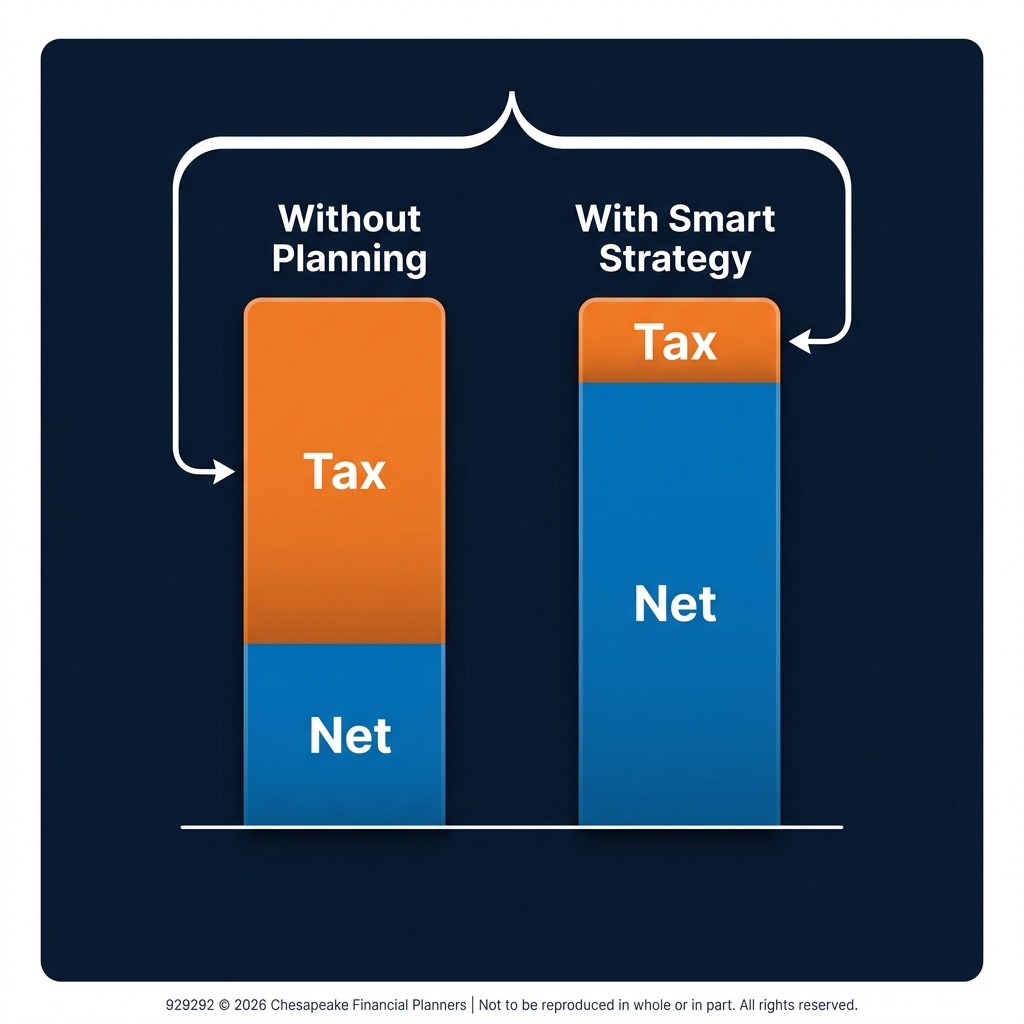
Stock options can create life-changing wealth—or become worthless. The difference is planning.
Understand your option type. Model tax implications. Exercise strategically. Diversify after liquidity.
Don't let complexity, inertia, or loyalty keep you from making smart financial decisions with your equity.
This content is for educational purposes only and should not be considered as financial, tax, or legal advice. Stock option terms vary by company. Consult with a qualified financial advisor, CPA, and attorney before making exercise or sale decisions.
Tax laws are complex and subject to change. AMT, QSBS, and capital gains treatment have specific requirements. Professional guidance is essential.
Stock options involve financial risk, including potential loss of your entire investment if the company fails or stock value declines.
Advisors associated with Chesapeake Financial Planners may be either (1) LPL Financial Registered Representatives offering securities through LPL Financial, Member FINRA and SIPC, and investment advisor representatives offering investment advice through Great Valley Advisor Group; or (2) solely investment advisor representatives offering investment advice through Great Valley Advisor Group and not affiliated with LPL Financial. Great Valley Advisor Group, and Chesapeake Financial Planners are separate entities from LPL Financial.
Chesapeake Financial Planners | 2402 Scotlon Ct, Forest Hill, MD 21050 | (410) 652-7868 | www.chesapeakefp.com
© 2026 Chesapeake Financial Planners | Not to be reproduced in whole or in part. All rights reserved.


