
Your offer letter says you're getting stock options. Great.
But it doesn't say whether they're ISOs or NSOs. And your recruiter didn't explain the difference because, honestly, most recruiters don't actually know.
Here's what matters: the type of option you get can change your tax bill by $50K+.
Let me break it down.
The Two Types (And Why It Matters)
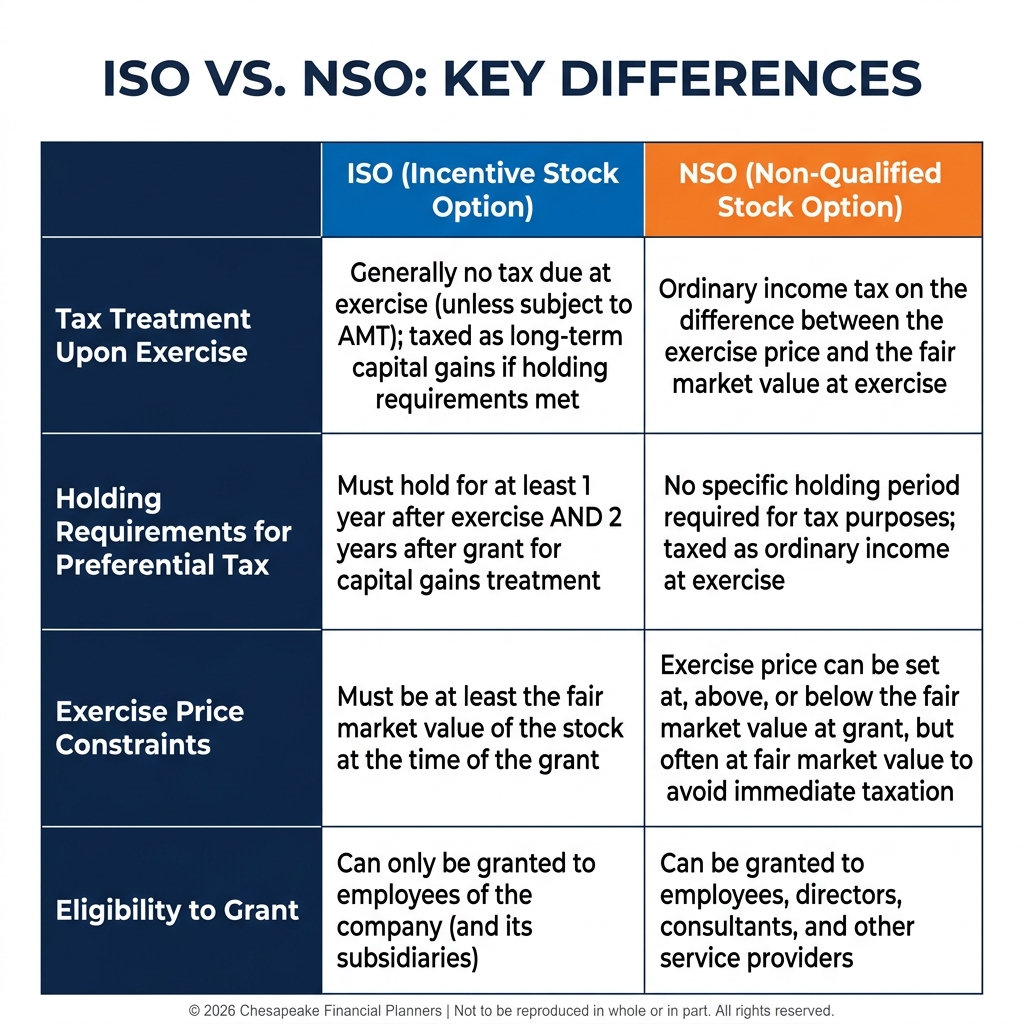
Incentive Stock Options (ISOs):
- Tax-advantaged
- Only available to employees
- Favorable treatment IF you follow the rules
- Subject to AMT on exercise
- 100K/year exercise limit
Non-Qualified Stock Options (NSOs):
- No special tax treatment
- Available to employees, contractors, advisors, board members
- Taxed as ordinary income on exercise
- No AMT
- No exercise limits
The headlines make ISOs sound like the obvious winner. But in practice, it's more nuanced.
The ISO Tax Advantage (When It Works)
With ISOs, if you follow the rules, you can convert ordinary income into long-term capital gains.
Here's the ideal scenario:
- You exercise ISOs early when the spread is small (or zero)
- You hold the shares for 1+ year from exercise AND 2+ years from grant
- You sell and pay long-term cap gains (20% max federal) instead of ordinary income (37% max federal)
Example:
- Exercise 10,000 ISOs at $1/share
- Sell 2 years later at $30/share
- Gain: $290,000
- Tax (long-term cap gains): ~$58,000 (20% federal)
- Tax if these were NSOs: ~$107,000 (37% federal)
- Tax savings: $49,000
That's real money.
But here's the catch: you have to follow the rules perfectly, and you have to be able to afford the illiquidity risk.
The ISO Traps
1. AMT on exercise
Even though ISOs aren't taxed as ordinary income on exercise, they ARE taxed under the Alternative Minimum Tax system. The spread between strike price and FMV at exercise is added to your AMT income.
If you exercise $200K worth of ISOs with a $180K spread, you could owe $50K+ in AMT before you've sold a single share.
2. The holding period requirements are rigid
To get favorable tax treatment, you must hold for:
- 1+ year from exercise, AND
- 2+ years from grant date
If you sell before hitting both thresholds, it becomes a "disqualifying disposition" and gets taxed like an NSO. You lose the entire tax advantage.
3. Illiquidity risk
To get the tax benefit, you have to hold the shares for 1-2 years. If the company is still private, that's 1-2 years of holding illiquid stock that you've already paid AMT on.
If the company tanks during that time, you lose everything. And you still owe the AMT.
4. The $100K/year limit
Only $100K worth of ISOs (based on FMV at grant date) can vest in any calendar year. Anything above that automatically becomes an NSO.
If you have a large grant vesting over 4 years, the first $100K of each year's vest is ISOs, the rest is NSOs.
This matters because you might think you have all ISOs, but you actually have a mix.
The NSO Advantage (It's Simpler)
NSOs don't have favorable tax treatment. You exercise, you pay ordinary income tax on the spread, done.
But here's why that's sometimes better:
1. No AMT
You pay ordinary income tax at exercise, but there's no AMT trap. You know exactly what you owe, and you can plan for it.
2. No holding period requirements
You can sell immediately after exercise. If the company is public and you want liquidity, you can exercise and sell in the same transaction (cashless exercise).
3. No $100K limit
You can have as many NSOs as the company wants to grant. No arbitrary cap.
4. Flexibility for non-employees
Contractors, advisors, and board members can only get NSOs. If you're in any of those roles, ISOs aren't an option.

The Real-World Comparison
Let's compare the same scenario with ISOs vs NSOs.
Scenario: You have 10,000 options, strike price $5, current FMV $25
With ISOs (ideal case):
- Exercise cost: $50,000
- AMT at exercise: ~$52,000 (on $200K spread, assuming 26% AMT rate)
- Total cash out: $102,000
- Hold for 2 years
- Sell at $35/share: $350,000 proceeds
- Tax on sale: ~$56,000 (long-term cap gains on $300K gain)
- Net after-tax: $192,000
With NSOs:
- Exercise cost: $50,000
- Tax at exercise: ~$74,000 (ordinary income on $200K spread, 37% rate)
- Total cash out: $124,000
- Sell immediately at $25/share: $250,000 proceeds
- No additional tax (cost basis is $25)
- Net after-tax: $126,000
The ISO scenario nets $66K more, but you had to:
- Come up with $102K vs $124K upfront (or sell some NSOs to cover)
- Hold illiquid stock for 2 years
- Take the risk that the stock goes to $0
The NSO scenario gives you immediate liquidity and eliminates the risk.
When ISOs Are Better
1. You're joining early-stage and exercising at grant
If you join a startup in the first year or two and exercise immediately, the spread is tiny (maybe $0). No AMT, low cost, huge upside if the company succeeds.
2. You have the cash and risk tolerance to hold
If you can afford to tie up $100K+ in illiquid stock for 2 years, and you believe in the company, ISOs can save you tens of thousands in taxes.
3. The company is growing fast and you're confident in an exit
If there's a clear path to IPO or acquisition within 2-3 years, the holding period risk is lower.
When NSOs Are Better (Or Fine)
1. You need liquidity
If you can't afford to tie up cash in illiquid stock, NSOs let you exercise and sell immediately (post-IPO).
2. You're joining a later-stage company
If the company is already at a $1B+ valuation, the spread at exercise is large, and AMT would be brutal. NSOs are cleaner.
3. You're not an employee
Contractors, advisors, and board members can only get NSOs.
4. You don't want to deal with AMT complexity
If tax planning isn't your thing and you just want simplicity, NSOs are straightforward.
What to Do Right Now
If you're negotiating an offer:
- Ask if the options are ISOs or NSOs
- Ask about the current 409A valuation (determines FMV)
- Model the tax impact under both scenarios
- Negotiate for ISOs if you're early-stage and can exercise early
If you already have ISOs:
- Decide if you're going to play the long-term cap gains game or treat them like NSOs
- If you're exercising, run an AMT projection first
- Consider exercising early (right after grant) to minimize spread and AMT
- Make sure you can afford to hold for 2 years if you want the tax benefit
If you have NSOs:
- Plan for the ordinary income tax hit at exercise
- If the company is public, consider cashless exercise to avoid tying up cash
- Don't stress about the "inferior" tax treatment simplicity has value
The Bottom Line
ISOs have better tax treatment on paper. But they come with AMT risk, holding period requirements, and illiquidity.
NSOs are taxed worse, but they're simpler and give you more flexibility.
The "right" choice depends on your financial situation, risk tolerance, and the company's stage. Early-stage with low valuations? ISOs. Late-stage with high valuations? NSOs are often cleaner.
Either way, understand what you have before you exercise. The tax difference can be $50K+.
This article is for educational purposes only and does not constitute tax advice. Consult a qualified tax professional regarding your specific situation.
Advisors associated with Chesapeake Financial Planners may be either (1) LPL Financial Registered Representatives offering securities through LPL Financial, Member FINRA and SIPC, and investment advisor representatives offering investment advice through Great Valley Advisor Group; or (2) solely investment advisor representatives offering investment advice through Great Valley Advisor Group and not affiliated with LPL Financial. Great Valley Advisor Group, and Chesapeake Financial Planners are separate entities from LPL Financial.
Chesapeake Financial Planners | 2402 Scotlon Ct, Forest Hill, MD 21050 | (410) 652-7868 | www.chesapeakefp.com
© 2026 Chesapeake Financial Planners | Not to be reproduced in whole or in part. All rights reserved.


