

Your startup just gave you 50,000 stock options. The grant letter says "ISOs." Your friend at another company got "NSOs." You Google the difference and fall into a rabbit hole of tax code, AMT calculations, and conflicting advice.
Here's the truth: The difference between ISOs and NSOs can mean tens of thousands of dollars in taxes, or it can mean almost nothing, depending on your specific situation.
Let's cut through the jargon and figure out which type you have, what it actually means for your wallet, and what you should do about it.
ISOs vs. NSOs: The Tax Treatment Difference That Matters
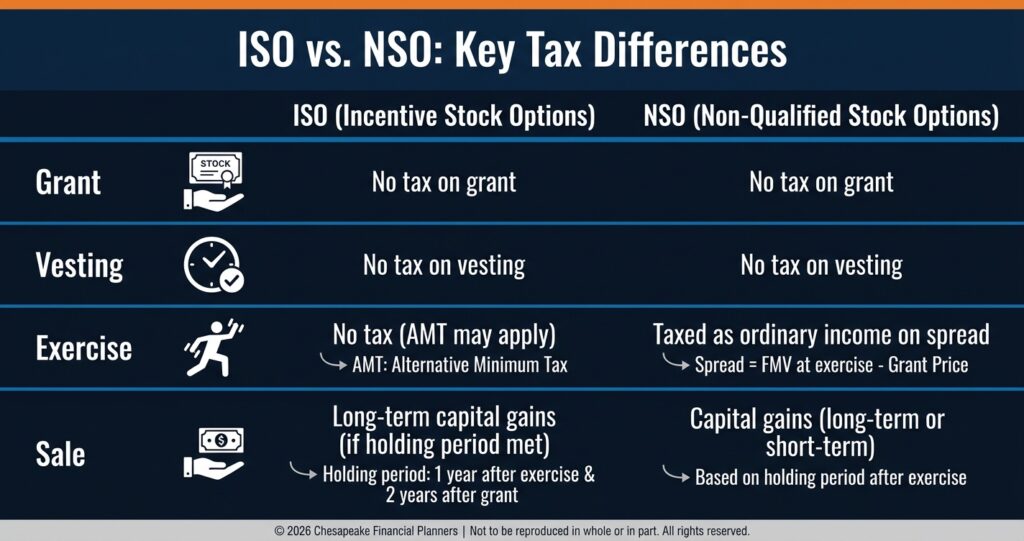
Both Incentive Stock Options (ISOs) and Non-Qualified Stock Options (NSOs) give you the right to buy company stock at a set price (the "strike price" or "exercise price"). The difference is how the IRS taxes them.
ISOs (Incentive Stock Options)
The upside: If you follow specific rules, ISOs get favorable tax treatment. You pay zero ordinary income tax when you exercise. If you hold shares for at least one year after exercise AND two years after the grant date, all gains are taxed at long-term capital gains rates (0%, 15%, or 20%), not ordinary income rates (up to 37%).
The catch: ISOs can trigger Alternative Minimum Tax (AMT) when you exercise. The spread between your exercise price and the fair market value at exercise gets added to your AMT calculation. For early-stage startup employees exercising ISOs when the stock is still relatively cheap, AMT might not hit. But if you're exercising when your company's valuation has grown significantly, AMT can create a tax bill even though you haven't sold shares yet.
Who gets them: Only current employees. Contractors, advisors, and board members can't receive ISOs.
NSOs (Non-Qualified Stock Options)
The upside: No AMT. When you exercise NSOs, you immediately owe ordinary income tax on the spread (difference between strike price and current fair market value), but you don't face the AMT complexity that ISOs create.
The catch: That spread is taxed as ordinary income at your marginal rate (potentially 35-37% federal, plus state taxes). This creates an immediate tax bill, even though you haven't sold shares.
Who gets them: Anyone: employees, contractors, advisors, board members. If you're not an employee, your options are NSOs by default.
The Real-World Scenarios: When Each Option Type Wins
The "best" option type depends on your company's stage, your income level, and your ability to handle tax bills.
Scenario 1: Early-Stage Startup, Low Strike Price
You join a Series A startup. You're granted ISOs with a $0.50 strike price. Current fair market value is also $0.50.
Best move: Exercise your ISOs early (possibly immediately after they vest, or even before they vest if your company allows early exercise with an 83(b) election).
Why it works: The spread is zero or very small when you exercise, so AMT won't hit. You start the clock on long-term capital gains treatment. If the company succeeds and your shares are worth $50 someday, that entire $49.50 gain per share is taxed at long-term capital gains rates, not ordinary income rates.
Tax savings: Massive. The difference between 37% ordinary income + state tax vs. 15-20% long-term capital gains can mean six figures on a successful exit.
Scenario 2: Late-Stage Startup, High Current Valuation
You join a Series D startup. Your ISO strike price is $10, but current fair market value is $25. You have 20,000 options.
The math: If you exercise all 20,000 options, the spread is $15 per share = $300,000. That $300,000 gets added to your AMT calculation, potentially creating a tax bill of $80,000+ even though you haven't sold a single share.
Best move: Exercise carefully. Run AMT projections. Consider exercising only the amount that doesn't trigger AMT (often around $75,000-$100,000 in spread for a married couple, depending on other income). You might need to spread exercises across multiple years.
Or: If AMT will definitely hit and you can't avoid it, NSOs might've been simpler (though you don't get to choose, your company decides).
Scenario 3: You're Leaving the Company
You're leaving your job. You have 90 days to exercise vested options, or they expire.
The decision: Exercise or lose them. This is when you find out whether your ISOs were actually valuable or just expensive.
ISO consideration: If you exercise now, do you trigger AMT? Can you afford both the exercise cost and potential AMT bill?
NSO consideration: You'll owe ordinary income tax on the spread immediately. Can you cover that tax bill?
Brutal reality: Many employees walk away from options because they can't afford the exercise cost + tax bill. This is why early exercise (when spread is small) is so powerful.
The AMT Trap: What You Need to Know About ISOs
Alternative Minimum Tax is a parallel tax system designed to prevent high earners from using deductions to pay zero tax. When you exercise ISOs, the spread is a "preference item" that can trigger AMT.
How it works:
You exercise 50,000 ISOs with a $5 strike price when fair market value is $15. Spread = $10 per share × 50,000 = $500,000.
That $500,000 gets added to your AMT income. If that pushes you into AMT territory, you'll owe roughly 28% on the AMT income, around $140,000.
But here's the twist: You haven't sold shares yet. You just owe $140,000 in taxes.
The nightmare scenario: You exercise ISOs, trigger AMT, pay the tax bill, then the company's stock crashes before you can sell. You've paid taxes on "gains" that evaporated. (You might eventually get AMT credits back, but that's cold comfort when you're out six figures.)
How to avoid this: Don't exercise ISOs blindly. Run AMT projections with a CPA before exercising. Understand your exposure.
NSOs: The Simpler (But Pricier Upfront) Alternative
NSOs don't have the AMT complexity, but they create an immediate ordinary income tax bill when you exercise.
Example:
You exercise 20,000 NSOs with a $5 strike price when fair market value is $20. Spread = $15 per share × 20,000 = $300,000.
You immediately owe ordinary income tax on $300,000. At a 35% federal bracket + 9.3% California state tax, that's roughly $133,000 in taxes owed.
Your company might withhold shares to cover taxes, or you might need to pay the tax bill separately.
The upside: Once you've exercised and paid those taxes, your cost basis is $20 per share. Any future appreciation is taxed at capital gains rates (if you hold more than one year).
When NSOs actually make sense: If you're going to owe AMT on ISOs anyway, NSOs simplify life. The tax treatment ends up similar (ordinary income tax on the spread), but you avoid AMT calculations and uncertainty.
Your Stock Options Action Plan
Step 1: Figure out what you have
Check your grant documents. ISOs will explicitly say "Incentive Stock Options." NSOs might say "Non-Qualified Stock Options" or "Nonstatutory Stock Options."
If you're not an employee, you have NSOs by default.
Step 2: Understand your vesting schedule and expiration
When do options vest? When do they expire? What happens if you leave the company?
Most options expire 10 years from grant date, but unvested options are forfeited if you leave. Vested options typically must be exercised within 90 days of departure or they expire.
Step 3: Run the tax projections
Don't guess. Work with a CPA who understands equity compensation. Run scenarios:
- What if you exercise X shares this year?
- Do you trigger AMT?
- What's the cash outlay (exercise cost + taxes)?
- What if you wait and exercise next year?
Step 4: Consider early exercise (if ISOs and if allowed)
If your company allows early exercise and you have ISOs with a low strike price near current fair market value, exercising early is often smart. You start the long-term capital gains clock when the spread is tiny, avoiding future AMT issues.
File an 83(b) election within 30 days of early exercise. This is critical and non-negotiable.
Step 5: Have a liquidation plan
Options are only valuable if you can eventually sell shares. Understand your company's liquidity timeline:
- Are they planning an IPO?
- Do secondary markets exist?
- Is an acquisition likely?
Don't exercise options in a company with no clear path to liquidity unless you can afford to lose the entire investment.

Early Exercise + 83(b) Election: The Power Move
If your company allows early exercise and you have ISOs, exercising before your options vest can be a game-changer.
How it works:
Day 1: You're granted 40,000 ISOs with a $1 strike price. Current FMV is also $1.
You early exercise: You pay $40,000 to buy all 40,000 shares immediately, even though they're unvested and subject to forfeiture if you leave before they vest.
You file an 83(b) election: Within 30 days of exercise, you tell the IRS you're electing to be taxed on the $0 spread ($1 FMV – $1 strike price = $0).
Over four years: Shares vest quarterly. During this time, the company grows and the stock appreciates to $25 per share.
Tax result: When shares vest, no additional taxes are owed because you already paid tax via the 83(b) election when the value was $0. When you eventually sell at $25, the entire $24 gain per share is taxed as long-term capital gains (if you've held more than one year from exercise).
Without the 83(b) election: As shares vest quarterly over four years, you're taxed on the spread between strike price and current FMV at vest. If the stock is $10 when the first batch vests, you're taxed on $9 per share as ordinary income. If it's $25 by year four, you're taxed on $24 per share as ordinary income. Painful and expensive.
The catch: You must file the 83(b) election within 30 days of exercise. Miss that deadline, and you've created a tax disaster.
ISOs vs. NSOs: Which Is "Better"?
There's no universal answer. ISOs offer better tax treatment if you can navigate the AMT minefield and hold shares long enough for long-term capital gains treatment. NSOs are simpler and avoid AMT but create immediate ordinary income tax bills.
What matters more than the option type is your strategy: When do you exercise? How much do you exercise? Can you afford the tax bills?
Most tech employees don't lose money because they had the "wrong" type of options. They lose money because they didn't understand the tax implications, couldn't afford exercise costs, or held concentrated positions that cratered.
Get professional advice. Run the numbers. Make informed decisions.
Your options are part of your compensation. Don't let tax complexity or confusion turn them into a liability.
When Early Exercise Makes Sense
You should consider early exercise if:
- Your strike price equals or is close to current FMV, with spread that is tiny or zero
- You're confident you'll stay at the company through vesting
- You can afford to lose the exercise cost if you leave or the company fails
- You want to start the long-term capital gains clock as early as possible
- Your company allows early exercise (not all do)
You should NOT early exercise if:
- The spread is already large, which would trigger AMT or large tax bills
- You're uncertain about staying through vesting
- The exercise cost would drain your emergency fund
- Your company's future is highly uncertain
The 90-Day Post-Termination Exercise Window
When you leave your company, you typically have 90 days to exercise vested options or they expire.
This creates pressure:
- You need cash immediately for exercise cost
- You need additional cash for taxes (if NSOs)
- You might trigger AMT (if ISOs)
- You're unemployed or starting a new job
- The company might be illiquid with no way to sell shares
Plan ahead: If you're considering leaving, understand your exercise obligations and costs before you resign. Don't let the 90-day clock catch you unprepared.
Your Decision Framework
If you have ISOs:
- Check strike price vs. current FMV
- Run AMT projections before exercising
- Consider early exercise if spread is small
- File 83(b) within 30 days if early exercising
- Hold shares > 1 year from exercise for long-term capital gains
If you have NSOs:
- Understand you'll owe ordinary income tax on spread at exercise
- Set aside 35-50% of spread for taxes
- Exercise only when you have liquidity (IPO, acquisition, secondary market)
- Or wait until you're leaving and have 90 days to decide
Either way:
- Don't exercise without a liquidity plan
- Work with a CPA who understands equity comp
- Don't let options expire because you didn't plan
- Set aside money for taxes. They're coming.
Common Mistakes to Avoid
Mistake 1: Exercising ISOs without checking AMT
You could owe a massive tax bill without realizing it.
Mistake 2: Letting vested options expire
If you leave and don't exercise within 90 days, they're gone forever.
Mistake 3: Early exercising without filing 83(b)
Missing the 30-day 83(b) deadline destroys the tax benefits of early exercise.
Mistake 4: Exercising in illiquid companies
You're locking up cash with no exit timeline. Make sure you can afford to wait years.
Mistake 5: Not planning for taxes
NSO exercises create immediate tax bills. ISOs might trigger AMT. Set aside money.
Get Professional Help
Stock options involve complex tax rules. A mistake can cost tens of thousands of dollars.
Work with:
- CPA experienced in equity compensation: For tax planning and projections <!– block:335fd93e-ec0e-812
© 2026 Chesapeake Financial Planners | Not to be reproduced in whole or in part. All rights reserved.


