
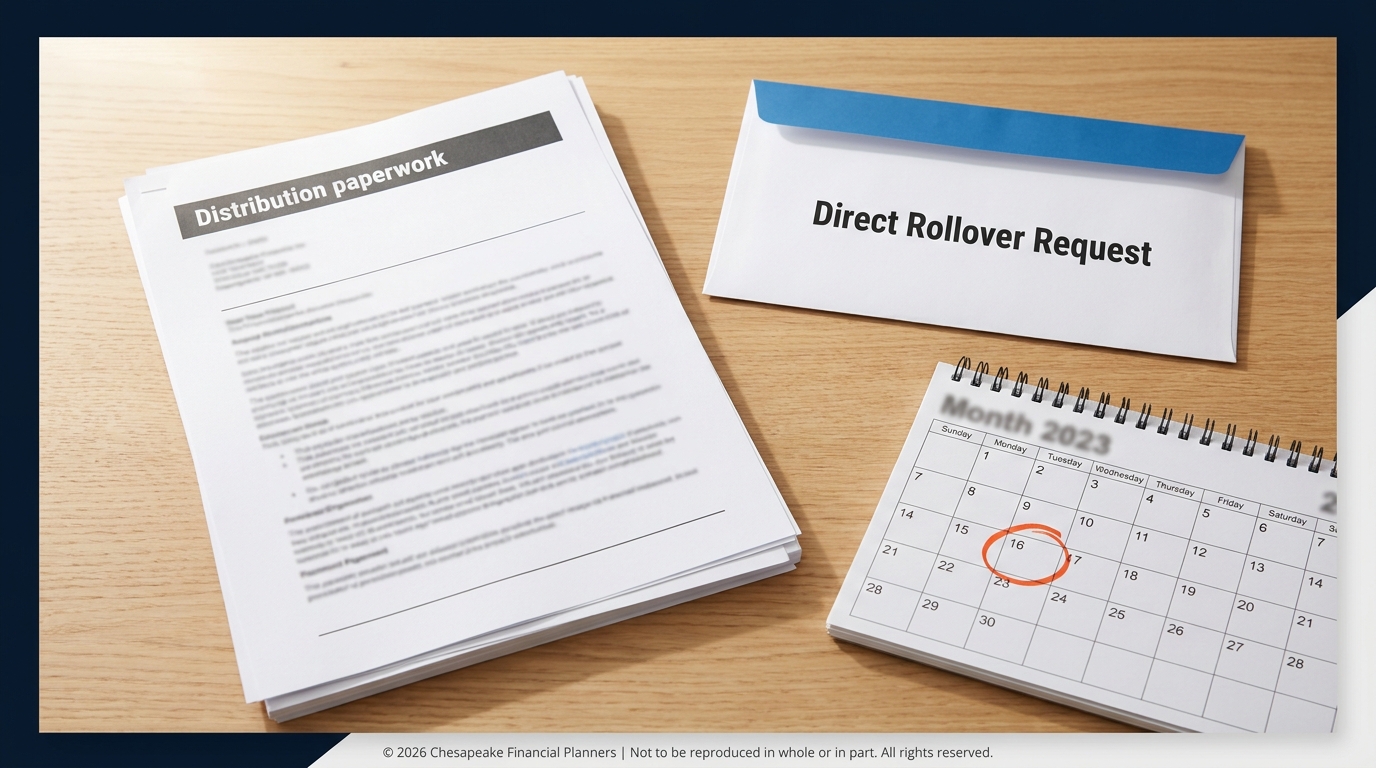
You've been offered a lump sum payout from a pension, a retirement plan buyout, or a severance package. The number looks substantial, perhaps life-changing. But before you make your decision, you need to understand something critical: the tax implications of that lump sum could dramatically reduce what you actually keep.
Here's what you need to know about the tax consequences of lump sum payouts.
How Lump Sums Are Taxed
Most lump sum retirement distributions are taxed as ordinary income in the year you receive them. This means the entire amount gets added to your other income for that year, potentially pushing you into significantly higher tax brackets.
If you're receiving a $200,000 lump sum distribution and you already earn $80,000 in salary, your taxable income for that year jumps to $280,000. In 2026, that kind of income spike can move you into meaningfully higher federal tax brackets; so the marginal rate applied to the top portion of the distribution may be much higher than your “normal” bracket.
The tax hit extends beyond just federal income taxes. Your state will likely tax the distribution as well, unless you live in one of the states with no income tax. You may also face additional Medicare surtaxes if your income exceeds certain thresholds ($250,000 for married couples, $200,000 for individuals).
The result? That $200,000 lump sum might only net you $120,000-$140,000 after federal and state taxes, depending on your situation.
Required Tax Withholding

When you receive a lump sum distribution from a qualified retirement plan, your employer or plan administrator is required to withhold 20% for federal taxes automatically unless you execute a direct rollover to an IRA or another qualified plan.
This mandatory withholding creates a cash flow problem if you're planning to roll over the funds. Say you receive that $200,000 lump sum. The plan withholds $40,000 for taxes, and you receive a check for $160,000. If you want to roll over the full $200,000 to avoid taxes, you must come up with the $40,000 from other sources within 60 days.
If you can't replace the withheld $40,000, you've effectively taken a $40,000 taxable distribution even if you rolled over the rest. That $40,000 gets taxed as ordinary income, and if you're under age 59½, you'll also owe a 10% early withdrawal penalty.
The solution? Request a direct rollover (sometimes called a trustee-to-trustee transfer) where the funds move directly from your employer's plan to your IRA without you ever touching the money. This avoids the mandatory withholding entirely.
The Early Withdrawal Penalty
If you're under age 59½ when you take a lump sum distribution, you'll generally owe an additional 10% early withdrawal penalty on top of regular income taxes, unless a specific exception applies.
Common exceptions include:
- Separation from service at age 55 or later for employer retirement plans (age 50 for public safety employees)
- Substantially equal periodic payments under IRS rules
- Permanent disability
- Certain medical expenses exceeding 7.5% of adjusted gross income
- Qualified domestic relations orders in divorce situations
Notice that "I need the money" or "I want to pay off debt" are not exceptions. If none of the specific exceptions apply and you're under 59½, that 10% penalty significantly increases the tax cost of taking your lump sum.
That $200,000 distribution at age 52? You're now looking at $20,000 in penalties plus ordinary income taxes, potentially reducing your net proceeds to $100,000-$120,000.
State Tax Considerations

State tax treatment of lump sum distributions varies significantly. Some states follow federal rules closely, taxing the full amount as ordinary income. Others offer special treatment:
States with no income tax (Alaska, Florida, Nevada, South Dakota, Tennessee, Texas, Washington, Wyoming) won't tax your distribution at all—a significant advantage if you're already living there or planning to relocate before taking your distribution.
Some states provide retirement income exclusions or lower tax rates for qualifying retirement distributions. Pennsylvania, for example, doesn't tax distributions from qualified retirement plans. Mississippi exempts all qualified retirement income for residents over 59½.
A few states offer age-based exclusions that allow older taxpayers to exclude some retirement income from state taxation.
If you have flexibility about when to take your distribution, consider whether relocating to a more tax-friendly state makes financial sense. Moving from California (up to 13.3% state tax) to Florida (0% state tax) before taking a large lump sum distribution could save tens of thousands of dollars.
Strategies to Minimize Tax Impact
While you can't eliminate taxes on traditional retirement plan distributions, you can manage the impact:
Spread the distribution across multiple years if possible. Rather than taking $300,000 in one year, taking $100,000 per year for three years keeps you in lower tax brackets each year. Not all plans offer this option, but it's worth asking.
Time the distribution strategically. Take it in a year when your other income is unusually low—perhaps after you've retired but before you start Social Security or required minimum distributions. The lower your baseline income, the less painful the tax hit from the lump sum.
Consider partial rollovers. You might roll over most of the lump sum to an IRA while taking just enough cash to meet immediate needs. This limits the current tax hit while preserving tax deferral on the bulk of your assets.
Use the distribution for Roth conversions. If you're going to pay taxes anyway, consider rolling the lump sum into a traditional IRA, then systematically converting portions to a Roth IRA over several years. You'll still pay taxes, but you'll gain tax-free growth going forward.
Coordinate with other tax planning. Bunch deductions into the year you take your distribution. Accelerate charitable contributions, medical expenses, or business deductions to offset some of the distribution income.
Net Unrealized Appreciation for Company Stock
If your lump sum includes company stock held in your employer's plan, you may qualify for net unrealized appreciation (NUA) treatment—a special tax break that can save substantial amounts.
Under NUA rules, you pay ordinary income tax only on the cost basis of the stock (what the plan originally paid), not its current value. The appreciation is taxed as long-term capital gains when you eventually sell the stock—typically at significantly lower rates.
This strategy only works in specific circumstances and requires careful execution. You must take a complete distribution of your entire plan balance within one calendar year, and you must transfer the company stock in-kind to a taxable brokerage account, not to an IRA.
For employees with substantial company stock holdings that have appreciated significantly, NUA treatment can save tens of thousands in taxes. But it's complex—consult with a CPA or tax advisor before pursuing this strategy.
Comparing Lump Sum vs. Pension Annuity
When you're choosing between a lump sum and a lifetime pension annuity, taxes play an important role in the analysis.
The lump sum creates an immediate, substantial tax hit. The pension annuity spreads taxation over your lifetime—you pay taxes only on the monthly payments as you receive them, keeping you in lower tax brackets each year.
However, the pension income is still fully taxable as ordinary income. It's not a tax-free option—just a tax-deferred one that spreads the tax burden over time rather than concentrating it in one year.
A proper comparison requires calculating the after-tax value of both options based on your specific tax situation, other income sources, and life expectancy. This is where professional financial planning becomes valuable.
Your Next Steps
Before accepting a lump sum payout, run the numbers with a CPA or financial advisor. Calculate your total tax bill including federal, state, and potential penalties. Compare the after-tax lump sum to alternative options like annuity payments or partial distributions over time.
Consider the timing of your distribution and whether strategic planning could reduce your tax burden. Understand your rollover options and how to execute them properly to avoid unnecessary withholding.
The stated lump sum amount is never what you'll actually receive. Understanding the tax implications helps you make informed decisions about what's truly best for your financial future.
This information is for educational purposes only and should not be considered personalized tax or financial advice. Every lump sum situation is unique. Consult with qualified tax and financial professionals before making decisions about retirement distributions.
Advisors associated with Chesapeake Financial Planners may be either (1) LPL Financial Registered Representatives offering securities through LPL Financial, Member FINRA and SIPC, and investment advisor representatives offering investment advice through Great Valley Advisor Group; or (2) solely investment advisor representatives offering investment advice through Great Valley Advisor Group and not affiliated with LPL Financial. Great Valley Advisor Group, and Chesapeake Financial Planners are separate entities from LPL Financial.
Chesapeake Financial Planners | 2402 Scotlon Ct, Forest Hill, MD 21050 | (410) 652-7868 | www.chesapeakefp.com
© 2026 Chesapeake Financial Planners | Not to be reproduced in whole or in part. All rights reserved.

