

You've built a $3 million portfolio through steady contributions, smart diversification, and patient compounding. Your mix of stocks and bonds has served you well. But lately, you're wondering if there's more.
Alternative investments like private equity, real estate syndications, hedge funds, and private credit used to be reserved for ultra-wealthy families with $50 million-plus portfolios. Today, investors with $1 to 5 million can access many of these strategies. The question isn't whether you can. It's whether you should, and if so, how much.
What Are Alternative Investments?
Alternative investments are assets outside traditional stocks, bonds, and cash. These include private equity (investments in private companies), private credit (direct lending to businesses), real estate (through syndications or funds), hedge funds (actively managed strategies), commodities (like gold, oil, and agricultural products), and collectibles (like art, wine, and classic cars).
The appeal: potential for higher returns, lower correlation to public markets, and diversification benefits. The reality: complexity, illiquidity, high fees, and risks requiring careful evaluation.
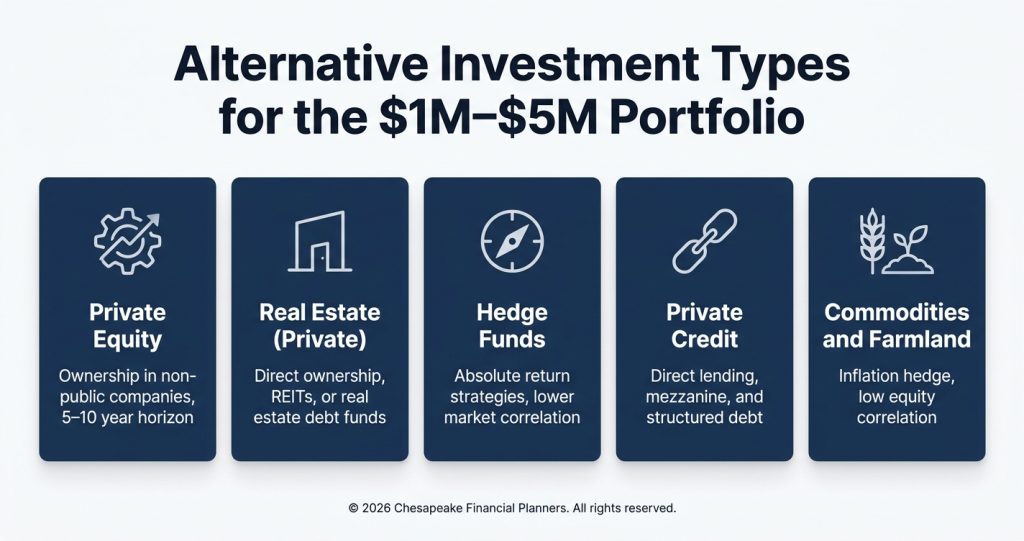
Why High Net Worth Investors Consider Alternatives
For families with $1 to 5 million, alternatives can serve specific portfolio roles.
Diversification beyond public markets.
When stocks and bonds move together, traditional 60/40 portfolios offer less diversification than expected. Alternatives with low correlation can reduce portfolio volatility.
Access to institutional quality strategies.
Pension funds and endowments have allocated to alternatives for decades. According to Yale University's annual endowment report, the Yale Endowment allocates over 50% to alternatives.[1]
Income generation beyond traditional bonds.
Private credit and real estate can generate higher income than bonds, though with different risk profiles.
Inflation protection.
Real assets like real estate and commodities provide inflation hedges that traditional portfolios lack.
Tax efficiency.
Certain alternative structures offer tax advantages through Opportunity Zone investments, depreciation benefits, and tax efficient income.
The $1-5M Investor's Reality Check
Access has democratized, but not every alternative investment makes sense for your portfolio.
What's changed
Ten years ago, most alternatives required $5 to 10 million minimums. Today, many platforms offer alternatives with $25,000 to $100,000 minimums through interval funds, tender offer funds, and crowdfunding platforms.
What hasn't changed
Lower minimums don't reduce complexity. You still need to understand the strategy, evaluate manager track records, assess liquidity terms, and monitor ongoing performance.
The 15 to 20% allocation guideline
Most advisors recommend limiting alternatives to 15 to 20% of your portfolio at the $1 to 5 million level. This provides diversification without over exposing you to illiquidity or complexity.
Alternative Strategies Worth Considering
Private Real Estate (Syndications and Funds)
Pooled investments in commercial real estate include multifamily apartments, office buildings, and industrial properties. Minimum investment is $25,000 to $100,000.
Potential benefits include steady income distributions, diversification, inflation protection, and tax benefits through depreciation.
Risks include illiquidity with 5 to 7 year holds, property specific risks, economic sensitivity, and sponsor quality that matters enormously.
Private Credit
Direct lending to middle market businesses or real estate projects. Minimum investment is $50,000 to $100,000.
Potential benefits include higher yields than public bonds, often 8 to 12%, floating rates that benefit in rising rate environments, and lower volatility than stocks.
Risks include credit risk where borrowers may default, illiquidity, complex structures, and economic sensitivity.
Interval Funds with Alternative Strategies
Registered funds investing in alternatives with limited quarterly liquidity, typically 5% of fund value per quarter. Minimum is $25,000 to $50,000.
Potential benefits include more liquidity than traditional private funds, regulatory oversight, and diversified exposure.
Risks include limited liquidity that means you can't exit quickly, plus underlying assets still carry alternative investment risks.
Diversified Alternative ETFs and Mutual Funds
Publicly traded funds investing in liquid alternatives including long/short equity, managed futures, merger arbitrage, or market neutral approaches.
Potential benefits include daily liquidity, lower minimums, and regulatory oversight.
Risks include often delivering returns closer to traditional portfolios and higher fees than traditional index funds.

The Due Diligence Questions You Must Answer
Do I understand the strategy? Can you explain what this investment does, how it makes money, and what can go wrong?
What's the liquidity profile? When can you access your money? Can you afford to have capital locked up?
What are the total fees? Management fees, performance fees, and administrative fees. Many alternatives charge 1 to 2% management plus 20% of profits.
Who's the manager? How long have they run this strategy? What's their performance during various market conditions?
How does this fit my overall allocation? Does this genuinely diversify your portfolio, or are you layering on correlated risks?
What are the tax implications? K1s for certain partnerships can complicate tax filing.
Common Alternative Investment Mistakes
Chasing performance. Last year's best performing fund is often this year's disappointment.
Over allocating to illiquid investments. Locking up 40% of your portfolio creates cash flow problems when life happens.
Ignoring fees. A 2% management fee plus 20% performance fee can erode returns significantly.
"My friend invested and made great returns" is not due diligence.
Treating alternatives as magic diversification. Some alternatives correlate highly with stocks during downturns.
Your Alternative Investment Action Plan
Define your goals for alternatives like diversification, higher income, inflation protection, or tax benefits. Assess your liquidity needs. How much can you truly lock up for 5 to 10 years? Start small at 10% or less and increase gradually if appropriate. Diversify within alternatives across strategies and managers. Work with experienced advisors who have deep experience evaluating alternatives.
Are Alternatives Right for You?
Alternative investments can enhance portfolios for investors with $1 to 5 million, but only when thoughtfully selected, properly allocated, and thoroughly understood.
If you have sufficient liquidity elsewhere, a long time horizon, and clear goals that alternatives can address, a 15 to 20% allocation can make sense.
If you're uncomfortable with complexity, need high liquidity, or don't want to spend time on due diligence, traditional stocks and bonds may serve you better.
The goal isn't to invest in alternatives because they're trendy. The goal is to build a portfolio aligned with your specific situation, risk tolerance, and objectives, whether that includes alternatives or not.
This information is not intended to be a substitute for specific individualized investment advice. We suggest that you discuss your specific situation with a qualified financial advisor.
Please consult your financial professional regarding your specific situation.
Content in this material is for general information only and not intended to provide specific advice or recommendations for any individual.
Alternative investments may not be suitable for all investors and involve special risks such as illiquidity, lack of diversification, and higher fees. Before investing, carefully consider the investment objectives, risks, charges, and expenses.
Real estate investments are subject to various risks, including fluctuations in property values, higher expenses or lower income than expected, and potential environmental problems and liability.
There is no assurance that any investment strategy will be successful or that any securities or investment programs mentioned will be suitable or profitable for your portfolio.
Advisors associated with Chesapeake Financial Planners may be either (1) LPL Financial Registered Representatives offering securities through LPL Financial, Member FINRA and SIPC, and investment advisor representatives offering investment advice through Great Valley Advisor Group; or (2) solely investment advisor representatives offering investment advice through Great Valley Advisor Group and not affiliated with LPL Financial. Great Valley Advisor Group, and Chesapeake Financial Planners are separate entities from LPL Financial.
Chesapeake Financial Planners | 2402 Scotlon Ct, Forest Hill, MD 21050 | (410) 652-7868 | www.chesapeakefp.com
© 2026 Chesapeake Financial Planners | Not to be reproduced in whole or in part. All rights reserved.

