
If you're active duty, a veteran, or a military retiree, you have access to benefits that most civilians don't. But these benefits are complex; and if you don't understand how to maximize them, you're leaving money on the table.
If you're active duty, a veteran, or a military retiree, you have access to benefits that most civilians don't. But these benefits are complex; and if you don't understand how to maximize them, you're leaving money on the table.
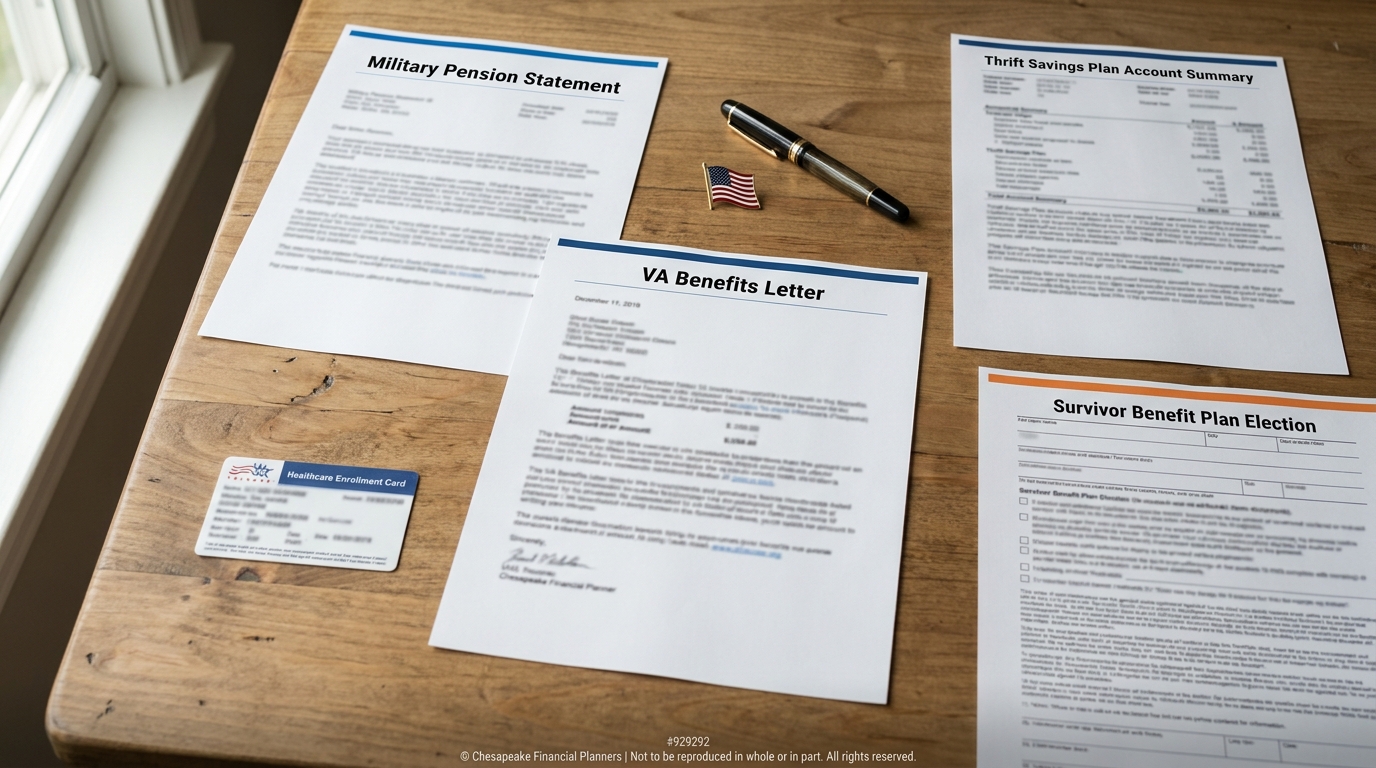
Military financial planning isn't just about saving and investing. It's about coordinating pensions, TSP, VA benefits, healthcare, and survivor protections into a cohesive strategy.
Let's break down the key military benefits and how to build a financial plan that makes the most of them.

The Unique Advantages of Military Benefits
Military service comes with financial benefits most people don't have:
Military pension (for 20+ year retirees):
Guaranteed monthly income for life, with COLA adjustments.
Thrift Savings Plan (TSP):
Low-cost retirement account with generous matching (under BRS).
Tricare:
Affordable healthcare for life (for retirees and families).
VA benefits:
Disability compensation, education benefits, home loans, and more.
Survivor Benefit Plan (SBP):
Continuation of pension benefits for your spouse after you pass.
GI Bill:
Education benefits for you and (potentially) your family.
These benefits are powerful—but only if you use them strategically.
Military Pension: Understanding Your Retirement Options
If you serve 20+ years, you're eligible for a military pension. There are two systems:
Legacy High-3 System (pre-2018)
Your pension is based on:
- Years of service
- Average of your highest 36 months of base pay
Formula: Years of service × 2.5% × High-3 average
Example: 20 years of service, $6,000 average monthly pay
→ 20 × 2.5% = 50%
→ $6,000 × 50% = $3,000/month for life
No matching TSP contributions under this system.
Blended Retirement System (BRS) (2018+)
Lower pension (2.0% per year instead of 2.5%), but you get:
- Automatic 1% TSP contribution
- Up to 5% TSP matching
- Continuation pay at mid-career
Formula: Years of service × 2.0% × High-3 average
Example: 20 years of service, $6,000 average monthly pay
→ 20 × 2.0% = 40%
→ $6,000 × 40% = $2,400/month for life
Plus, TSP matching adds significant value if you contribute consistently.
Which is better?
- High-3 if you're staying 20+ years and not maxing TSP
- BRS if you're contributing heavily to TSP or might leave before 20 years
Thrift Savings Plan (TSP): Your Primary Wealth-Building Tool
The TSP is one of the best retirement plans in the country:
- Ultra-low fees: Expense ratios as low as 0.042%
- Generous matching (BRS): Up to 5% match
- Tax advantages: Traditional (pre-tax) or Roth (after-tax) options
2026 Contribution limits:
- $24,500 ($32,500 if 50+, or $35,750 if ages 60-63)
- Includes employer match
TSP fund options:
- G Fund: Government securities (safe, low return)
- F Fund: Bond index
- C Fund: S&P 500 index
- S Fund: Small/mid-cap index
- I Fund: International index
- L Funds: Target-date funds (automatic allocation)
Strategy for most people:
- Early career: Heavily weighted toward C, S, and I funds (growth)
- Mid-career: Start adding F fund (bonds) for stability
- Near retirement: Shift toward G and F funds (preservation)
If you're under BRS, contribute at least 5% to get the full match. That's free money.

VA Disability Compensation: Tax-Free Income
If you have a service-connected disability, VA disability compensation provides tax-free monthly income based on your disability rating.
2026 rates (examples):
- 10% rating: ~$180/month
- 50% rating: ~$1,133/month
- 100% rating: ~$3,939/month (higher with dependents)
This is tax-free income for life. Factor it into your retirement planning—it reduces how much you need to save.
If you're eligible but haven't filed: File your claim. Even small ratings add up over time.
Tricare: Affordable Healthcare for Life
Tricare is one of the most valuable military benefits, especially for retirees.
Tricare for Life (age 65+):
Acts as secondary insurance to Medicare. Minimal out-of-pocket costs.
Tricare Prime/Select (under 65):
Low premiums and out-of-pocket costs compared to civilian plans.
Why it matters:
Healthcare is one of the biggest retirement expenses. Tricare dramatically reduces that burden, freeing up money for other goals.
Planning tip: If you're retiring before 65, budget for healthcare until Tricare for Life kicks in. But even Tricare Prime is far cheaper than most civilian plans.
Survivor Benefit Plan (SBP): Protecting Your Spouse
The SBP allows your spouse to continue receiving a portion of your military pension after you pass.
Cost: You pay a premium (typically 6.5% of the benefit amount).
Benefit: Your spouse receives 55% of your pension for life.
Should you elect SBP?
Yes, if:
- Your spouse will rely on your pension for income
- You don't have substantial other assets
- Your spouse is significantly younger or in good health
Maybe not, if:
- You have significant life insurance or other assets
- Your spouse has their own retirement income
- You're in poor health and your spouse is not
Run the numbers. For many military retirees, SBP is the most cost-effective way to protect a spouse.
VA Home Loan: A Powerful Wealth-Building Tool
The VA home loan is one of the best mortgage products available:
- No down payment required
- No PMI (private mortgage insurance)
- Competitive interest rates
- Flexible credit requirements
This can save you tens of thousands compared to conventional loans.
Strategy: Use the VA loan to buy your primary residence, then consider renting it out when you move (with VA loan, you can keep the property and get another VA loan for a new home in many cases).
Real estate can be a powerful wealth-building tool for military families, especially given frequent moves.
GI Bill: Education Benefits for You and Your Family
The Post-9/11 GI Bill covers:
- Tuition and fees
- Monthly housing allowance
- Books and supplies
You can transfer unused benefits to your spouse or children if you meet service requirements.
This is a huge financial benefit—worth $100,000+ depending on the school.
Strategy: If you're not using it, transfer it to your kids. This can dramatically reduce or eliminate college costs.
Common Financial Planning Mistakes for Military Families
Not contributing to TSP:
Even small contributions compound massively over a 20-year career.
Ignoring VA disability:
File your claim. Even small ratings add tax-free income.
Not planning for transition:
Military to civilian transitions are financially disruptive. Plan ahead.
Carrying high-interest debt:
Frequent moves, deployments, and lifestyle adjustments can lead to credit card debt. Tackle it aggressively.
Not having adequate life insurance:
SGLI (Service members' Group Life Insurance) is cheap and critical. Keep it—or get term life insurance as a civilian.
Neglecting estate planning:
Wills, beneficiaries, and powers of attorney are essential, especially during deployments.
Building Your Military Financial Plan
Here's a simple framework:
Step 1: Maximize TSP contributions
Aim for at least 5% (to get the match under BRS). Ideally, max it out ($24,500 for 2026).
Step 2: File for VA benefits
If you're eligible for disability, education, or home loan benefits, use them.
Step 3: Plan for healthcare
Understand your Tricare options and budget accordingly.
Step 4: Protect your family
Elect SBP if appropriate. Carry adequate life and disability insurance.
Step 5: Minimize debt
Tackle high-interest debt aggressively. Use VA loans for housing to avoid PMI.
Step 6: Build an emergency fund
3-6 months of expenses in a high-yield savings account.
Step 7: Invest for the long term
TSP is your primary tool, but consider a Roth IRA or taxable brokerage account for additional flexibility.
The Bottom Line
Military benefits are powerful—but complex. The key is understanding what you have, how to maximize it, and how to coordinate everything into a cohesive plan.
Your pension, TSP, VA benefits, and Tricare give you a financial foundation most civilians don't have. Use it wisely, and you can build serious wealth.
At Chesapeake Financial Planners, we work with active duty service members, veterans, and military retirees to build financial plans that honor your service and set you up for long-term success.
Ready to maximize your military benefits? Let's talk.
This material is for general information only and is not intended to provide specific advice or recommendations for any individual. To determine which strategies may be appropriate for you, please consult your financial professional prior to making financial decisions.
Advisors associated with Chesapeake Financial Planners may be either (1) LPL Financial Registered Representatives offering securities through LPL Financial, Member FINRA and SIPC, and investment advisor representatives offering investment advice through Great Valley Advisor Group; or (2) solely investment advisor representatives offering investment advice through Great Valley Advisor Group and not affiliated with LPL Financial. Great Valley Advisor Group, and Chesapeake Financial Planners are separate entities from LPL Financial.
Chesapeake Financial Planners | 2402 Scotlon Ct, Forest Hill, MD 21050 | (410) 652-7868 | www.chesapeakefp.com
© 2026 Chesapeake Financial Planners | Not to be reproduced in whole or in part. All rights reserved.

