

You're in your 30s or 40s. Your income is growing. Your financial life is getting more complex. And you're wondering: Is it worth paying for financial advice?
It's a fair question. Financial advisors charge fees—and when you're busy building wealth, every dollar counts. But the right financial planner can save you far more than they cost.
Let's break down when financial advice is worth it, what you should expect, and how to know if you're ready.
Why Your 30s and 40s Are Critical Financial Years
Your 30s and 40s are your wealth-building prime. You're earning more, but you're also juggling competing priorities:
- Building retirement savings
- Managing debt (student loans, mortgage)
- Raising kids (childcare, college planning)
- Navigating career changes or promotions
- Dealing with equity compensation or bonuses
- Planning for major purchases (home, car, vacations)
- Caring for aging parents
You're making financial decisions that will compound for decades. Get them right, and you accelerate wealth. Get them wrong, and you lose years of progress.
This is exactly when professional guidance can pay off massively.
What a Financial Planner Actually Does
A good financial planner doesn't just pick investments. They act as a strategic partner across your entire financial life:
Financial planning:
Building a roadmap for your goals—retirement, education, major purchases, financial independence.
Investment management:
Creating and managing a diversified portfolio aligned with your risk tolerance and timeline.
Tax optimization:
Coordinating with your CPA to minimize taxes through smart account selection, Roth conversions, tax-loss harvesting, and more.
Risk management:
Making sure you have the right insurance (life, disability, umbrella) to protect what you're building.
Estate planning:
Wills, trusts, beneficiaries, powers of attorney—so your assets go where you want.
Behavioral coaching:
Keeping you from making emotional, costly mistakes during market volatility or life transitions.
Accountability:
Making sure you stay on track and adjust as life changes.
It's not just about returns—it's about making smart decisions across every aspect of your financial life.

The Real Cost of Not Having a Planner
Let's talk about what not having a financial planner can cost you:
Tax inefficiency:
Saving in the wrong accounts, missing Roth conversions, or failing to harvest losses could cost you tens of thousands over a career.
Investment mistakes:
Panic-selling during downturns, chasing hot investments, or holding a poorly diversified portfolio can destroy wealth.
Insurance gaps:
Not having disability or life insurance when you need it can financially devastate your family.
Suboptimal decisions:
Taking Social Security too early, cashing out a 401(k), or mismanaging equity compensation can each cost six figures.
Opportunity cost:
Not maximizing 401(k) matches, HSA contributions, or employer benefits leaves money on the table.
Time and stress:
Researching, managing, and worrying about finances drains energy you could spend on your career, family, or health.
A financial planner's value isn't just what they help you gain—it's what they help you avoid losing.
When Financial Advice Is Worth It
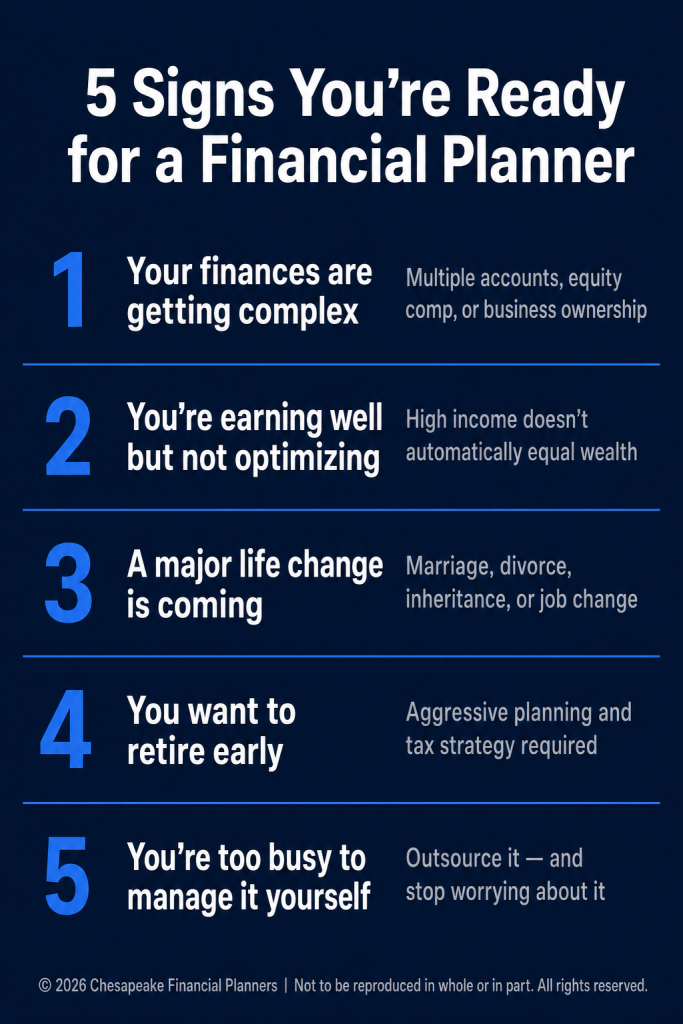
Here are clear signs you're ready for a financial planner:
Your financial situation is getting complex
Multiple income sources, equity compensation, investment accounts, real estate, or side businesses create complexity. A planner helps you coordinate everything.
You're earning more but not sure how to optimize
High income doesn't automatically equal wealth. A planner helps you turn income into long-term financial security.
You're experiencing a major life change
Marriage, divorce, new baby, inheritance, job change, business sale—these are high-stakes moments. A planner helps you navigate without costly mistakes.
You want a second opinion
Even if you're financially savvy, having an expert review your strategy can identify blind spots.
You don't have time or interest in managing it yourself
You're busy. Outsourcing financial management frees up time and reduces stress.
You've made mistakes and want to avoid repeating them
Emotional investing, poor timing, or bad advice in the past? A planner provides structure and accountability.
You're behind on retirement savings
If you're not on track, a planner can create a roadmap to catch up.
You want to retire early or achieve financial independence
This requires aggressive planning, tax optimization, and risk management. A planner makes it realistic.
The ROI of Financial Planning
How much value does a financial planner actually provide?
Studies show:
- Russell Investments' "Value of an Advisor" research estimates a good advisor adds roughly 3% per year in net returns through behavioral coaching, tax strategies, and smart portfolio construction.
- Morningstar estimates 1.5-2% per year in added value.
Let's put that in perspective:
If you have $500,000 invested and a planner adds 2% per year, that's $10,000 annually. Over 20 years (assuming 7% base returns), that could be an additional $400,000+.
Even if a planner charges 1% ($5,000/year on $500,000), the net value is massive.
And that's just the investment side. Tax savings, insurance optimization, and avoiding costly mistakes add even more value.
What About Robo-Advisors?
Robo-advisors (Betterment, Wealthfront, etc.) are low-cost, algorithm-driven platforms that manage portfolios automatically.
Pros:
- Very low fees (0.25% or less)
- Easy to use
- Good for simple, straightforward situations
Cons:
- No personalized advice
- No tax planning, estate planning, or risk management
- No behavioral coaching
- Can't handle complex situations (equity compensation, business ownership, etc.)
Bottom line: Robo-advisors are great for beginners or simple portfolios. But if your financial life has complexity, a human advisor provides far more value.
How Much Does a Financial Planner Cost?
Fees vary widely depending on the advisor and service model:
Assets Under Management (AUM) fee:
Typically 0.5-1.5% of assets managed annually. Common for ongoing, comprehensive planning.
Flat annual fee:
$2,000-10,000+/year for holistic planning, regardless of assets.
Hourly fee:
$200-500/hour for project-based advice (one-time financial plan, second opinion, etc.).
Commission-based:
Advisor earns commissions on products sold (insurance, annuities, etc.). Be cautious—this can create conflicts of interest.
At Chesapeake Financial Planners, we use a fee-based model where compensation is transparent and aligned with your interests, not product sales.
Is the Cost Worth It?
Here's how to think about it:
If a financial planner:
- Saves you $5,000/year in taxes
- Helps you avoid a $20,000 panic-selling mistake
- Optimizes your portfolio to gain an extra 1-2% annually
- Saves you 10 hours/month of research and stress
…the fee pays for itself many times over.
Financial planning isn't an expense—it's an investment in your future.
What to Look for in a Financial Planner
Not all financial advisors are created equal. Here's what to prioritize:
Fiduciary duty:
Choose a fiduciary who is legally required to act in your best interest (not all advisors are).
Fee-only or fee-based:
Avoid commission-based advisors who profit from selling you products.
Relevant credentials:
Look for CFP® (Certified Financial Planner), CPA, or RICP® (Retirement Income Certified Professional).
Experience with your situation:
Do they work with people in your income range, life stage, and financial complexity?
Comprehensive planning:
They should address investments, taxes, insurance, estate, and retirement—not just pick funds.
Chemistry:
You'll be sharing personal financial information. Make sure you trust and feel comfortable with them.
Can You Do It Yourself?
Yes—but it's hard.
DIY financial planning works if:
- You have the time and interest to research deeply
- You can stay disciplined and avoid emotional mistakes
- Your financial situation is simple
- You're confident in tax, investment, and estate strategies
But even financially savvy people benefit from a second set of eyes, accountability, and expertise.
Think of it like fitness: You can work out alone, but a coach helps you reach goals faster and avoid injury.
The Bottom Line
Is financial advice worth it in your 30s and 40s? Absolutely—if your financial life has complexity, you're earning well, or you want to accelerate wealth-building.
The cost of a good financial planner is almost always outweighed by the value they provide through tax savings, better investment decisions, and avoiding costly mistakes.
Your 30s and 40s are your financial prime. Don't waste them guessing. Get a plan, get a partner, and build the financial future you actually want.
At Chesapeake Financial Planners, we help driven professionals in their 30s and 40s turn income into wealth—with clarity, strategy, and accountability.
Ready to see if financial planning is right for you? Let's talk.
This material is for general information only and is not intended to provide specific advice or recommendations for any individual. To determine which strategies may be appropriate for you, please consult your financial professional prior to making financial decisions.
Advisors associated with Chesapeake Financial Planners may be either (1) LPL Financial Registered Representatives offering securities through LPL Financial, Member FINRA and SIPC, and investment advisor representatives offering investment advice through Great Valley Advisor Group; or (2) solely investment advisor representatives offering investment advice through Great Valley Advisor Group and not affiliated with LPL Financial. Great Valley Advisor Group, and Chesapeake Financial Planners are separate entities from LPL Financial.
Chesapeake Financial Planners | 2402 Scotlon Ct, Forest Hill, MD 21050 | (410) 652-7868 | www.chesapeakefp.com
© 2026 Chesapeake Financial Planners | Not to be reproduced in whole or in part. All rights reserved.

