

The buyout closed. After years of building your business, you're sitting on $2 million, $3 million, or more in your checking account. For the first time in your career, you're not worrying about payroll, customer issues, or operational problems. You're just staring at a number larger than you've ever managed.
The buyout closed. After years of building your business, you're sitting on $2 million, $3 million, or more in your checking account. For the first time in your career, you're not worrying about payroll, customer issues, or operational problems. You're just staring at a number larger than you've ever managed.
Now comes the question that keeps you awake: what do I do with this money?
For most business owners, the buyout represents their largest asset and primary source of future income. How you invest these proceeds will determine whether you achieve financial security or whether you run out of money faster than expected.
Here's the challenge: Running a business doesn't prepare you to manage a large investment portfolio. The skills that made you a successful entrepreneur, taking concentrated risks, controlling outcomes, building from scratch: don't translate directly to investment management.
You need a fundamentally different approach.

Why Business Owners Often Get Investment Strategy Wrong
Business owners make predictable mistakes when investing buyout proceeds:
Mistake #1: Staying Too Concentrated
You built wealth through concentrated risk in your business. It worked. So you invest buyout proceeds in one or two "sure thing" opportunities maybe another business, a friend's venture, or heavy concentration in a sector you know.
The problem: Your wealth is already concentrated from years in one business. Post-buyout, you need diversification to reduce risk, not more concentration.
Mistake #2: Keeping Money in Cash Too Long
Suddenly having millions in your account feels good. You're afraid of making the wrong move, so you leave it in cash "temporarily" while you figure things out.
The problem: Inflation erodes purchasing power at 3-4% annually. $2 million today becomes $1.48 million in purchasing power in 10 years if left in cash. You're losing money by not investing.
Mistake #3: Trying to Get Rich Again
You already built substantial wealth through your business. Now you're chasing 15-20% annual returns through aggressive investments.
The problem: You don't need to get rich you already are. Your goal is preserving wealth and generating sustainable income, not maximizing returns through excessive risk.
Mistake #4: Trusting the Wrong Advisors
Friends, family members, or business acquaintances approach with "opportunities." Or you work with advisors who don't understand business owner needs and high-net-worth strategies.
The problem: Emotional decisions and inexperienced advice destroy more post-buyout wealth than market downturns.
Your Primary Investment Objectives
Before investing a dollar, clarify what you're actually trying to achieve:
Generate Sustainable Income
If buyout proceeds represent your retirement funding, you need income to replace the salary and distributions you previously earned.
Key question: How much annual income do you need, and can your portfolio sustainably generate it?
Preserve Capital
Losing 30-40% of your portfolio in a market downturn when you're 60 years old and depending on this money for income is devastating. Capital preservation matters more than aggressive growth.
Outpace Inflation
Your money needs to maintain purchasing power over 20-30+ years. Even modest 3% inflation reduces purchasing power significantly over time.
Manage Tax Efficiency
Where and how you invest impacts taxes. Strategic tax management can add 0.5-1% to your annual after-tax returns meaningful over decades.
Reduce Concentrated Risk
You spent years with all eggs in one basket (your business). Diversification across asset classes, geographies, and investment types reduces overall portfolio risk.
A Prudent Investment Framework for Buyout Proceeds
Here's how to think about investing substantial business sale proceeds:
Create Your Investment Policy Statement
Before investing anything, document:
- Time horizon: When do you need this money? 5 years? 20 years? 40 years?
- Risk tolerance: How would you react to a 20-30% portfolio decline?
- Income needs: How much annual income must the portfolio generate?
- Liquidity requirements: Do you need significant cash available for major purchases?
- Tax situation: What tax strategies optimize after-tax returns?
- Legacy goals: Are you trying to pass wealth to heirs or charities?
This framework guides all investment decisions and keeps you from making emotional choices.
Build Diversified Core Portfolio
Most business owners should build a diversified core portfolio as their foundation:
Stock allocation (50-70%):
- US large-cap stocks (20-30%)
- US mid and small-cap stocks (10-15%)
- International developed markets (10-15%)
- Emerging markets (5-10%)
Bond allocation (25-40%):
- Investment-grade corporate bonds
- Treasury bonds
- Municipal bonds (if tax-efficient for your situation)
- Short to intermediate duration to manage interest rate risk
Alternative investments (5-15%):
- Real estate (REITs or direct ownership)
- Commodities or inflation hedges
- Private investments (carefully selected)
Typical conservative allocation: 60% stocks / 35% bonds / 5% alternatives
Typical moderate allocation: 70% stocks / 25% bonds / 5% alternatives
Maintain Adequate Cash Reserves
Keep 1-2 years of living expenses in cash or cash equivalents. This prevents you from selling investments at inopportune times to cover expenses.
Example: If you need $120,000 annually, keep $120,000-$240,000 in high-yield savings, money market funds, or short-term bonds.
Implement Tax-Efficient Investment Location
Where you hold investments matters for taxes:
Tax-deferred accounts (Traditional IRA, 401k):
- Bonds and taxable fixed income
- REITs
- Actively managed funds with high turnover
Tax-free accounts (Roth IRA):
- Highest expected return investments
- Assets you won't need for longest period
Taxable accounts:
- Stocks held for long-term capital gains treatment
- Tax-efficient index funds
- Municipal bonds (if in high tax bracket)
Strategic asset location can save tens of thousands in taxes annually.
Consider Income-Generating Strategies
If you need portfolio income, several strategies can help:
- Dividend-focused stock portfolio: Quality dividend-paying stocks provide 2-4% annual income
- Bond ladder: Staggered maturity bonds provide predictable income
- Systematic withdrawal strategy: Sell a portion of portfolio monthly or quarterly to fund spending
- Income-oriented alternatives: Real estate, business lending, royalty funds (carefully evaluated)
Don't chase yield blindly. High-yield investments often carry high risk.
What About Investing in Another Business?
Many business owners consider buying or starting another business with sale proceeds.
When it makes sense:
- You're energized by operating a business, not ready to retire
- You have specific expertise in the opportunity
- The investment represents a small portion (10-20%) of proceeds, not all of it
- You're comfortable with the risk and time commitment
When it doesn't make sense:
- You're trying to preserve wealth for retirement
- You don't have relevant expertise
- It would consume most of your buyout proceeds
- You're emotionally attracted to the "action" of business ownership
Remember: You just exited a business. Maybe diversifying away from business risk is smarter than jumping back in.
Working with Professional Advisors
Managing substantial wealth typically requires professional guidance:
Financial Advisor
What they provide:
- Investment strategy and portfolio construction
- Retirement income planning
- Tax-efficient investment management
- Ongoing portfolio monitoring and rebalancing
Look for: Fiduciary advisors (legally required to act in your best interest), experience with business owner clients, fee-only compensation structure
Tax Advisor (CPA)
What they provide:
- Tax-efficient investment strategies
- Coordination between investment and tax planning
- Estate and gift tax planning
- Year-round tax guidance, not just annual filing
Estate Planning Attorney
What they provide:
- Update estate plan to reflect new wealth
- Consider trusts, gifting strategies, charitable planning
- Ensure business sale proceeds are structured for efficient transfer
Red Flags to Avoid
- "Guaranteed" high returns: If it sounds too good to be true, it is
- Illiquid investments: Tying up substantial money in hard-to-sell investments is risky
- Complex strategies you don't understand: If you can't explain it simply, don't invest
- Pressure to decide immediately: Legitimate opportunities allow time for due diligence
- Investments from friends or family: Mixing relationships and money creates problems
- Chasing past performance: Last decade's winner is often next decade's loser
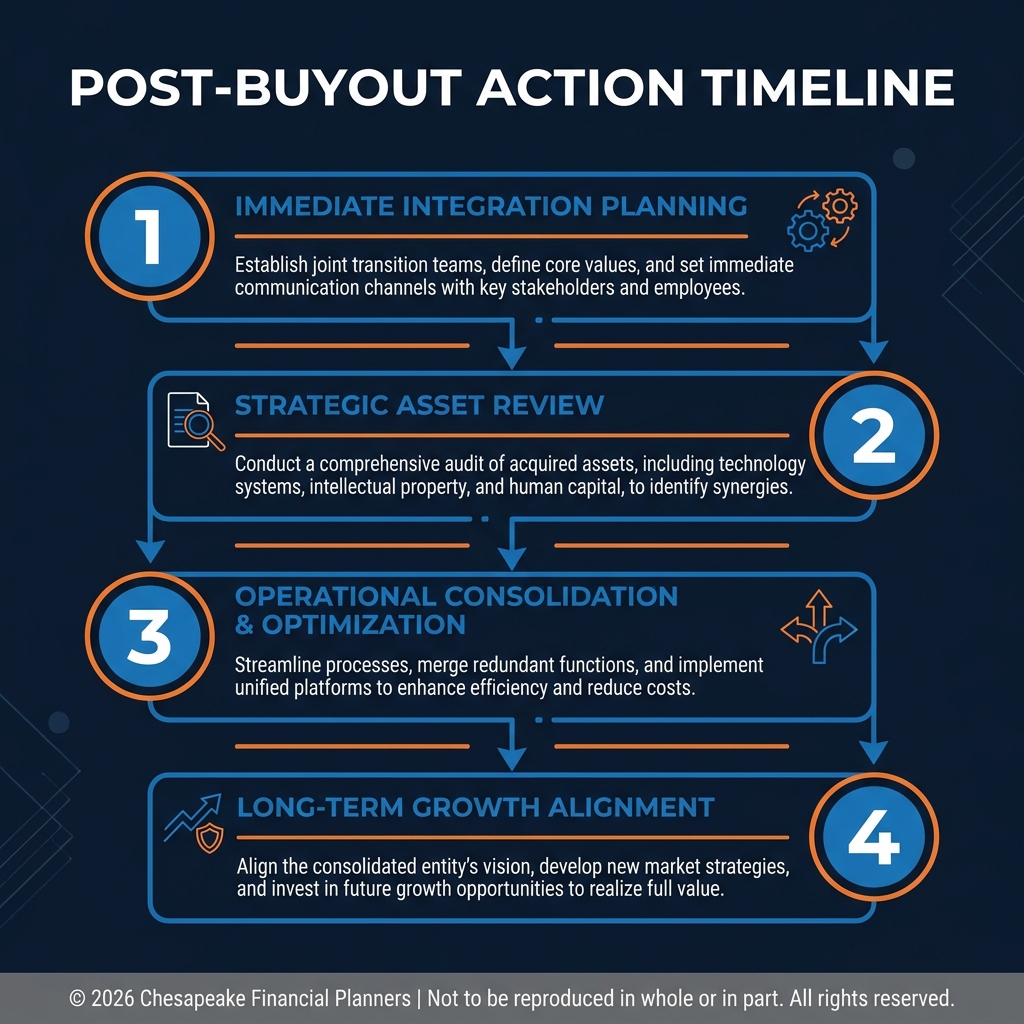
Your Action Plan
Immediately after closing (Week 1-2):
- Move funds to FDIC-insured accounts or money market (temporary holding)
- Take time to decompress—no investment decisions for 30-60 days
- Interview 3-5 financial advisors
- Begin documenting your investment policy statement
First 90 days:
- Select advisory team (financial advisor, CPA, estate attorney)
- Complete comprehensive financial planning
- Finalize investment strategy
- Begin systematic implementation of portfolio
First year:
- Implement investment strategy in phases (dollar-cost averaging)
- Monitor spending against projected income needs
- Adjust portfolio based on actual experience
- Review tax situation and optimize for following year
Ongoing:
- Quarterly portfolio reviews
- Annual comprehensive planning updates
- Rebalance as needed to maintain target allocation
- Adjust strategy as life circumstances change
The Bottom Line
You built substantial wealth through entrepreneurship and concentrated risk. Now your job is preserving that wealth through diversification and prudent management.
The goal isn't getting rich again—it's ensuring your buyout proceeds fund the life you've envisioned for decades to come.
Received business buyout proceeds? Schedule a comprehensive investment planning consultation to develop your post-exit investment strategy.
The information provided is for educational purposes only and should not be construed as investment advice. Investment strategies should be tailored to individual circumstances, risk tolerance, and goals. Past performance doesn't guarantee future results. Consult with qualified financial professionals regarding your specific situation.
Advisors associated with Chesapeake Financial Planners may be either (1) LPL Financial Registered Representatives offering securities through LPL Financial, Member FINRA and SIPC, and investment advisor representatives offering investment advice through Great Valley Advisor Group; or (2) solely investment advisor representatives offering investment advice through Great Valley Advisor Group and not affiliated with LPL Financial. Great Valley Advisor Group, and Chesapeake Financial Planners are separate entities from LPL Financial.
Chesapeake Financial Planners | 2402 Scotlon Ct, Forest Hill, MD 21050 | (410) 652-7868 | www.chesapeakefp.com
© 2026 Chesapeake Financial Planners | Not to be reproduced in whole or in part. All rights reserved.

