

You just got married, and between thank-you cards and honeymoon photos, someone mentions you should "get your finances in order." But what does that actually mean? Update your insurance? Combine bank accounts? Create a will? The list feels overwhelming, and you're not even sure where to start.
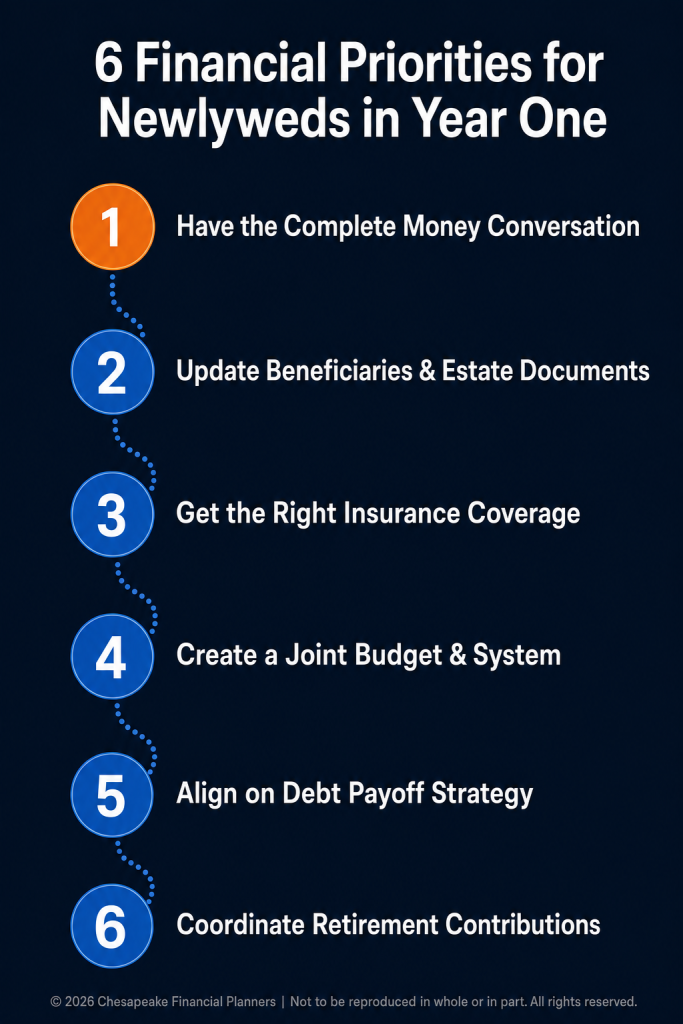
Here's what you need to know: the financial decisions you make in the first year of marriage set the foundation for decades of financial security or decades of stress. Let's walk through exactly what newlyweds need to do to protect their financial future, in order of priority.
Priority #1: Have the Complete Money Conversation
Before you make any financial changes, you need total transparency. This isn't just one conversation; it's an ongoing dialogue.
Discuss Fully and Honestly:
Current financial situation:
- Credit scores (pull them together from AnnualCreditReport.com)
- All debts (student loans, credit cards, car loans, medical debt)
- Assets (savings, investments, retirement accounts, property)
- Income and job stability
Money values and beliefs:
- How you were raised around money
- What financial security means to you
- Your biggest money fears
- Your financial goals for 1 year, 5 years, 10 years
Spending and saving habits:
- Are you a spender or saver?
- What do you refuse to compromise on spending?
- What seems wasteful to you that your spouse loves?
Financial goals:
- Homeownership timeline
- Children and family planning
- Retirement vision
- Career ambitions that affect finances
No secrets. Hidden debt, poor credit, or undisclosed financial obligations discovered later cause far more damage than honest disclosure now.
Priority #2: Update Beneficiaries and Estate Documents
This is often overlooked but critically important.
Beneficiary Designations
Update beneficiaries on:
- Life insurance policies (through work and private)
- Retirement accounts (401(k), IRA, etc.)
- Bank accounts with payable-on-death (POD) options
- Investment accounts with transfer-on-death (TOD) options
Important: Beneficiary designations override your will. If your 401(k) still lists your ex or your parents, your spouse won't automatically inherit it, even if your will says otherwise.
Create or Update Estate Planning Documents
Even young, healthy newlyweds need:
- Wills: Specify who inherits your assets and who would be guardian for future children
- Durable power of attorney (financial): Names who can make financial decisions if you're incapacitated
- Healthcare power of attorney: Names who can make medical decisions for you
- Living will / advance directive: States your wishes for end-of-life care
- HIPAA authorization: Allows your spouse to access your medical information
Cost: Basic estate planning documents can be created for $500-$2,000 with an attorney, or less with online services (though attorney review is recommended).
Priority #3: Get the Right Insurance Coverage
Life Insurance
Who needs it: Both spouses if you depend on each other's income. Even a stay-at-home spouse contributes economic value (childcare, household management).
How much: 10-15x annual income is a common guideline. Enough to replace lost income, pay off debts, and cover future goals.
Type: Term life insurance is typically best for newlyweds. It's affordable and provides high coverage during the years you need it most.
Action: Get quotes from multiple carriers. A 30-year-old in good health can often get $500,000 in coverage for $30-$50/month.
Health Insurance
Review options: Compare both spouses' employer plans. Which has better coverage? Lower premiums? Better provider network?
Marriage is a qualifying event: You have 30-60 days to add your spouse or switch plans.
Consider: Premium cost, deductible, out-of-pocket max, coverage for specialists and prescriptions.
Disability Insurance
Why it matters: You're more likely to become disabled than die during your working years. Disability insurance replaces income if you can't work due to illness or injury.
Check employer coverage: Many employers offer short-term and long-term disability. If not, or if coverage is inadequate, consider private coverage.
Recommendation: Cover 60-70% of your income. If possible, pay premiums with after-tax dollars so benefits are tax-free.
Auto and Homeowners/Renters Insurance
Combine policies: Many insurers offer discounts for bundling.
Update coverage: Add spouse to policies, ensure adequate liability coverage (at least $300,000, ideally $500,000 or more).
Consider umbrella policy: If you have assets to protect, a $1-2 million umbrella policy costs $150-$300/year and provides additional liability coverage.

Priority #4: Create a Joint Budget and Financial System
Decide on Account Structure
Three main approaches:
- 1. All joint (everything shared)
- Pros: Simple, transparent, reinforces unity
- Cons: No spending autonomy, one spouse's poor habits affect both
- 2. All separate (everything individual)
- Pros: Autonomy, protects individual credit
- Cons: Complicated expense-splitting, feels less like teamwork
- 3. Hybrid (joint + individual)
- Pros: Shared expenses covered fairly, personal autonomy maintained
- Cons: More accounts to manage
Most popular approach: Joint checking for shared expenses (rent, utilities, groceries), individual accounts for personal spending
Create a Budget Together
Track current spending: Use last 3 months of bank/credit card statements to understand where money actually goes
Categorize expenses:
- Fixed (rent, insurance, loan payments)
- Variable (groceries, gas, utilities)
- Discretionary (dining out, entertainment, hobbies)
Align on priorities: Agree on how much to save, what spending is non-negotiable, where you can cut if needed
Use tools: Budgeting apps (YNAB, Mint, EveryDollar), shared spreadsheets, or regular money dates to review spending
Set Savings Goals
Emergency fund: 3-6 months of expenses (start with $1,000 if you have debt, then build from there)
Short-term goals: Vacation, car down payment, home down payment
Long-term goals: Retirement, children's education
Automate savings: Set up automatic transfers each payday so saving happens without decision fatigue
Priority #5: Align on Debt Payoff Strategy
If either spouse has debt, create a plan together.
- List all debts: Balances, interest rates, minimum payments
- Choose a strategy: Avalanche (pay off highest interest first) or snowball (pay off smallest balance first)
- Decide responsibility: Will you tackle debt together or individually? Both approaches work, but agree on the plan.
- Avoid judgment: One spouse's past financial mistakes don't define the marriage. Focus on moving forward together.
Priority #6: Coordinate Retirement Contributions
Maximize Employer Matches
At minimum, contribute enough to get full employer 401(k) match. If your employer matches 50% up to 6% of salary, contribute at least 6%. That's free money.
Coordinate Contributions Strategically
If one spouse has a better 401(k) (lower fees, better investment options), consider prioritizing contributions there after both of you max out matches.
Overall goal: Save 15-20% of gross income for retirement
If that feels impossible now, start with what you can and increase 1% each year.
Consider Roth vs. Traditional
- Roth contributions: Pay taxes now, grow tax-free, withdraw tax-free in retirement
- Traditional contributions: Tax deduction now, pay taxes in retirement
Strategy: If you're early in your career with lower income, Roth may be better. As income rises, traditional contributions become more valuable.
Priority #7: Plan for Major Goals Together
Homeownership
If you're planning to buy a house:
- Set a savings goal for down payment (20% avoids PMI, but 3-10% is common)
- Check both credit scores (lenders use the lower score)
- Get pre-approved to understand what you can afford
- Decide whose income/credit to use if one spouse has significantly better credit
Children
If you're planning for children:
- Review health insurance maternity coverage
- Calculate childcare costs in your area
- Consider impact on income if one spouse reduces work
- Start or increase contributions to 529 college savings plans
Career Planning
Discuss:
- Career advancement goals
- Potential relocations
- Further education (MBA, certifications)
- Entrepreneurship plans
Financial decisions (who prioritizes career growth, who might take time off, how to fund education) need alignment.
Priority #8: Understand Tax Implications
Update W-4 Forms
After marriage, both spouses should submit new W-4 forms to employers to adjust tax withholding. The IRS withholding calculator can help you avoid underpayment penalties or giving the IRS an interest-free loan.
Decide Filing Status
- Married filing jointly: Most common, usually results in lowest tax
- Married filing separately: Rarely beneficial, but sometimes necessary (one spouse has large medical expenses, significant debt, or concerns about liability)
Coordinate Tax Strategy
Consider:
- Who claims dependents (if you have children)
- Timing of major purchases or income (Roth conversions, selling investments)
- Charitable giving strategies
- Student loan repayment plans (income-driven plans look at household income for married couples)
Priority #9: Establish Money Meetings
- Schedule regular check-ins: Monthly or quarterly, review budget, goals, upcoming expenses, and any concerns.
- Keep it structured: 30-45 minutes, specific agenda, no blame or judgment.
- Celebrate wins: Hit a savings goal? Paid off a debt? Acknowledge progress together.
Priority #10: Build Financial Resilience Together
- Protect against financial infidelity: Agree on spending thresholds that require discussion (e.g., purchases over $200 need a quick heads-up, over $1,000 require joint decision).
- Create individual credit history: Both spouses should maintain at least one credit card in their own name to build independent credit.
- Plan for the unexpected: Disability, job loss, major medical expenses. Having insurance, an emergency fund, and open communication protects your marriage from financial crises.
The Bottom Line
The first year of marriage is financially critical. The systems you build, the transparency you establish, and the alignment you create will determine whether money is a source of stress or a tool for building the life you want together.
Don't let financial planning feel overwhelming. Take it one step at a time. The couples who thrive financially aren't the ones without challenges; they're the ones who communicate openly, plan intentionally, and work as a team.
Just got married and want to build a strong financial foundation? Schedule a complimentary consultation with our team. We'll help you navigate the financial transition, create a plan that works for both partners, and set you up for a lifetime of financial security. Because the best wedding gift you can give yourselves is a solid financial future.
This material is for general information only and is not intended to provide specific advice or recommendations for any individual. Please consult with a qualified financial advisor regarding your specific situation.
For educational purposes only.
Advisors associated with Chesapeake Financial Planners may be either (1) LPL Financial Registered Representatives offering securities through LPL Financial, Member FINRA and SIPC, and investment advisor representatives offering investment advice through Great Valley Advisor Group; or (2) solely investment advisor representatives offering investment advice through Great Valley Advisor Group and not affiliated with LPL Financial. Great Valley Advisor Group, and Chesapeake Financial Planners are separate entities from LPL Financial.
Chesapeake Financial Planners | 2402 Scotlon Ct, Forest Hill, MD 21050 | (410) 652-7868 | www.chesapeakefp.com
© 2026 Chesapeake Financial Planners | Not to be reproduced in whole or in part. All rights reserved.

